
Growth campaigns · Senior Care

Senior care marketing for the family making the call

Three days after a fall, an adult daughter in another state is comparing agencies between calls with a discharge planner. This campaign puts your screening process, your coverage of her mother's address and the phone that gets answered on a Sunday in front of her that week.

Live Senior Care demo

Sunrise Senior Home Care

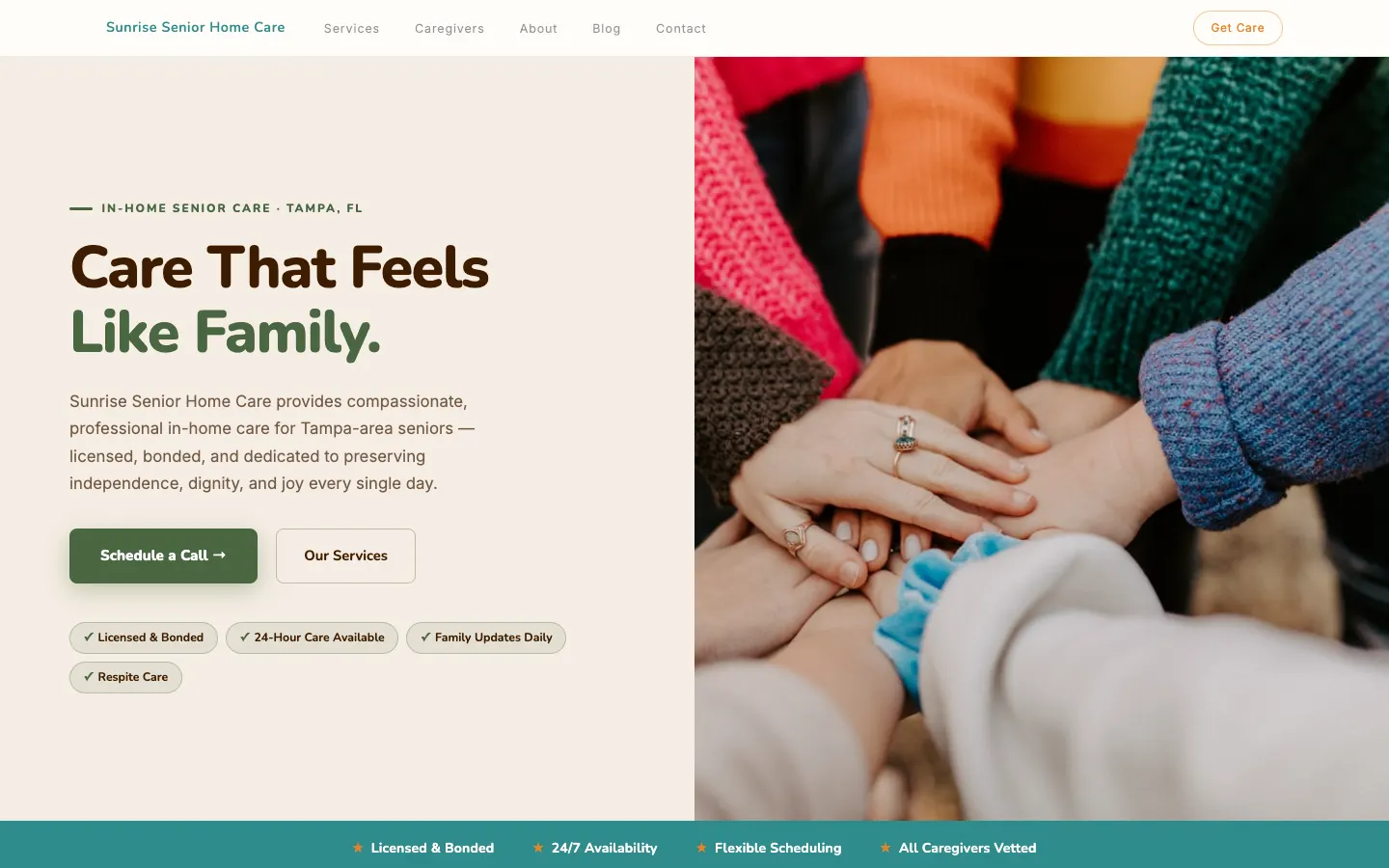
A warm, trust-forward in-home senior care site with caregiver profiles, care plan options, and family-facing reassurance content.

Caregiver Matching + Care Plan Guide. Sunrise Senior Home Care is the reference build: caregiver profiles, care plan options and written screening detail, which is the material that answers a daughter's questions before she picks up the phone.

Open the live demo → Senior Care websites

Sunrise Senior Home Care — live senior care website built on WorkspaceCMS
Where the demand is

How senior care buyers actually search

Senior care demand is event-driven. A fall, a hospital discharge with a short window to arrange help, a diagnosis, a spouse who can no longer manage alone. The search begins hours or days after that event and the decision is often made inside a week, which is a completely different clock from most local services. Agencies that show up only in slow-burn content marketing miss the moment entirely.

The searcher is usually the adult daughter, frequently living in another state, coordinating with siblings and a discharge planner. She is not evaluating clinical technique. She is evaluating whether she can trust a stranger in her mother's house: how caregivers are screened, whether the same person comes each visit, what happens when someone calls out, and whether anyone will answer the phone on a Sunday. Those questions decide the agency, and most agency sites never answer them in writing.

The competitive set is also unusual, because national referral and lead-aggregation services bid heavily on the obvious terms and then resell the same inquiry to several agencies at once. A family that arrives through an aggregator is comparing you against two competitors before you have said a word. Earning organic and direct visibility for your own service area is what produces an inquiry nobody else is working simultaneously. Caregiver recruitment competes for many of the same local searches, which agencies routinely forget to plan for.

The keyword clusters we build around

  • Post-discharge urgencySearches tied to coming home from a hospital or rehab stay. These need a page that states how quickly care can start and what the first visit involves, because the family is working against a discharge date.
  • Condition-specific careDementia, Parkinson's, stroke recovery, hospice support. Families search the condition, not the service category, and a page written for the condition earns the click and the trust.
  • Service-area coverageCity and neighborhood terms from a family checking whether you actually cover the parent's address. Real coverage pages, not a padded list, keep the answer honest and the page useful.
  • Cost and payment sourcesLong-term care insurance, VA benefits, private pay, what Medicare does and does not cover. This is the highest-anxiety question in the category and answering it in plain language wins the inquiry.
  • Caregiver vetting and continuityBackground checks, training, supervision, and whether the same caregiver returns. Publishing the actual process converts better than any adjective about compassion.
  • Caregiver recruitmentYour staffing pipeline runs through the same local search results as your client pipeline. A careers path that ranks is part of the campaign, not an afterthought.
The campaign

Three ways we go get the traffic

Local SEO, AI-assistant visibility and paid media, run by the agency team that has been doing it since long before WorkspaceCMS existed.

Local SEO

Condition pages and honest coverage pages carry this vertical. Families search dementia, Parkinson's or stroke recovery rather than home care, so a page written for the condition earns the click before anyone has heard of your agency. Coverage pages confirm you genuinely staff the town her mother lives in, which is the first thing she checks and the fastest way to lose her. Beneath both, the pages describing caregiver screening, shift continuity and what happens when an aide calls out are what turn a reader into a phone call.

AI search visibility

How do I arrange care for a parent being discharged on Friday, and what should I ask an agency? Assistants answer that constantly, and they quote agencies that wrote the process down: which towns are actually staffed, how caregivers are background-checked and supervised, whether the same aide returns each visit, how long-term care insurance and VA benefits get billed, what a weekend call reaches. Adjectives about compassion give ChatGPT and AI Overviews nothing to repeat back to a worried family.

Paid media

Two audiences search the same local words here, and running them together quietly starves whichever one you were not thinking about: families arranging care, and caregivers looking for shifts. They belong in separate structures with separate landing paths. Local Services Ads matter more than usual, because a screening badge answers the exact anxiety the search carries. Delivery weights toward evenings and weekends, when discharge planning actually happens and when the national referral brokers are slowest to call a family back.

Campaigns are an add-on to a WorkspaceCMS plan and start from $499/mo. The plan itself is a monthly subscription. The build is included, the platform is not free. Local SEO campaigns are scoped to single and multi-location businesses rather than national or global SEO. Paid search management covers service businesses rather than online stores; ad spend is billed by Google or Meta directly to your own account. Full campaign scope → · Plan pricing →

What gets in the way

Six things that hold senior care sites back

01

Lead aggregators resell the same family to your competitors

National referral services capture the obvious searches and distribute each inquiry to several agencies. Building your own organic and direct visibility produces conversations nobody else is having at the same moment, which changes both close rate and margin.

02

The site never says how caregivers are screened

Families ask about background checks, training, supervision and callout coverage on every intake call. Agencies answer it beautifully by phone and never in writing. Publishing the process moves the objection out of the call and into the research phase.

03

Coverage pages that overstate the service area

Listing every town within an hour looks like reach and reads like a stub. Worse, it generates inquiries you have to decline, which burns staff time. Honest coverage pages tied to where caregivers actually live perform better on both counts.

04

Payment questions go unanswered until the sales call

Long-term care insurance, VA benefits and what Medicare will not cover are the questions blocking the decision. A site that walks a family through the funding paths, without quoting figures, earns inquiries from families who arrive already oriented.

05

Client marketing and caregiver hiring compete for the same terms

You need clients and you need staff, and both audiences search locally. Running them as one undifferentiated effort means the careers path gets whatever attention is left. We plan them as two intents on one site.

06

Inquiries arrive after hours and go cold

Discharge planning happens on weekends and evenings. A contact path that only reaches a voicemail box until Monday loses families who called three agencies that night. Response mechanics are part of the campaign, not a separate operations problem.

Campaign add-ons

Pick the campaign that fits the market

Every package below is bought from your dashboard once your site is live. Names, prices and deliverables are read from the catalog at page load, so what you see here is what you would be buying.

Questions

Senior Care marketing, answered

How do we compete with referral services that resell the same family to several agencies?

By owning the searches rather than renting them. An enquiry that reaches you through your own condition and coverage pages is a conversation nobody else is having at that moment, which changes the close rate as much as it changes what the enquiry costs.

Can the same campaign help us recruit caregivers?

Yes, and it has to be planned deliberately. Caregiver searches surface in the same local results as family searches, so the careers path is built alongside the service pages instead of receiving whatever attention is left at the end of the month.

Families ask about long-term care insurance and VA benefits. Does that belong on the site?

It belongs near the front. Funding is the question blocking the decision, and a family that arrives already oriented on private pay, benefits and what Medicare will not cover has a shorter, calmer first call with your intake team.

Most of our enquiries arrive at night or on a weekend. Does the campaign account for that?

It has to, because hospital discharges are planned then. We weight advertising toward those hours and build the contact path so an after-hours family reaches something better than a voicemail box that will not be heard until Monday.

Should our service area page list every town within an hour's drive?

No. Padding the list generates enquiries you have to decline, which burns intake time and disappoints a family twice. Coverage pages tied to where your caregivers actually live read as credible and answer the address question honestly.

Your free site is one click away

Ready to grow a senior care business?

Get the site built, then put a campaign behind it. Start online, or talk it through with a strategist first.

Want the full picture? See what a campaign includes