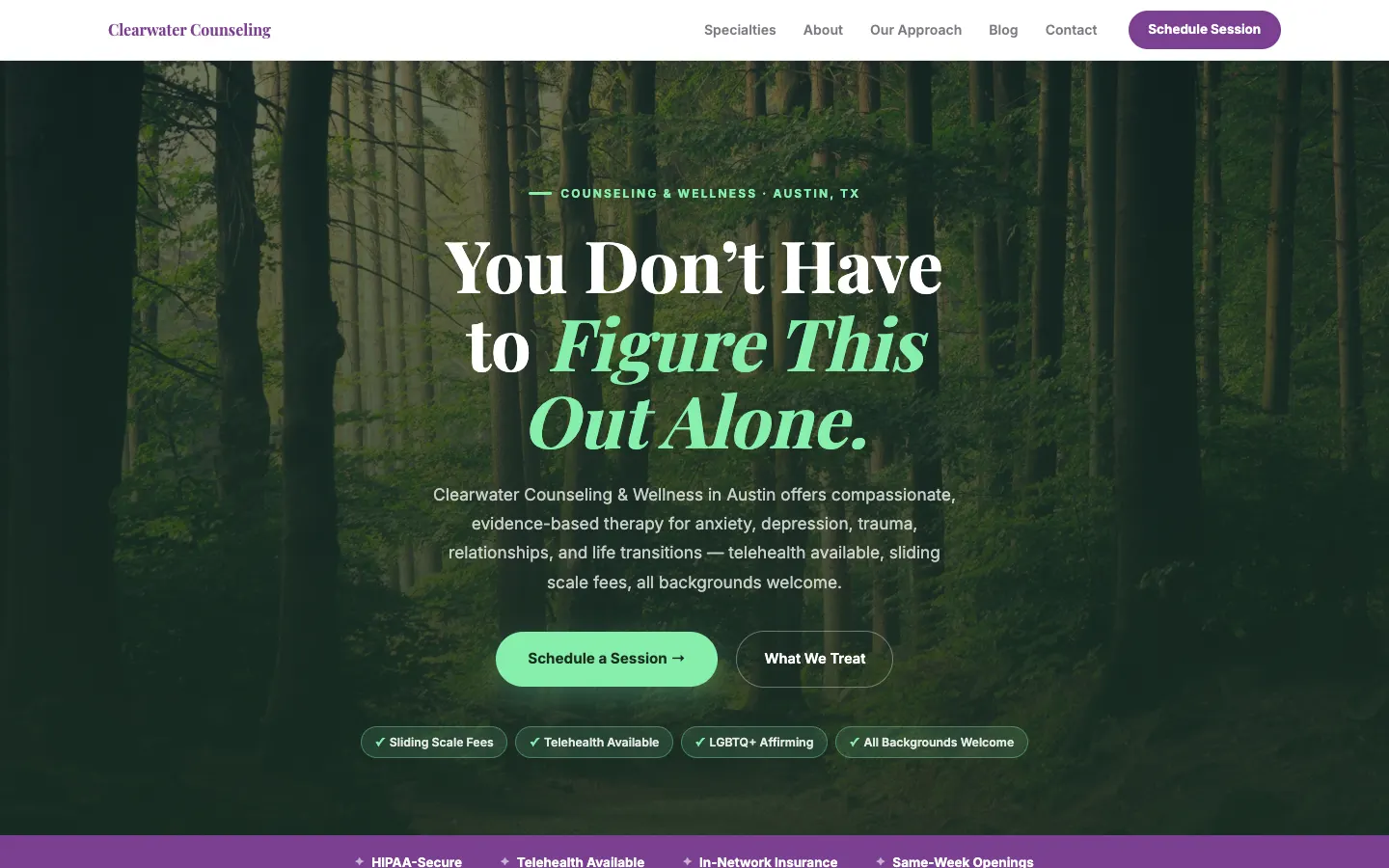
Therapy is chosen on fit, and fit is assessed by reading. A prospective client will open several therapist pages, read the bios closely, and form a judgement about whether this is a person they could talk to. That makes the clinician page the conversion asset in this vertical, which is unusual: in most industries the service page carries the decision. It also means a directory profile with a stock photograph and a paragraph of generic language competes poorly against a practice site that lets each clinician sound like themselves.
Search behaviour is unusually technical for a consumer service. Clients arrive having been told to look for EMDR, DBT, CBT, IFS, ACT or somatic work, or they search by population and situation: postpartum, grief, ADHD assessment, couples, teens, first responders. Those queries have modest volume individually and very high intent collectively, and a practice with one broad services page captures almost none of them. Splitting modality and specialty into their own pages is the structural change that most often opens up organic traffic here.
Two constraints shape everything else. Capacity is finite and waitlists are normal, so the goal is rarely raw volume; it is the right referrals for the clinicians who have openings, which changes what the campaign should optimise toward. And privacy runs deeper than in any other health vertical: analytics, form handling, remarketing and ad targeting all have to be configured on the assumption that a visitor would be distressed to learn their interest had been recorded, and the ad platforms independently restrict targeting built on mental health interest.