Growth campaigns · Dermatology

Growth campaigns for dermatology practices

A dermatology practice is really two businesses sharing a front door: insurance-driven medical care and elective cosmetic work. We build a campaign that gives each one its own search path instead of blurring them into a single message.

Live Dermatology demo

Solstice Dermatology

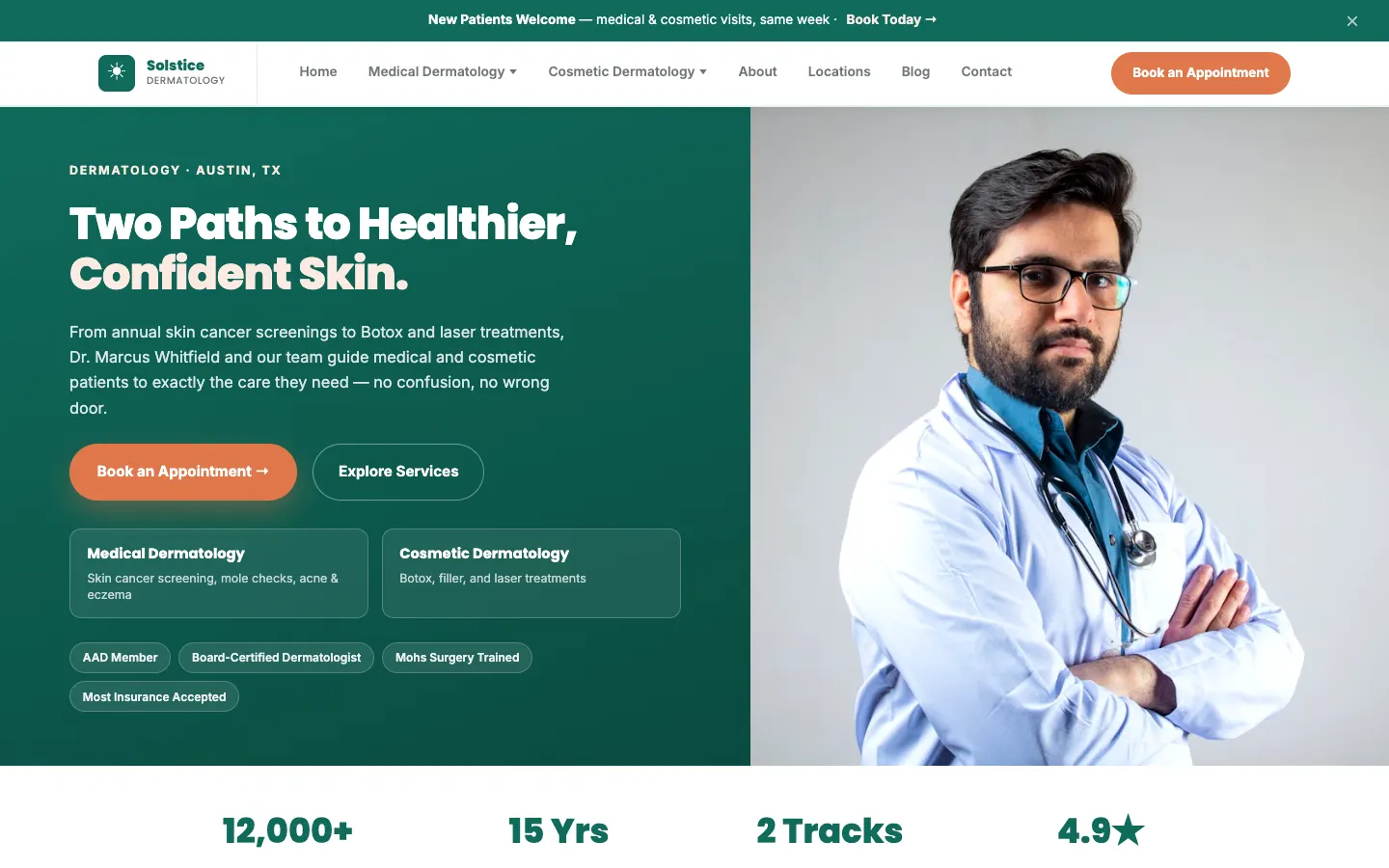
A dual-track dermatology practice site for Austin: medical screenings and cosmetic treatments each get their own clear path, from the hero all the way through booking.

Dual Medical + Cosmetic Patient Pathing. Solstice Dermatology at derm.workspacecms.ai demonstrates the dual pathing this campaign depends on, with medical screening and cosmetic treatment each holding their own route from the hero through to booking.

Open the live demo → Dermatology websites

Solstice Dermatology — live dermatology website built on WorkspaceCMS
Where the demand is

How dermatology buyers actually search

Start with the split, because everything else follows from it. Medical dermatology demand arrives through insurance and referral: annual skin checks, a mole someone noticed, persistent acne, eczema, psoriasis. It is largely inelastic, often booked weeks out, and the searcher's real question is whether you take their plan and how soon they can be seen. Cosmetic demand behaves nothing like that. It is discretionary, price-aware, comparison-heavy, and it moves with events and seasons rather than with symptoms.

The competitive picture differs by half as well. On the medical side you are compared with hospital-affiliated groups and other board-certified practices, and credentials genuinely matter to the searcher. On the cosmetic side you are competing with med spas, injector-led studios and aesthetic clinics that advertise heavily, discount openly and are often faster to book. Those competitors bid on the same treatment names, so a practice that leads only with its medical credentials can find itself absent from every cosmetic query in its own city.

Seasonality is real and it is not subtle. Skin check interest climbs as warm weather approaches and again after summer exposure, while injectable and laser interest builds ahead of holidays, weddings and events, with laser resurfacing skewing toward the low-sun months when downtime is easier to schedule. A campaign that publishes the same content year-round misses both curves. Layered on top, ad platforms restrict health-condition targeting, so the medical half in particular has to be won organically and through AI citation rather than through audience buying.

The keyword clusters we build around

  • Skin cancer and screeningSkin check, mole check and spot-on-my-skin searches, often urgent and anxious. Pages state what a screening involves and how appointments are scheduled, without offering diagnosis.
  • Chronic medical conditionsAcne, eczema, psoriasis, rosacea and hair loss searched by name, frequently by parents or long-term sufferers. Each condition earns a real page rather than a shared list item.
  • Injectables and neuromodulatorsTreatment-name searches where med spas compete hardest. Content differentiates on who performs the treatment and how consultations work, not on discounting.
  • Lasers and resurfacingDevice and outcome-adjacent searches with strong seasonality around downtime. Pages explain the process, the consultation and what candidacy assessment involves.
  • Insurance and referral logisticsWhether a plan is accepted, whether a referral is required, how long the wait is. These decide medical bookings and belong in indexable text.
The campaign

Three ways we go get the traffic

Local SEO, AI-assistant visibility and paid media, run by the agency team that has been doing it since long before WorkspaceCMS existed.

Local SEO

Organic work runs on two tracks. The medical track builds condition and screening pages with practice-specific detail, plus the insurance and scheduling answers that decide bookings. The cosmetic track builds treatment pages that compete on who performs the work and how candidacy is judged. Both feed a profile and citation cleanup and neighbourhood targeting around the office itself.

AI search visibility

Assistants get asked constantly whether something warrants seeing a dermatologist and who nearby does a given treatment. Practices that get cited publish structured service and location data, credential detail an assistant can attribute, real FAQ content about scheduling and coverage, and consistent review signals. Vague condition copy with no practice specifics gives ChatGPT, Claude, Perplexity or AI Overviews nothing to quote.

Paid media

Cosmetic terms carry the budget here, because they convert on clear intent and tolerate a real cost per click, while medical demand is cheaper to earn organically than to buy. The competition is rarely other clinics; it is med-spas and injector chains bidding the same treatment names, so the ads lean hard on physician credentials and on who is actually holding the needle. Restricted health targeting means audiences are assembled from query and geography rather than from any inferred condition.

Campaigns are an add-on to a WorkspaceCMS plan and start from $499/mo. The plan itself is a monthly subscription. The build is included, the platform is not free. Local SEO campaigns are scoped to single and multi-location businesses rather than national or global SEO. Paid search management covers service businesses rather than online stores; ad spend is billed by Google or Meta directly to your own account. Full campaign scope → · Plan pricing →

What gets in the way

Six things that hold dermatology sites back

01

Medical and cosmetic traffic collide on one homepage

A patient worried about a changing mole and a patient pricing injectables need opposite reassurance, opposite proof and opposite calls to action. A single blended hero dilutes both, and it is why dual pathing from the first screen tends to move more than any individual page rewrite.

02

Med spas own the cosmetic search results

Aesthetic studios advertise continuously, publish aggressively and are structured to convert on price. A physician-led practice cannot out-discount them, but it can win on who is performing the treatment, how candidacy is assessed and what happens if something needs medical attention, provided that argument is actually on the page.

03

Booking lead times are invisible until someone calls

When the next medical opening is weeks away and the site says nothing, patients assume the worst or book elsewhere. Publishing how scheduling works, what gets triaged sooner and how the waitlist operates converts uncertainty into a booking instead of an abandoned form.

04

Condition pages read like a textbook, not a practice

Generic dermatology condition copy is everywhere and ranks for nobody. What differentiates is practice-specific detail: how this office approaches the condition, what a first visit looks like, which treatments are offered on site. Encyclopedia content without that is filler with a search engine's name on it.

05

Before-and-after imagery carries compliance weight

Cosmetic photography is persuasive and is also governed by consent, platform policy and advertising rules on implied results. Campaigns have to use it in ways that stay inside those constraints, which means treating the gallery as a documented asset rather than a folder of images someone drops onto a page.

06

Health targeting rules block the obvious paid plays

You cannot build ad audiences around skin conditions, and remarketing based on inferred health interest is restricted. That removes the retargeting funnel other industries rely on and pushes the medical half of the practice toward organic and AI visibility, with paid concentrated where intent is explicit in the query.

Campaign add-ons

Pick the campaign that fits the market

Every package below is bought from your dashboard once your site is live. Names, prices and deliverables are read from the catalog at page load, so what you see here is what you would be buying.

Questions

Dermatology marketing, answered

Can you market both sides of the practice at once?

That is the normal setup. Medical and cosmetic get separate pages, separate keyword sets and separate calls to action, running under one campaign. Trying to serve both with the same message is the most common problem we are brought in to fix.

Do you offer national SEO for a dermatology brand?

No. Our SEO and AI campaigns are local, for single and multi-location practices. Each location gets its own search footprint. National or global programmes are outside what we take on.

Who controls the advertising budget?

You do. Ad spend is billed to your own Google and Meta accounts, and the account history stays yours. Our side is management: structure, creative, targeting, negatives, landing pages and reporting.

Can we run ads targeted at people with acne or eczema?

No, and neither can anyone else operating within policy. Ad platforms restrict targeting and remarketing built on health conditions. We work through search intent and location instead, which is a large part of why the organic and AI-citation work matters more in dermatology.

Should medical and cosmetic dermatology share one campaign?

They need separate tracks. A patient checking a changing mole and someone comparing injectors are different searches with different urgency and different ad rules, and blending them pushes medical enquiries into a page that reads like a spa menu, which suppresses both.

Your free site is one click away

Ready to grow a dermatology business?

Get the site built, then put a campaign behind it. Start online, or talk it through with a strategist first.

Want the full picture? See what a campaign includes