
Growth campaigns · Family Medicine

Growth campaigns for family medicine practices

Primary care demand arrives on a life change: a move, a new job, a new plan, a child who needs a physical before term starts. The campaign meets those moments and answers the payer question that decides most of them.

Live Family Medicine demo

Clearview Family Medicine

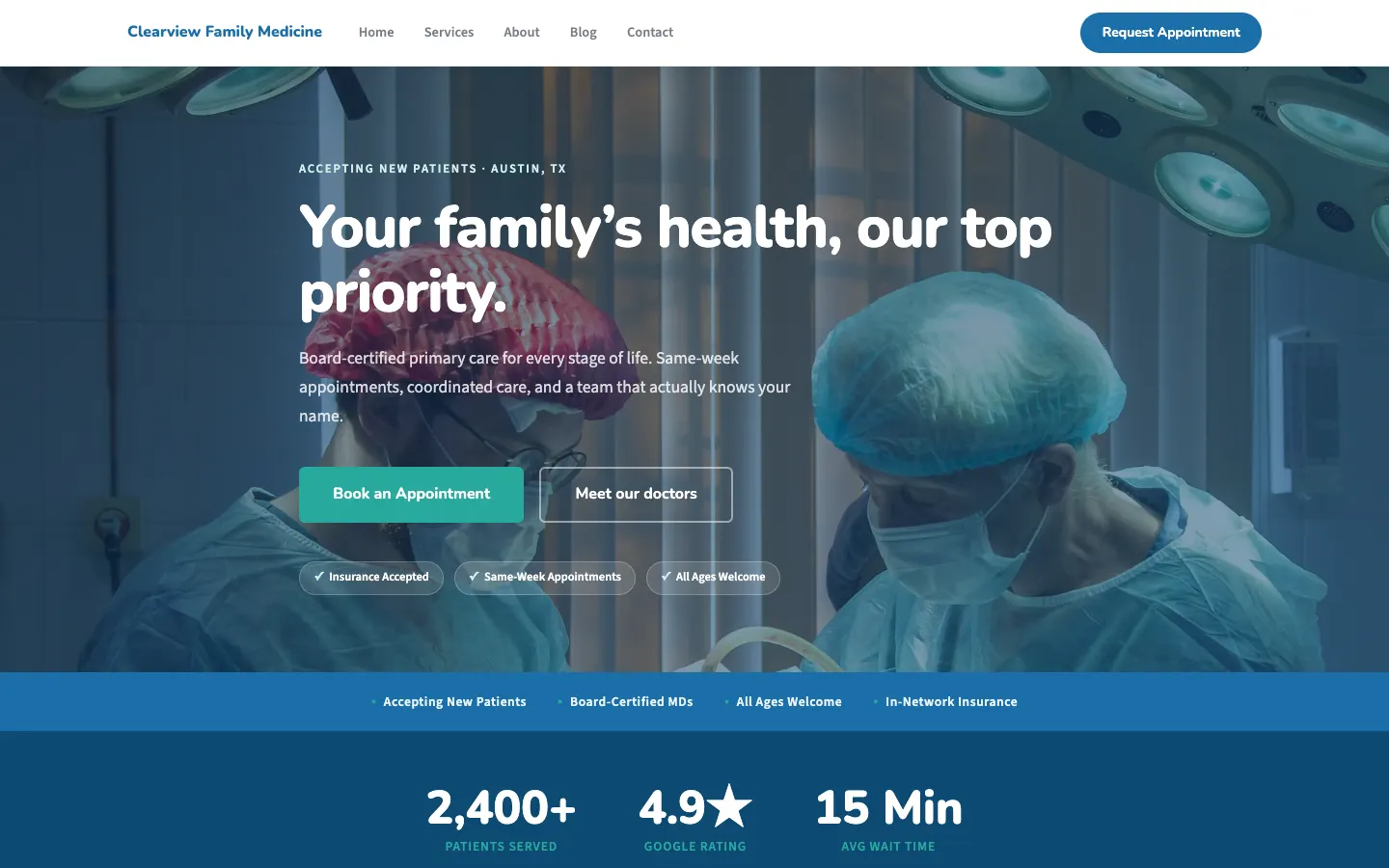
Clean, trust-forward family practice site built on the Essentials tier. Accepting-new-patients hero, services overview, and doctor profiles. Nothing superfluous.

Essentials: 3-Page Practice Site. Clearview Family Medicine at doc.workspacecms.ai shows how little a primary care site needs when the accepting-new-patients message, services overview and doctor profiles are the first things a campaign visitor meets.

Open the live demo → Family Medicine websites

Same business, different design direction: Clearview Family Medicine. Both are real, published builds, useful when you want to see how far the look can move without changing what the campaign targets.

Clearview Family Medicine — live family medicine website built on WorkspaceCMS
Where the demand is

How family medicine buyers actually search

Almost nobody searches for a family doctor because they woke up wanting one. The search follows a trigger. Someone relocates, changes employers, ages off a parent's plan, has a baby, or gets told by a specialist that they need a referral from a primary care physician. Because the trigger is administrative as often as it is clinical, the two queries that decide the outcome are whether the practice is taking new patients and whether it takes the plan. Sites that answer neither lose patients who were genuinely ready to enrol.

The calendar has a shape here that other clinical verticals do not share. Insurance changes cluster around open enrolment and the start of the plan year, producing a January wave of people establishing care with a new practice. School and sports physicals concentrate in late summer. Wellness visit interest rises early in the year alongside deductible resets. Publishing against those windows before they arrive is a meaningful advantage, because the searcher in January is choosing a practice for the year, not for a visit.

Competition comes from formats, not only from other clinics. Urgent care chains, retail clinics and telehealth services intercept the exact symptoms a family practice would have handled, and they market with budgets no independent office matches. Hospital-owned groups occupy the directory listings and the branded search results. The ground an independent practice can hold is continuity: the argument that one clinician who knows the family beats an interchangeable visit, made concretely on the site rather than asserted as a slogan.

The keyword clusters we build around

  • Accepting new patientsThe defining query in primary care. It needs a clear, current, indexable answer plus a path to register, not a phone number and a hope.
  • Insurance and plan acceptancePlan-name searches, especially around enrolment periods. An accepted-plans page in real text is what turns this traffic into scheduled visits.
  • Physicals and preventive visitsAnnual exams, school and sports physicals, wellness visits and immunizations. Strongly seasonal and worth publishing ahead of the window.
  • Chronic condition managementOngoing care searches from people looking for a long-term clinician rather than a single appointment. Content emphasises continuity and how follow-up works.
  • Clinician and location searchesDoctor-name and neighbourhood queries where a patient is verifying a recommendation. Provider pages and consistent listings decide whether the verification succeeds.
The campaign

Three ways we go get the traffic

Local SEO, AI-assistant visibility and paid media, run by the agency team that has been doing it since long before WorkspaceCMS existed.

Local SEO

The organic programme starts with the answers that decide enrolment: panel status, accepted plans, how to register and how quickly someone can be seen. From there it builds provider pages that outrank third-party directory profiles, seasonal content timed to enrolment and physical season, and neighbourhood targeting around the office, backed by profile and citation cleanup across the listings patients actually check.

AI search visibility

People ask assistants which nearby practices take new patients and accept a given plan. Getting named requires publishing that in structured, checkable form: service and location markup, an accepted-plans page, provider credentials, real scheduling FAQs and a current review corpus. A practice that keeps this information in a phone script rather than on the page is not quotable by ChatGPT, Claude, Perplexity or AI Overviews.

Paid media

Demand is not level and the budget should not be either. Enrolment periods and the physical season carry most of the value, and a plan that spends evenly through the year overpays in the quiet months and runs out exactly when families are choosing. Payer vocabulary qualifies harder than any demographic filter would. Since platforms forbid inferring a health condition, campaigns are built from explicit queries and a realistic drive-time radius.

Campaigns are an add-on to a WorkspaceCMS plan and start from $499/mo. The plan itself is a monthly subscription. The build is included, the platform is not free. Local SEO campaigns are scoped to single and multi-location businesses rather than national or global SEO. Paid search management covers service businesses rather than online stores; ad spend is billed by Google or Meta directly to your own account. Full campaign scope → · Plan pricing →

What gets in the way

Six things that hold family medicine sites back

01

Nobody can tell whether the panel is open

Accepting new patients is the highest-intent phrase in the vertical, and it usually appears nowhere in indexable text. Stating it plainly, keeping it current, and giving it a registration path is often the fastest improvement available to a family practice site.

02

Urgent care intercepts the visits you should have had

Retail and urgent care marketing is built to catch the same sore throat and rash searches primary care handles, and it is funded far past what an independent office can match. Competing means making same-week availability and continuity visible rather than assuming patients know the difference.

03

January demand is planned for in January

The wave of patients establishing care after a plan change is predictable, and most practices react to it rather than publish ahead of it. Insurance and new-patient content that is already indexed when enrolment ends performs very differently from content posted once the wave arrives.

04

Third-party directories outrank the practice's own site

Physician directories and hospital system pages frequently sit above a practice's own provider pages, carrying incomplete or outdated details. Making the practice's own pages the better answer, and keeping the directory records consistent, is ongoing maintenance rather than a one-off cleanup.

05

A small site is treated as an excuse to say nothing

Lean practice sites are appropriate, and lean is not the same as empty. A compact site still has to carry insurance information, provider background, scheduling logistics and location detail, because those pages are exactly what search engines and assistants have to work with.

06

Health advertising rules limit audience building

Ad platforms restrict targeting and remarketing based on health and medical interest, so campaigns cannot be assembled from condition-based audiences. Primary care paid work is therefore geographic and query-driven, which puts more of the burden on organic visibility and on being cited by assistants.

Campaign add-ons

Pick the campaign that fits the market

Every package below is bought from your dashboard once your site is live. Names, prices and deliverables are read from the catalog at page load, so what you see here is what you would be buying.

Questions

Family Medicine marketing, answered

We have a small three-page site. Is that enough?

It can be, if the pages carry the right information. Panel status, accepted plans, provider background, location and scheduling are what search engines and assistants read. A compact site that says those things clearly outperforms a large one that buries them.

Should each physician have their own page?

Yes, because patients search for a doctor rather than a practice. Many are choosing on background, languages spoken and whether that physician is accepting new patients, and a single combined staff page ranks for none of those and answers none of them well.

Do you take a percentage of ad spend?

The spend goes directly into your own Google and Meta accounts under your billing, so it never passes through us. The campaign add-on covers management: structure, copy, targeting, landing pages and reporting.

Can you write clinical content for the site?

We write about the practice, not about diagnosis or treatment. Anything clinical is drafted for your review and stays with your clinicians, because medical guidance has to come from the people responsible for the patient.

Our panel is nearly full. Can a campaign still be worth running?

Yes, but the goal changes from volume to mix. Targeting shifts toward the visits and payers you actually want more of, and toward replacing attrition, so the practice fills the schedule with better-matched patients rather than simply more of them.

Your free site is one click away

Ready to grow a family medicine business?

Get the site built, then put a campaign behind it. Start online, or talk it through with a strategist first.

Want the full picture? See what a campaign includes