
Growth campaigns · Swim School

Growth campaigns for swim schools

Swim schools rarely have a demand problem in June. They have a February problem, a waitlist problem and a parent who cannot tell from the website whether their child is ready for level two.

Live Swim School demo

Blue Otter Swim School

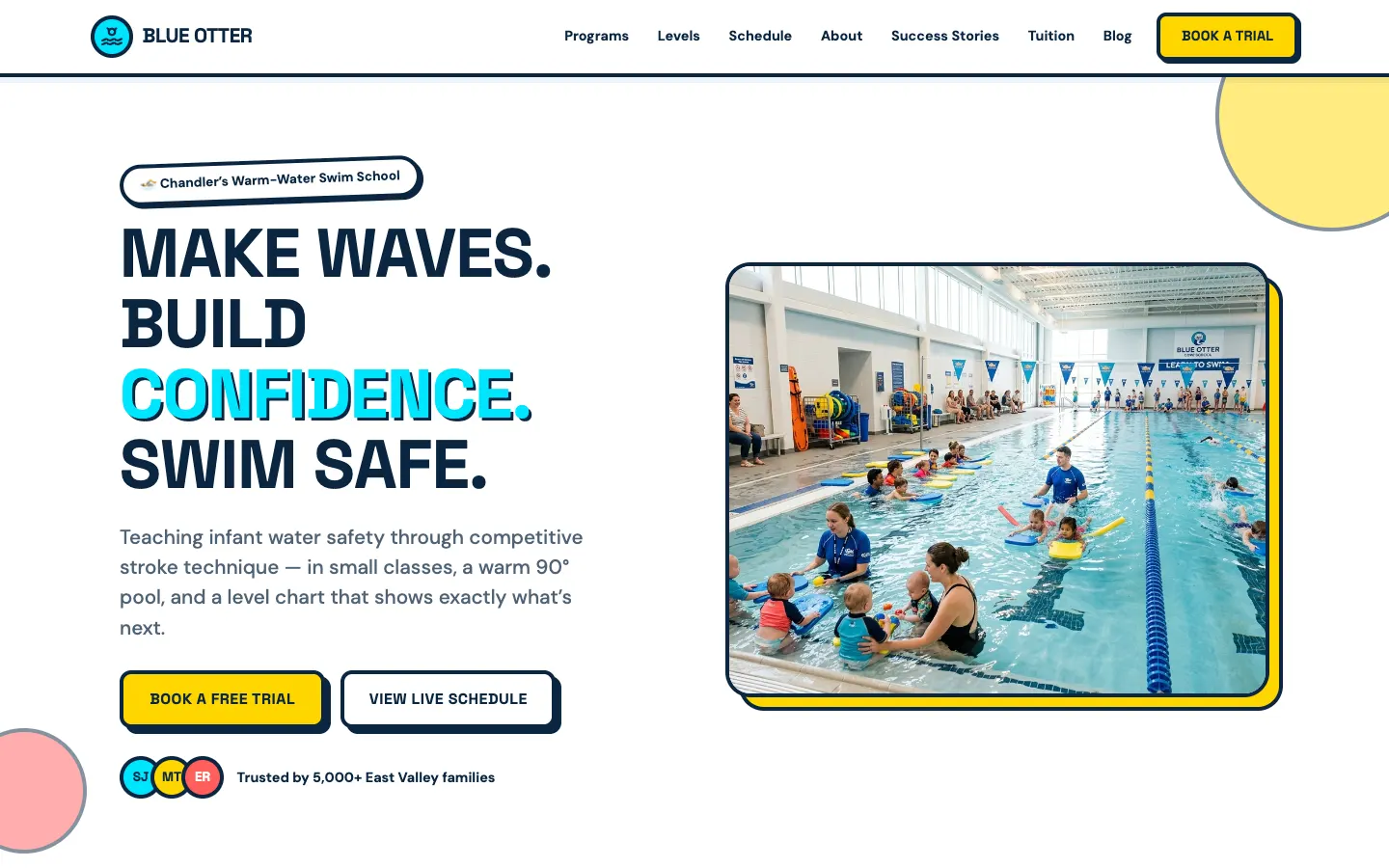
A bold, playful neo-brutalist swim-school site from Chandler, AZ: deep-sea navy with aqua, sunny-yellow, and coral accents, chunky borders and hard offset shadows, in Space Grotesk + DM Sans. Explore five programs (Infant Survival through Competitive Prep), a seven-level progression chart, an interactive weekly schedule with live openings, tuition ladders, instructor bios, and a water-safety blog.

Level Progression Chart + Live Schedule Board + Small-Class Booking. Blue Otter Swim School is the reference: a seven-level progression chart, an interactive weekly schedule showing live openings, tuition ladders and a water-safety blog, all of which the campaign feeds directly.

Open the live demo → Swim School websites

Blue Otter Swim School — live swim school website built on WorkspaceCMS
Where the demand is

How swim school buyers actually search

Almost alone in this catalog, swim schools are capacity-constrained rather than lead-constrained. Ratios, pool time and instructor availability cap how many lessons can be sold in a week, so a campaign that simply generates more enquiries during peak season creates a waitlist and a customer-service burden rather than revenue. The valuable work is the inverse: filling the mid-morning and shoulder-season slots that sit empty while evenings and summer Saturdays overflow.

The purchase motive is safety, and that changes the emotional register entirely. Parents search after a near-miss at a pool, before a holiday involving water, or because a paediatrician or a school mentioned it, and the language they use reflects urgency rather than leisure. Water-safety content is genuinely useful to those parents and it also happens to be the strongest organic asset a swim school can build, because it earns links and answers questions that nobody else in the local market is bothering to address.

Level structure is where enquiries stall. A parent cannot tell whether their four year old belongs in a parent-and-child class or an independent beginner group, and if the site does not resolve that in a glance they either call and take up staff time or they do nothing at all. Published level progression, honest ratios, real instructor certifications and a visible view of which sessions have openings turn the site into an enrolment tool rather than a brochure. Retention then runs for years, because families stay through the whole progression.

The keyword clusters we build around

  • Age-banded lesson searchInfant, toddler, preschool and school-age lessons are separate products with separate anxieties. Each needs its own page stating ratios, format and what a first lesson looks like.
  • Water-safety and readinessResearch-stage parents asking when to start and what a child should be able to do. This is the content that earns authority and feeds every other page.
  • Availability and scheduleParents checking which times are open before enquiring. Surfacing live openings turns a browsing visit into a booking.
  • Level progressionSearchers trying to place their child correctly. A published progression chart removes the single biggest reason enquiries stall.
  • Off-peak and shoulder seasonThe commercially useful demand. Campaigns push weekday-morning and cooler-month availability rather than adding to an already full Saturday.
The campaign

Three ways we go get the traffic

Local SEO, AI-assistant visibility and paid media, run by the agency team that has been doing it since long before WorkspaceCMS existed.

Local SEO

Programme pages by age band, a published level progression, and stated ratios and instructor certifications, because those are the things parents are actually comparing. Water-safety content is treated as a serious organic asset rather than a blog afterthought, since it answers real questions and earns local authority. Location and hours data is kept exact so the map result fires for the neighbourhoods families will drive from.

AI search visibility

Parents ask assistants when a child should start lessons and which local school takes infants, and the answers come from structured, specific sources. We publish programmes, age ranges, schedules and location as machine-readable service data, write out the level progression and the ratio policy, and turn the desk questions about readiness and make-up lessons into a real FAQ. Safety specifics stated in text are what make a swim school citable.

Paid media

The point is filling the slots that do not fill themselves. Weekday mornings and shoulder-month intakes are the target; the summer rush needs no help and paying into it just lengthens a waitlist. Water-safety creative works on local parents in a way that a discount never does, because the motivation is fear rather than price. Everything is paced against real capacity, so the campaign is not selling places that do not exist.

Campaigns are an add-on to a WorkspaceCMS plan and start from $499/mo. The plan itself is a monthly subscription. The build is included, the platform is not free. Local SEO campaigns are scoped to single and multi-location businesses rather than national or global SEO. Paid search management covers service businesses rather than online stores; ad spend is billed by Google or Meta directly to your own account. Full campaign scope → · Plan pricing →

What gets in the way

Six things that hold swim school sites back

01

Peak season sells itself and shoulder season does not

Spring and summer fill without help while weekday mornings and winter terms sit empty. Marketing spend aimed at the peak mostly manufactures a waitlist.

02

Capacity caps mean more leads is not the goal

Ratios and pool time are fixed. A campaign judged purely on enquiry volume can look successful while creating an unmanageable waitlist and a reputation for being unreachable.

03

Parents cannot self-place their child

Without a clear progression chart, level selection becomes a phone call or a dropped enquiry. This is the most common friction point in the entire funnel.

04

Safety credibility is asserted, not evidenced

Instructor certifications, ratios and supervision policy are what parents are really assessing. Left unpublished, a school looks the same as one that has none of it.

05

Waitlists leak without any follow-up

Families placed on a waitlist quietly enrol elsewhere. Keeping that list warm is a marketing job that almost nobody resources.

06

Council and hotel pools compete on price

Municipal and leisure-centre programmes undercut easily. The counter is small-group ratios and a stated progression, argued explicitly on the page.

Campaign add-ons

Pick the campaign that fits the market

Every package below is bought from your dashboard once your site is live. Names, prices and deliverables are read from the catalog at page load, so what you see here is what you would be buying.

Questions

Swim School marketing, answered

We already have a waitlist. Why would we advertise?

To fill the sessions that are empty, not the ones that are full. Weekday mornings and shoulder-season terms are usually where the unsold capacity is, and that is where campaigns are aimed.

What actually helps a swim school rank locally?

Programme pages by age band, a published level progression, stated ratios and instructor certifications, and genuinely useful water-safety content. Those also happen to be what parents compare on.

Can you market more than one pool location?

Yes. Local SEO and AI campaigns cover single and multi-location businesses, and each pool gets its own page and location signals rather than sharing one.

Who pays for the advertising budget?

The school does, billed straight from its own ad accounts. We run the campaigns themselves, so the audiences built around each intake season remain yours if the arrangement ever ends.

How do we handle a season where every parent enrolls at once?

By publishing the schedule and waitlist honestly and campaigning ahead of the rush rather than during it. Swim demand spikes hard before summer, and a site that shows real availability turns a frustrating sold-out search into a booked place next term.

Your free site is one click away

Ready to grow a swim school business?

Get the site built, then put a campaign behind it. Start online, or talk it through with a strategist first.

Want the full picture? See what a campaign includes