
Growth campaigns · Gym / Fitness

Growth campaigns for gyms and fitness centres

A gym does not lose to the chain down the road on equipment. It loses on the search result, the trial offer and the twenty minutes between someone deciding to join and someone talking them out of it.

Live Gym / Fitness demo

Forged Athletics

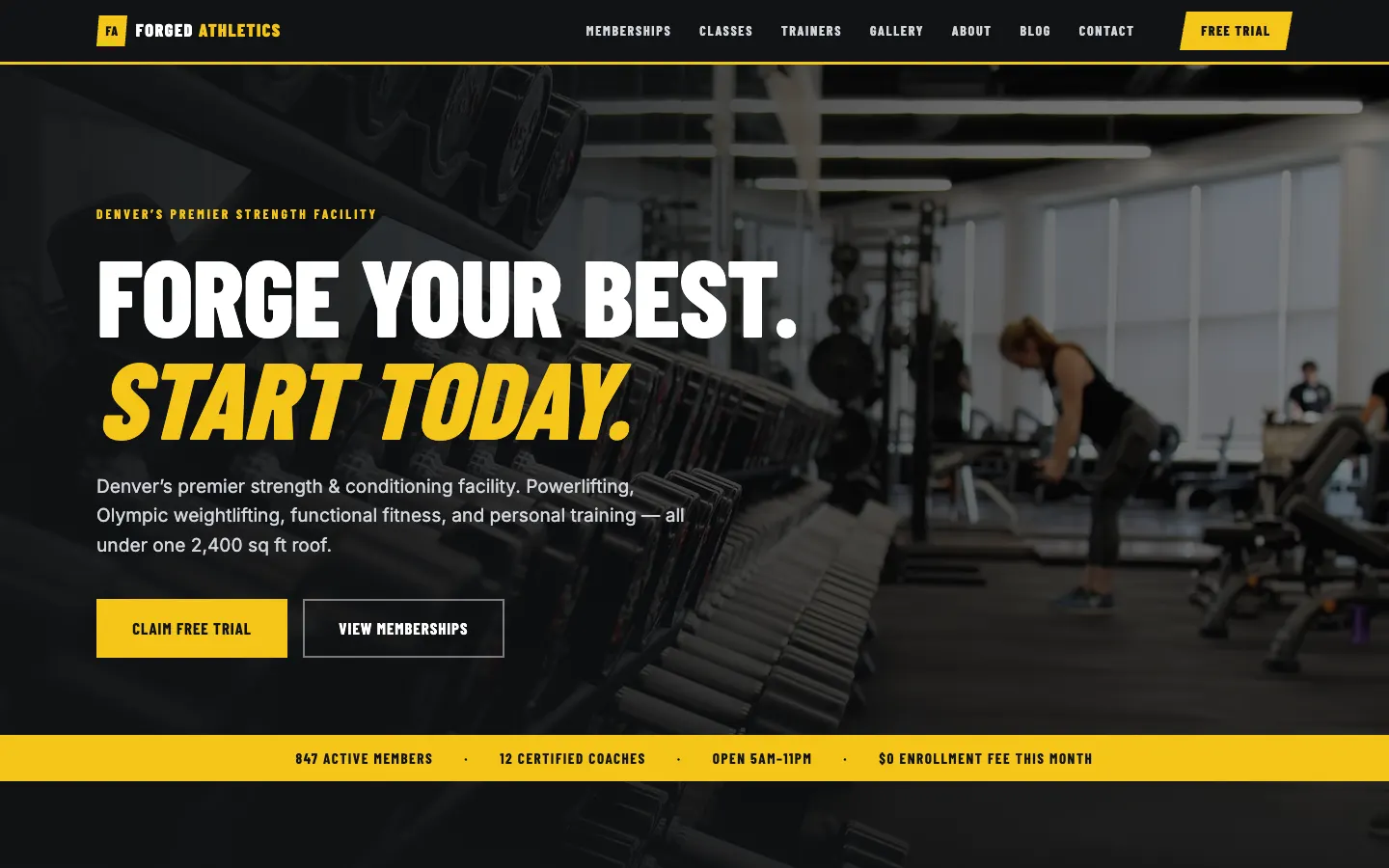
High-energy Denver strength gym: membership pricing tiers, class schedule grid, trainer roster, and a free-trial lead-capture flow.

Membership Tiers + Free Trial Flow. Forged Athletics is the reference build: membership tiers stated plainly, a class grid people can scan, a trainer roster with real names, and a free-trial capture flow the ads can drive straight into.

Open the live demo → Gym / Fitness websites

Forged Athletics — live gym / fitness website built on WorkspaceCMS
Where the demand is

How gym / fitness buyers actually search

No other local category has a demand curve this violently seasonal. Interest spikes in the first weeks of January, again after the summer holiday, and dies through late December, and the January cohort is simultaneously the largest and the least loyal. A campaign built only for that spike buys a churn problem, which is why the harder and more valuable work is the September and spring intake where intent is quieter but retention is much better.

Searchers arrive with a logistics question rather than a fitness question. They want to know the opening hours, whether there is parking, whether the contract locks them in and whether the place will be empty at the hour they can actually attend. The single most common objection in this category is contractual, not physical, because almost everyone has a story about a membership that was easy to start and impossible to cancel, and a gym that publishes its cancellation terms plainly converts better than one that hides them.

Brand terms are contested ground here in a way they are not elsewhere. National chains and aggregator apps routinely bid on an independent gym's own name, so a searcher who has already decided to join can be intercepted at the last step. Defending that is cheap and almost always the highest-return line in the account. Meanwhile the organic ground is fought over class-format terms, because someone looking for a strength gym, a powerlifting rack or a small-group session is looking for something a big-box floor cannot give them.

The keyword clusters we build around

  • Proximity and hoursSearches anchored to a neighbourhood or an opening time. These are decided on the map result and the hours block, so the location data has to be exact and current.
  • Format and equipmentPeople looking for strength, powerlifting, small-group or specific equipment rather than a generic gym. Higher intent, lower volume, far better retention.
  • Membership and contract termsSearchers researching pricing structure, joining fees and cancellation policy before they enquire. Publishing the answer wins the comparison outright.
  • Trial and guest passThe offer searchers respond to. We route these to the free-trial flow rather than to a contact form that asks them to wait for a call back.
  • Brand defenceYour own gym name, which competitors and aggregators bid on. Cheap to hold and expensive to concede at the moment of decision.
The campaign

Three ways we go get the traffic

Local SEO, AI-assistant visibility and paid media, run by the agency team that has been doing it since long before WorkspaceCMS existed.

Local SEO

The map pack decides most of this category, so the work starts with exact location data, current hours and a location page that reads like a real gym rather than a template. From there we build format pages for strength, small-group and whatever the floor is genuinely known for, publish the membership structure and the cancellation terms as indexable pages, and keep the class timetable fresh because it is the page people actually land on.

AI search visibility

When someone asks an assistant for a strength gym near a neighbourhood with early opening hours, the answer is assembled from structured data and published specifics. We mark up hours, amenities, membership tiers and location as machine-readable service data, publish real answers on contracts, day passes and trainer credentials, and keep the review corpus flowing. A gym that never states its hours in text is a gym no assistant can recommend.

Paid media

The first job is holding your own name against aggregators and pass resellers who bid it and then sell the member a bundle. After that, budget follows the intake curve hard: January and September carry most of the value, and spending evenly through summer is how gyms burn a year of budget on browsers. Weight-loss and body-image creative has to be written to platform policy from the first draft, because an account that keeps getting disapproved mid-campaign never builds the history it needs.

Campaigns are an add-on to a WorkspaceCMS plan and start from $499/mo. The plan itself is a monthly subscription. The build is included, the platform is not free. Local SEO campaigns are scoped to single and multi-location businesses rather than national or global SEO. Paid search management covers service businesses rather than online stores; ad spend is billed by Google or Meta directly to your own account. Full campaign scope → · Plan pricing →

What gets in the way

Six things that hold gym / fitness sites back

01

January volume hides a retention problem

The new-year cohort signs up fastest and leaves soonest. Optimising the campaign purely for that peak buys expensive churn and flatters the reporting.

02

Chains bid on your gym's name

A member who has already chosen you can be intercepted by a national brand at the last click. Unless brand terms are defended, that traffic is paid for twice.

03

Contract anxiety is the real objection

Prospects assume the membership is a trap. Cancellation and freeze terms published as plain text remove more friction than any amount of gym photography.

04

The trial converts on-site, not in the ad

Booking a free trial is easy. Getting the person through the door, matched with a trainer and asked for the membership on the day is where the money is made or lost.

05

Peak-hour crowding is the top review complaint

Capacity at six in the evening drives the negative reviews that later drag on the map pack. This is an operational fact the marketing has to be honest about, not paper over.

06

Class timetables go stale and nobody notices

The schedule is the most visited page and the least maintained. A wrong time on a class listing costs a visit and often a member.

Campaign add-ons

Pick the campaign that fits the market

Every package below is bought from your dashboard once your site is live. Names, prices and deliverables are read from the catalog at page load, so what you see here is what you would be buying.

Questions

Gym / Fitness marketing, answered

Should we only advertise in January?

No. January brings the volume and the worst retention. We keep pressure on the spring and September intakes as well, because those members stay longer and cost less to hold.

Why would we pay for our own gym's name?

Because national chains and aggregator apps bid on it. If you do not hold that placement, someone who has already chosen you gets a competing offer at the moment of decision.

Do you manage ads for more than one location?

Yes. Local SEO and AI campaigns cover single and multi-location businesses, with each site getting its own location signals rather than sharing one page.

Does January still matter as much as it used to?

It still carries the year, but retention decides whether it was worth having. Campaigns selling a January price attract people who leave by March, so the work is aimed at somebody looking for a routine rather than a resolution.

Can you run national campaigns for an online coaching arm?

Our SEO and AI campaigns are scoped to local and multi-location businesses rather than national or global programmes. If you have an online arm, that is worth a direct conversation with the team.

Your free site is one click away

Ready to grow a gym / fitness business?

Get the site built, then put a campaign behind it. Start online, or talk it through with a strategist first.

Want the full picture? See what a campaign includes