
Growth campaigns · Orthodontics

Growth campaigns for orthodontic practices

Orthodontic decisions are made by two very different buyers: a parent comparing practices for a teenager and an adult quietly researching aligners. We build the search, AI and paid presence that reaches both and moves them to a consultation.

Live Orthodontics demo

Meridian Orthodontics

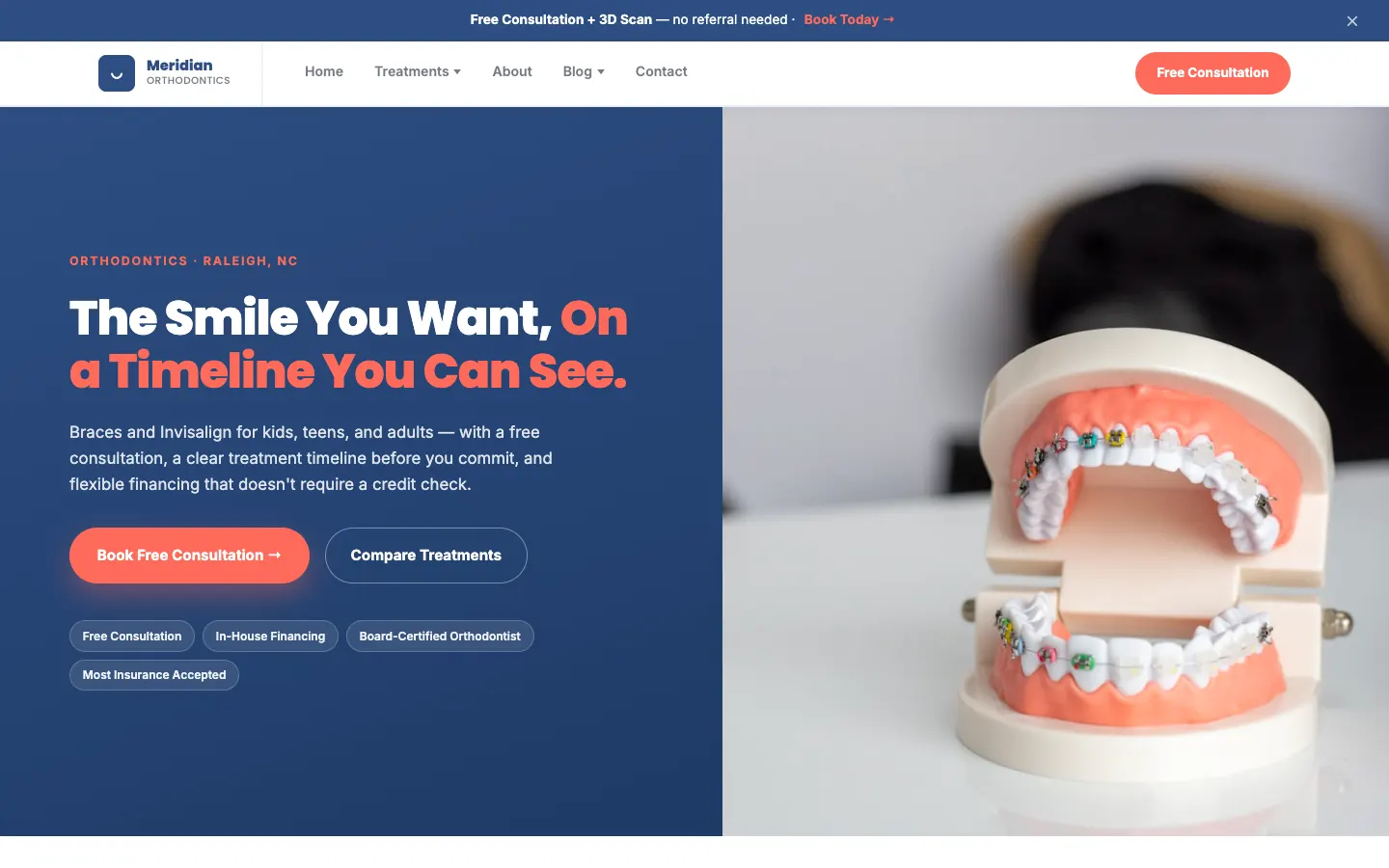
A modern orthodontic practice site for Raleigh families: treatment comparison, transparent financing, and a free-consultation booking flow front and center.

Treatment Comparison + Free Consultation Booking. Meridian Orthodontics at ortho.workspacecms.ai leads with treatment comparison, financing transparency and consultation booking, which is the exact path a campaign in this vertical needs to hand traffic to.

Open the live demo → Orthodontics websites

Meridian Orthodontics — live orthodontics website built on WorkspaceCMS
Where the demand is

How orthodontics buyers actually search

The consultation is the conversion, and everything upstream exists to produce it. Almost no one books treatment from a website; they book a consultation, and the practice closes in the chair. That changes what the campaign optimises for and what the pages must do: reduce the perceived cost of showing up, explain what the visit involves, and remove the money question as an obstacle rather than deferring it. A site that hides financing until the appointment is asking the visitor to take a leap most will not take.

Two buyers arrive by different routes. A parent is typically comparing a shortlist for a teenager, weighing convenience of appointments against sibling logistics and school schedules, and is often acting on a general dentist's referral. An adult researching clear aligners behaves like a considered consumer purchase, comparing the practice against direct-to-consumer aligner brands and against general dentists now offering aligner cases, and is frequently sensitive about discretion. The same homepage has to route both without making either feel like the afterthought.

Seasonality is pronounced and predictable. Starts cluster after the school year ends and around holiday breaks, when a family can absorb the initial appointments, so the research that produces those starts happens weeks earlier. Referral flow from general dentists runs on its own relationship-driven cycle and is checked online before it is made. And because treatment runs for a long stretch, the value of a single start is high, which is what justifies competing for terms where the click cost is steep.

The keyword clusters we build around

  • Treatment comparisonBraces versus clear aligners, and aligner brand comparisons. The searcher wants an even-handed explanation, and the practice that provides it earns the consultation.
  • Cost and financingPayment plan, insurance and monthly payment searches. Explaining how financing works, without stating figures we cannot stand behind, is what converts this traffic.
  • Adult treatmentDiscreet options for adults comparing a practice against direct-to-consumer brands. Content emphasises supervised care and in-person monitoring.
  • Teen and child timingWhen to start, early evaluation and parent-side scheduling questions. These pages speak to the parent, not to the patient.
  • Free consultation intentSearches already looking to book. The job here is friction removal: what the visit includes, how long it takes and how to schedule it immediately.
The campaign

Three ways we go get the traffic

Local SEO, AI-assistant visibility and paid media, run by the agency team that has been doing it since long before WorkspaceCMS existed.

Local SEO

Organic work builds honest comparison content between treatment types, a financing explanation that answers the real question without quoting figures, separate paths for adult and teen treatment, and consultation pages designed to be booked from. Around that sits neighbourhood targeting, profile and citation cleanup, and review cadence, since parents comparing a shortlist read reviews closely.

AI search visibility

Assistants get asked constantly how aligners compare to braces and which local practices offer them. Practices that get cited publish structured service and location data, genuine comparison content, clear consultation and financing explanations, and a live review corpus. A page that only markets one option, with no explanation of how the choice is made, gives ChatGPT, Claude, Perplexity or AI Overviews nothing worth quoting.

Paid media

A single start carries treatment value measured in years, which is what makes this one of the few clinical categories where genuinely expensive comparison and consultation terms still make sense. Timing is the discipline: the summer and post-holiday start windows are worth crowding, and the months between are worth conceding. Direct-to-consumer aligner brands bid the same words with a national budget, so the angle is supervision and complexity rather than price.

Campaigns are an add-on to a WorkspaceCMS plan and start from $499/mo. The plan itself is a monthly subscription. The build is included, the platform is not free. Local SEO campaigns are scoped to single and multi-location businesses rather than national or global SEO. Paid search management covers service businesses rather than online stores; ad spend is billed by Google or Meta directly to your own account. Full campaign scope → · Plan pricing →

What gets in the way

Six things that hold orthodontics sites back

01

Direct-to-consumer aligners set the price expectation

Mail-order aligner brands advertise a number the visitor carries into every comparison. A practice cannot answer that with silence about cost. The counter-argument is supervised treatment, in-person monitoring and what happens when a case does not track, made explicitly on the page rather than left implied.

02

General dentists have become competitors and referrers at once

The same dental practices that send referrals now advertise aligner cases themselves. The relationship has to be maintained while the practice competes for the same searches, which usually means content that clarifies when a case belongs with a specialist without disparaging anyone.

03

Financing is deferred to the consultation

Cost is the dominant unspoken question in orthodontics, and most sites push it entirely into the appointment. Explaining how payment plans, insurance coordination and down payments work, in general terms, is what gets a hesitant parent to book instead of continuing to research elsewhere.

04

The parent decides but the teenager objects

Two people have to agree, and they care about different things. Copy aimed only at the parent ignores the appearance and sports and instrument concerns that stall the decision at home, while copy aimed only at the teenager fails to answer the scheduling and cost questions the parent is actually weighing.

05

Summer starts are pursued in summer

The research that leads to a summer start happens well before school ends, and campaigns that ramp in June are chasing decisions already made. Content and paid presence need to be established during the preceding term, when the parent is first thinking about it.

06

Health targeting rules limit remarketing

Ad platforms restrict audience building and remarketing based on health and medical interest, which narrows the follow-up sequences a long consideration cycle would otherwise invite. Campaigns lean on query intent, geography and strong consultation landing pages instead.

Campaign add-ons

Pick the campaign that fits the market

Every package below is bought from your dashboard once your site is live. Names, prices and deliverables are read from the catalog at page load, so what you see here is what you would be buying.

Questions

Orthodontics marketing, answered

Can we advertise a specific treatment price?

That is your call and your dental board's, not ours. We will build a campaign around any offer your practice has cleared, and we do not invent or publish figures on our own. What we will flag is anything that looks likely to create a compliance problem.

Do you run national campaigns for aligner brands?

No. Our SEO and AI campaigns are local, for single and multi-location practices, with each office treated as its own footprint. National and global SEO programmes are outside our scope.

How do we reach a parent researching treatment for a child?

By writing for the parent rather than the patient. The searches are about the right age to start, what a first visit involves, how long treatment runs and what it costs, and practices that answer those plainly get shortlisted long before a consultation is booked.

Can you promise more starts this summer?

No. We do not promise outcomes, rankings or dates. We commit to the campaign work and to reporting monthly on what changed, and we time the programme so the content and paid presence are established before the start window rather than during it.

How do we compete with direct-to-consumer aligner brands?

By competing on what they cannot offer rather than on price. Supervision, scans, complex cases and what happens when treatment goes wrong are the searches where a real practice wins, so those questions get their own pages instead of a comparison chart.

Your free site is one click away

Ready to grow a orthodontics business?

Get the site built, then put a campaign behind it. Start online, or talk it through with a strategist first.

Want the full picture? See what a campaign includes