Growth campaigns · Marina & Boat Dealership

Marketing for marinas and boat dealerships

A buyer spends a season reading owner threads about one hull before towing distance decides which dealer gets the call. Slip renters move faster, often in a week. This campaign speaks to both, plus the yard work that keeps the lifts busy after the showroom goes quiet.

Live Marina & Boat Dealership demo

Blue Heron Marina & Boatworks

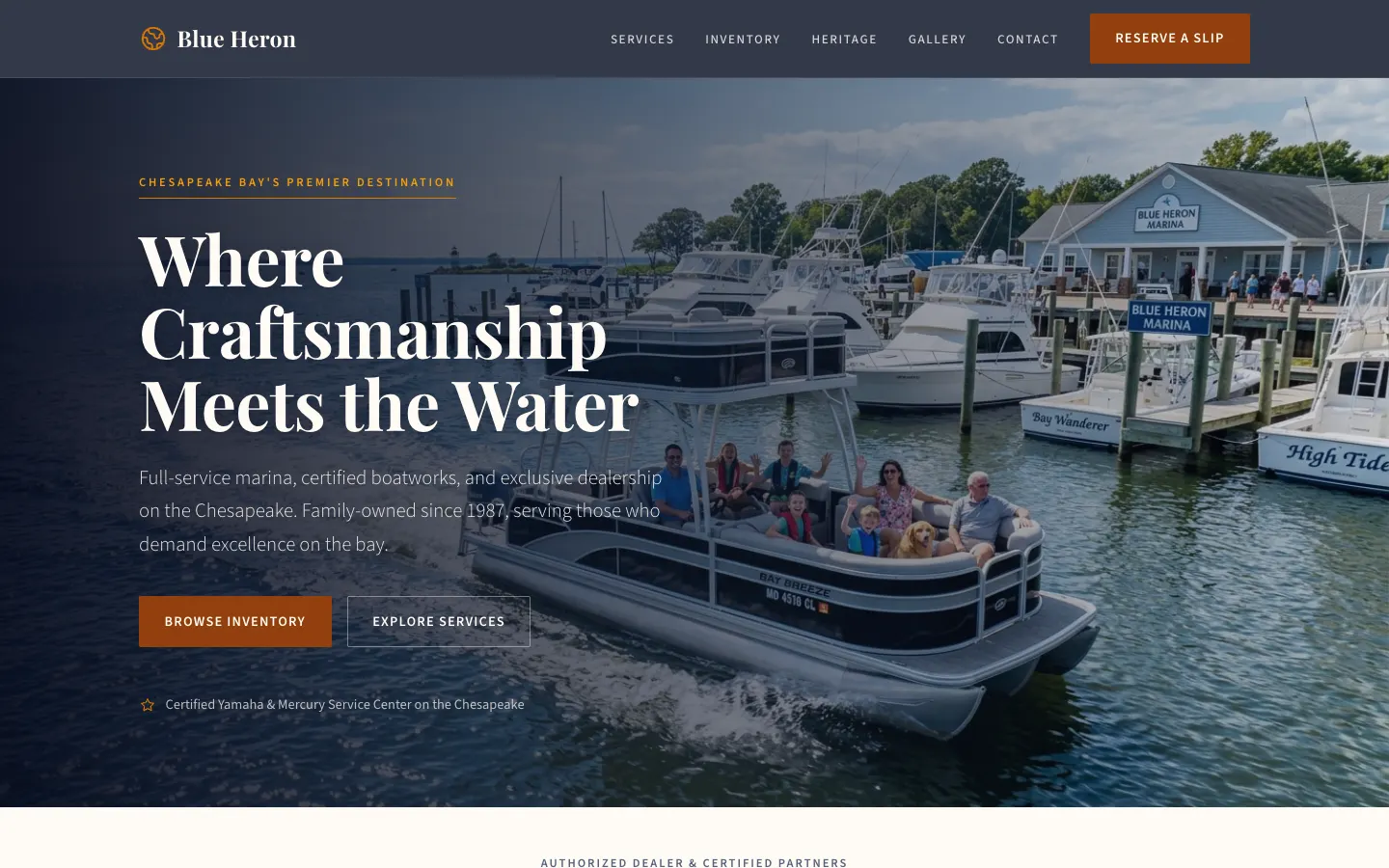
A full-service Chesapeake Bay marina and boat dealership, built for a business that sells hulls, services engines and rents out the water itself. Playfair Display over Source Sans 3 in navy, champagne and brass: a featured-vessel inventory listing new and certified pre-owned boats by year, condition and price with an inquire-and-sea-trial flow instead of a cart, six service pages covering slips and dry-stack storage, service and repair, sales and brokerage, seasonal rentals, parts and supplies and financing and trade-ins, a dedicated slip-reservation form that asks boat length and wet slip versus dry stack, an authorized-dealer partner wall, a heritage story running back to 1987, and a buying-with-us FAQ.

Featured Vessel Inventory + Slip Reservation Form. Blue Heron Marina & Boatworks is the reference build: featured-vessel pages that survive inventory turnover, service split into distinct bays rather than one page, and a slip form that asks for length overall and draft before it asks for an email.

Open the live demo → Browse all demos

Blue Heron Marina & Boatworks — live marina & boat dealership website built on WorkspaceCMS
Where the demand is

How marina & boat dealership buyers actually search

Almost nobody buys a boat the way they buy a car. The search starts with a hull and an engine package, not a dealer: someone types a make and a length, reads owner threads for a season, then narrows to the two or three dealers within towing distance who actually stock it. By the time a phone rings, the buyer knows the model year differences better than most salespeople, and the only open question is condition, trade allowance and how soon a sea trial can happen.

The listing aggregators are the real competitor for that search, not the marina down the creek. Boat Trader and YachtWorld carry your brokerage inventory, rank above your own detail pages for the exact model, and hand you a lead with the buyer already comparing four other boats. That is fine as a channel and terrible as a dependency. The pages that pull a buyer directly are the ones the aggregators cannot reproduce: your service department, your haul-out capacity, your dealer authorizations and the story of who has been rebuilding outdrives on that river since before the buyer was boating.

Then there is the second business, which is the one that pays through the winter. Slips, dry stack, storage, winterization and spring commissioning run on a calendar that has nothing to do with the sales cycle, and the searches shift with it: slip availability and waitlist questions in late winter, bottom paint and repower in spring, shrink wrap and haul-out from the first cold snap. A campaign that only chases boat sales goes quiet exactly when your yard is at capacity and your best margin work is being booked by someone else.

The keyword clusters we build around

  • Model and hull searchesA buyer searching a specific make, length or model year wants to know whether you have it on the hard right now. Point these at inventory detail pages that state condition, hours, engine package and trade posture, with an inquire-and-sea-trial path rather than a cart.
  • Slip, dry stack and storageRenters search by boat length and by facility type, and they are checking availability more than price. Send them to a slip page that names beam and draft limits, wet versus dry stack, and a reservation form that asks for the boat before it asks for the person.
  • Service and repowerEngine brand plus a symptom or a job is the highest-margin search you own. Give each service its own page with what is included, what a typical turnaround looks like in season, and which engine lines your techs are certified on.
  • Brokerage and consignmentSellers search for who will list their boat, and they are comparing commission structure and reach. Answer that on a page rather than in a phone call, and capture the listing before it lands with an aggregator-only broker.
  • Seasonal haul-out and commissioningWinterization, shrink wrap, bottom paint and spring launch searches spike in narrow windows. Pages published ahead of the window collect the booking; pages published during it arrive after the yard is already full somewhere else.
The campaign

Three ways we go get the traffic

Local SEO, AI-assistant visibility and paid media, run by the agency team that has been doing it since long before WorkspaceCMS existed.

Local SEO

Radius targeting is the wrong shape for a yard. What matters is the body of water, the ramps and passages boaters launch from, and whether your lift can take their weight. So the facility page publishes beam and draft limits, depth at the dock and hours through the season; service pages split by job and engine line rather than sitting under one Service tab; and model or class pages stay permanent so a sold hull does not leave a dead URL behind. Reviews and map presence decide who gets trusted with an outdrive.

AI search visibility

Ask ChatGPT or Perplexity which yard can haul a heavy sportfish, who is certified on a given outboard line, or where there is dry stack near a particular lake, and the answer is assembled from whoever wrote the details down. Google AI Overviews will quote a lift capacity stated in plain text on the page; it cannot quote a brochure line about pride in service. Engine certifications listed by brand, wet versus dry stack spelled out, sea trial and trade-in questions answered directly: that is the material assistants can lift.

Paid media

Broad model-name auctions are a trap for a yard. National dealer networks and the listing marketplaces bid on every make and length without a ceiling, and a hull query rarely belongs to someone within towing distance anyway. Effort goes instead where the geography is genuinely narrow: winterization and shrink-wrap searches as the first cold snap lands, repower and bottom paint through spring commissioning, and slip enquiries in the late-winter window when boaters are working out where they will keep the boat this year. Paid social carries launch-day and haul-out imagery that search cannot.

Campaigns are an add-on to a WorkspaceCMS plan and start from $499/mo. The plan itself is a monthly subscription. The build is included, the platform is not free. Local SEO campaigns are scoped to single and multi-location businesses rather than national or global SEO. Paid search management covers service businesses rather than online stores; ad spend is billed by Google or Meta directly to your own account. Full campaign scope → · Plan pricing →

What gets in the way

Six things that hold marina & boat dealership sites back

01

The aggregators outrank your own inventory pages

Your listings live on marketplaces that have more authority than you do for every model query. The campaign does not fight them head on. It builds the pages the marketplaces have no version of, service capability, dealer authorization, brokerage terms, so the buyer who has already seen your boat on an aggregator comes to your site to decide on you.

02

Inventory turns and leaves dead pages behind

Boats sell, listings expire, and the detail pages that earned rankings quietly start returning nothing. Handled badly this bleeds authority every season. The fix is a deliberate policy for sold units, redirecting to the class or model page rather than the homepage, and keeping the model landing pages permanent even when the specific hull is gone.

03

Manufacturer dealer locators control the referral

For an authorized line, the brand site sends traffic wherever its locator decides, and your own pages for that brand are treated as duplicate marketing copy. Beating that means writing about the line from the yard's point of view: what you stock, what you rig, what you service, and what a sea trial on your water actually looks like.

04

Two businesses, one calendar, opposite peaks

Sales demand and yard demand rarely peak together, and a single campaign budget tends to follow whichever one someone looked at last. Splitting the plan by season, sales and slips forward through spring, service and storage forward through autumn, keeps the site earning in the months when the showroom is quiet.

05

Slip waitlists look like a marketing failure

When the docks are full, a slip page that only says call us wastes every visit it gets. A waitlist that captures boat length, draft and preferred season turns a shortage into next year's pipeline, and gives you something honest to say in search results instead of pretending availability exists.

06

Local intent stops at the water, not the county line

Boaters travel for the right yard and ignore a closer one that cannot lift their weight. Standard local targeting misses that entirely. The geography that matters is the body of water, the ramps, the passages and the towns boaters actually launch from, and the pages have to name them the way boaters do.

Campaign add-ons

Pick the campaign that fits the market

Every package below is bought from your dashboard once your site is live. Names, prices and deliverables are read from the catalog at page load, so what you see here is what you would be buying.

Questions

Marina & Boat Dealership marketing, answered

What happens to an inventory page after the boat sells?

It redirects to the model or class page rather than the homepage, and the model page itself stays permanent. Hulls turn over every season, so treating each listing as disposable quietly drains the authority the yard spent months earning.

Can we ever outrank Boat Trader for our own listings?

Rarely on the model query itself, and chasing it is wasted effort. The work builds what a marketplace has no version of: your haul-out capacity, your engine certifications, your brokerage terms, so the buyer who found the hull there still comes to you to judge the yard.

Our slips are full. Is a slip page still worth ranking?

More than ever, provided it stops saying call us. A waitlist form capturing length overall, beam, draft and preferred season turns a shortage into next spring's tenancy list, and gives you something honest to publish instead of implied availability.

How do you stop the campaign drifting entirely toward boat sales?

By planning sales and yard demand as two separate curves. Inventory and brokerage content leads into the spring buying window, while winterization, shrink wrap, storage and commissioning are pushed ahead of their own seasons, and reporting keeps the two apart.

Does the manufacturer's dealer locator work for us or against us?

Both. It sends traffic on the brand's terms and treats your pages for that line as duplicated marketing copy. Writing about the line from the yard's point of view, what you stock, what you rig, what a sea trial on your water looks like, is what breaks the tie.

Your free site is one click away

Ready to grow a marina & boat dealership business?

Get the site built, then put a campaign behind it. Start online, or talk it through with a strategist first.

Want the full picture? See what a campaign includes