
Growth campaigns · Pool Service

Marketing Built Around the Route, Not Just the One-Off Call

Route density is the whole business. We build the campaign around the subdivisions your truck already passes on a Tuesday, then make sure the Saturday algae bloom, the heater that will not fire before a party, and the spring opening rush all land on you first.

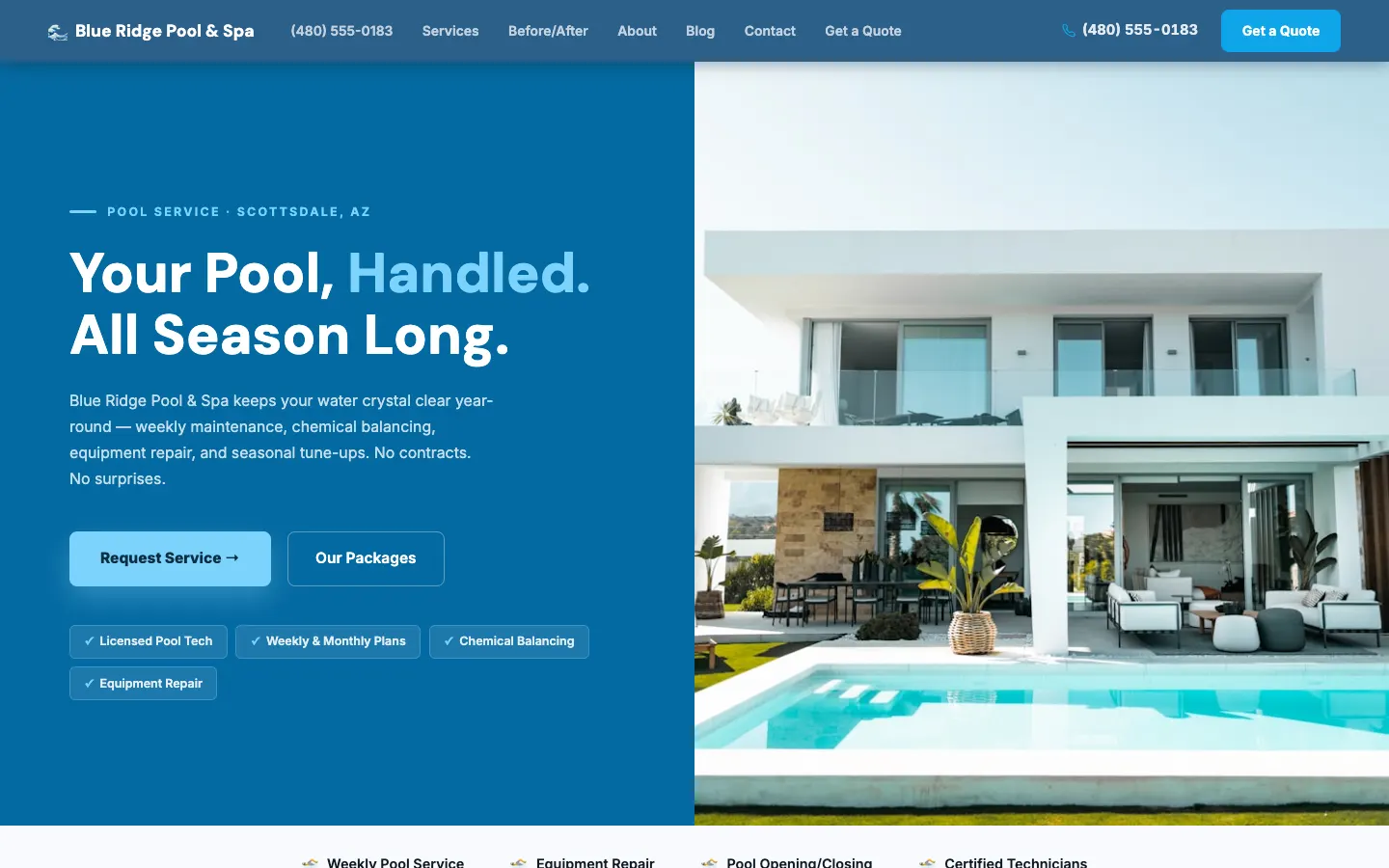
Live Pool Service demo

Blue Ridge Pool & Spa

A crisp pool-blue service site with seasonal maintenance plans, chemical treatment menus, and recurring service subscription tiers.

Maintenance Plan Subscription Tiers. Blue Ridge Pool & Spa is the version we point campaigns at: the weekly service tiers are the landing page, so a Saturday green-pool search has somewhere to become a route customer.

Open the live demo → Pool Service websites

Blue Ridge Pool & Spa — live pool service website built on WorkspaceCMS
Where the demand is

How pool service buyers actually search

Pool demand is one of the sharpest seasonal curves in home services, and the shape matters more than the volume. Opening searches spike in a two-week window that moves with the weather rather than the calendar, then collapse into a long steady plateau of maintenance and repair queries, then spike again at closing. A campaign that goes live in June has already missed the year's most valuable moment, because the homeowner who books an opening usually stays on a weekly plan through the fall.

The other half of demand is unplanned and emotional. A pool turns green over a long weekend, the pump starts screaming, the heater will not fire before a party, and the homeowner searches from the deck with the phone in one hand. Those searches convert on whoever answers, and they are the single best source of new route customers, because a homeowner who has just been rescued rarely goes shopping again.

The competitive field is unusual too. You are bidding against solo owner-operators who run a route out of a truck and spend nothing on marketing, national franchise brands with real ad budgets, and big-box retailers whose water-testing counters intercept the chemical question upstream of you. None of those three compete the same way, so the campaign has to defend different terms for different reasons: route terms against the solos, repair and equipment terms against the franchises, and chemistry and troubleshooting content against the retail counter.

The keyword clusters we build around

  • Seasonal open and closePool opening and closing searches that cluster into short windows. We front-load these before the weather turns and route them to a page that books the appointment, not to a generic services list.
  • Recurring maintenance plansWeekly and biweekly cleaning searches from homeowners who are tired of doing it themselves. These are the ones worth the most over a season, so they land on the plan tiers rather than the contact form.
  • Green pool and algae rescueUrgent, high-intent, and often searched on a weekend. Handled with fast-loading pages and paid coverage that stays on when the office is closed.
  • Equipment repair and replacementPump, filter, heater, and salt-cell queries carry the largest ticket. We build them out by component and brand so the searcher lands on the exact part they typed.
  • Neighborhood service areaRoute density is the whole economics of this business, so the geographic pages target the subdivisions you already serve rather than the whole metro.
The campaign

Three ways we go get the traffic

Local SEO, AI-assistant visibility and paid media, run by the agency team that has been doing it since long before WorkspaceCMS existed.

Local SEO

Organic depth here is measured in components, not in service pages. Variable-speed pump, cartridge filter, gas heater ignition lockout, salt cell scaling, automation panel: each gets a page written around the symptom a homeowner actually types, with the repair-versus-replace reasoning spelled out so the search does not end at the manufacturer's support site. Geography follows drive time rather than city limits, with pages for the subdivisions and HOA communities the route already passes. Opening and closing content is published in the off-season so it has age on it before the window opens.

AI search visibility

A homeowner asks an assistant why the water went cloudy after a storm, whether a salt system still needs chlorine, or what a weekly visit should actually include. Assistants quote sources that commit to specifics, so the service tiers state what is and is not covered at each level, the chemistry pages give real alkalinity and cyanuric acid troubleshooting instead of a pitch, and the service area is named down to the community. That is what gets a pool company repeated by ChatGPT, Claude, Perplexity and Google AI Overviews rather than the big-box water-testing counter.

Paid media

The mistake is running one flat, always-on budget across a season that is anything but flat. Weight moves ahead of the opening window, thins through the maintenance plateau, then shifts again at closing. Green-pool and equipment-failure terms stay live through weekends and evenings, because that is when a pump starts screaming and the office is dark. Search carries rescue and repair intent, Local Services Ads carry the pool cleaning category where it is offered, and paid social handles seasonal service promotions aimed at the neighborhoods you can reach without adding a second truck.

Campaigns are an add-on to a WorkspaceCMS plan and start from $499/mo. The plan itself is a monthly subscription. The build is included, the platform is not free. Local SEO campaigns are scoped to single and multi-location businesses rather than national or global SEO. Paid search management covers service businesses rather than online stores; ad spend is billed by Google or Meta directly to your own account. Full campaign scope → · Plan pricing →

What gets in the way

Six things that hold pool service sites back

01

The season ends before the campaign warms up

Organic work takes time to compound, and the pool year does not wait. The build order is deliberate: paid coverage and the booking path go live first so the opening rush is captured, while the content and location pages mature toward the following spring.

02

One-off cleanings that never become routes

A green-pool rescue is a good day and a bad business if it ends there. The site is structured so every emergency page has an obvious next step into a maintenance tier, and the campaign measures plan signups separately from raw calls.

03

Chemistry questions answered by the retail counter

Homeowners take a water sample to a big-box store and get free advice attached to a shelf of chemicals. Publishing genuinely useful chlorine, alkalinity, and cyanuric acid troubleshooting content is how a service company gets into that conversation first.

04

Route geography that does not match the metro

Pool routes are shaped by drive time, not by city limits. Pages targeting neighborhoods and subdivisions off the existing route are worth more than a page for a city you would need a second truck to serve.

05

Equipment brand searches going to manufacturers

A homeowner searching a specific pump or heater model usually lands on the manufacturer or a parts retailer. Model-level service pages, with the symptoms and the repair-versus-replace reasoning written out, pull that traffic back to a local installer.

06

Weekend calls with nobody to answer them

The most urgent pool searches happen exactly when the office is closed. Paid schedules, a booking flow that works without a phone call, and after-hours expectations set plainly on the page keep those leads from bouncing to the next result.

Campaign add-ons

Pick the campaign that fits the market

Every package below is bought from your dashboard once your site is live. Names, prices and deliverables are read from the catalog at page load, so what you see here is what you would be buying.

Questions

Pool Service marketing, answered

How early before opening season do we need to be live?

The opening rush decides the size of your route for the rest of the year, and it moves with the weather rather than the calendar. Being visible through the last cold weeks is what catches the homeowners booking ahead of it.

Can we compete with the big-box store's water testing counter?

Not on price, but on the answer itself. Publishing genuine troubleshooting for cloudy water, high cyanuric acid and low alkalinity puts your company into that conversation before the homeowner ever carries a sample bottle into a retail aisle.

How does a green-pool rescue become a weekly route customer?

Every emergency page ends in a maintenance tier rather than a thank-you message, and the reporting separates recurring signups from raw calls, so rescue work is judged on what it converts into instead of on the day it produced.

Should we build pages for specific pump and heater models?

Yes. A homeowner searching a model number usually lands on the manufacturer or a parts seller. A page that names the model, lists the symptoms and reasons through repair versus replacement pulls that search back toward a local installer.

What does the campaign do once the pools are closed?

It shifts rather than pauses. Winterization and cover repair intent gets the coverage, and the quiet months are when the subdivision pages and the equipment library get built out, so the next opening starts from a stronger position.

Your free site is one click away

Ready to grow a pool service business?

Get the site built, then put a campaign behind it. Start online, or talk it through with a strategist first.

Want the full picture? See what a campaign includes