Growth campaigns · Personal Injury Law

Campaigns for the Most Expensive Terms in Local Search

Injury search is contested by firms with broadcast budgets and by aggregators reselling the same claimant to several practices at once. Depth by incident type, a real neighborhood footprint and an intake line answered at two in the morning are what survive that auction.

Live Personal Injury Law demo

Sterling & Reyes Trial Attorneys

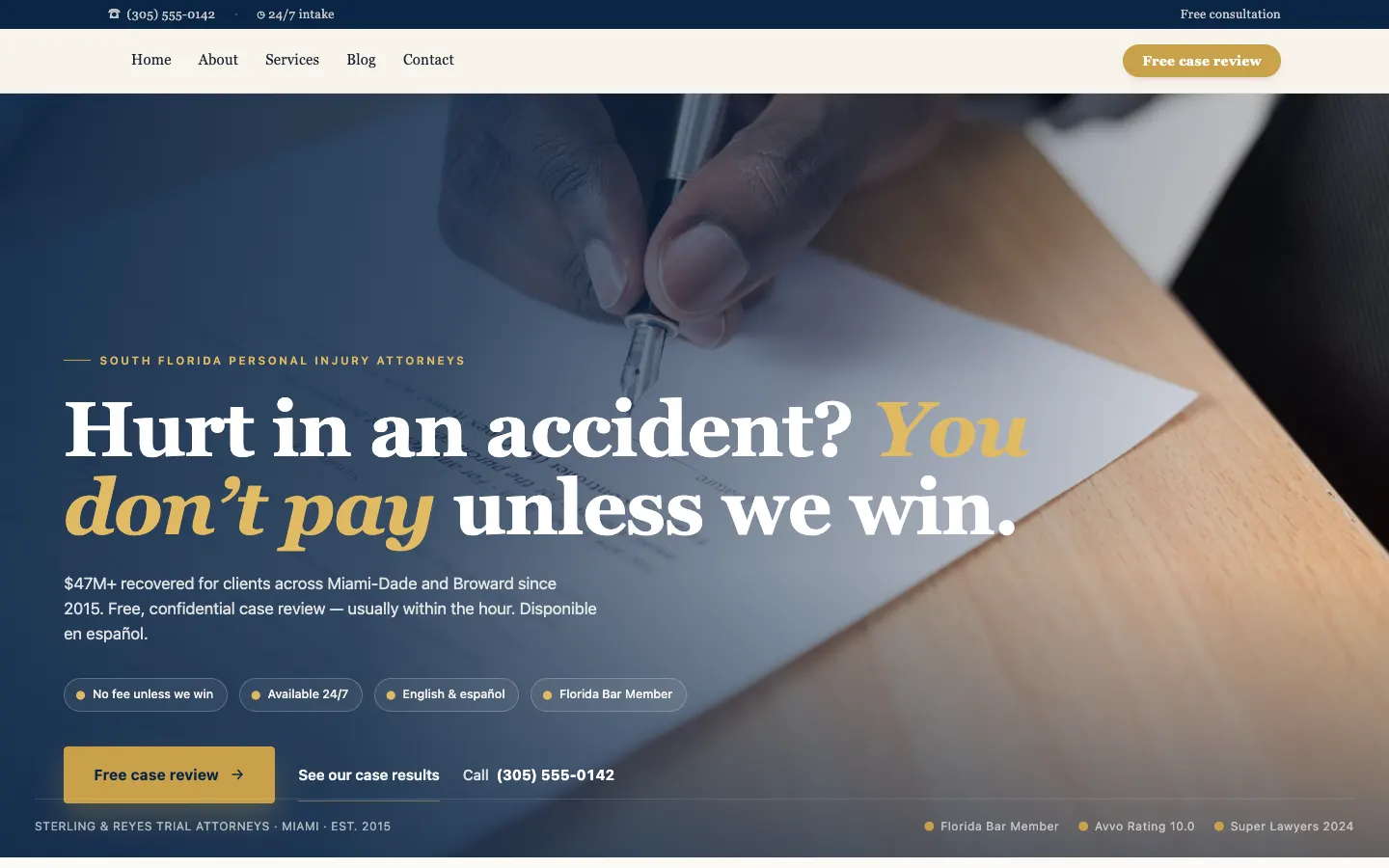
Editorial gravitas for a high-stakes practice. $47M in verdict-and-settlement proof, presented like a case file.

$47M Case-Results Timeline. Sterling & Reyes Trial Attorneys shows the structure an injury campaign needs behind its traffic: attorney credentials and a case-review booking path sitting together on one screen.

Open the live demo → Personal Injury Law websites

Sterling & Reyes Trial Attorneys — live personal injury law website built on WorkspaceCMS
Where the demand is

How personal injury law buyers actually search

No other local vertical is fought over this hard. Injury terms sit at the very top of paid search costs because a single retained matter can justify an enormous acquisition cost, and the bidders include firms running television, lead aggregators who resell the same claimant to several firms, and settlement-funding companies buying the same keywords for a different product. A small firm cannot outbid that field, and a campaign that tries is spending its way to nothing.

The claimant's path is short and emotional. The search often happens within days of a collision, sometimes from an emergency department waiting room, and it is frequently a family member searching rather than the injured person. Whoever answers the phone, at any hour, in the claimant's language, tends to get the consultation. The consequence is that intake is not a downstream operational detail; it is part of the marketing, and campaigns that generate calls into an unanswered line are simply donating money to the ad auction.

What actually gives a firm room to compete is specificity. Broad injury terms are commodity auctions, but the long tail is not: a particular type of collision, a particular kind of injury, a specific insurer's tactics, a named road or intersection, a language spoken in a specific neighborhood. Layer on regulated advertising, every state bar governs how a firm may describe itself and what it must disclaim, and the practical strategy becomes depth and geography rather than volume and claims.

The keyword clusters we build around

  • Incident-type intentCollision, premises, and workplace injury searches broken out by incident type rather than lumped into one page, because the searcher's language differs sharply by how they were hurt.
  • Injury and treatment questionsSearches that begin with the injury or the medical bills rather than with hiring anyone. Answered with genuinely useful content that earns the consultation later.
  • Insurance and claims processWhat an adjuster asks, what a recorded statement is, how a claim timeline works. High-trust content, and among the most quotable material a firm can publish.
  • Neighborhood and corridor geographyLocation pages tied to real communities and to the roads and intersections where collisions actually happen in your market.
  • Language and community reachMultilingual content where the client base calls for it. Frequently the least contested and most productive part of the whole program.
The campaign

Three ways we go get the traffic

Local SEO, AI-assistant visibility and paid media, run by the agency team that has been doing it since long before WorkspaceCMS existed.

Local SEO

Head terms are a commodity auction, so the organic plan lives in the long tail. Pages split by how someone was hurt, because a rear-end collision, a dog bite and a fall in a grocery aisle are searched in completely different language. Around that sits claims-process content: what a recorded statement is, what an adjuster asks first, how a filing deadline runs in your state. Attorney pages establish who actually tries these matters, geography follows the corridors and intersections where collisions happen locally, and second-language content is added where the client base calls for it.

AI search visibility

People ask assistants the questions they are too shaken to bring to a firm yet: whether to give a recorded statement, whether an emergency room bill has to be paid now, how long they have to file in their state. Firms cited by ChatGPT, Claude, Perplexity and Google AI Overviews are the ones publishing jurisdiction-specific, plainly written answers with clear attorney attribution and structured practice and location data, and doing it without any claim about outcomes or fees. A page that dodges the question behind a call-now banner is never the source quoted.

Paid media

The constraint is the auction itself. Injury terms are the most expensive in local search, and the bidders include broadcast advertisers, claimant aggregators and settlement-funding companies chasing the same words for a different product. Bidding head terms straight is how a small firm spends its way to nothing, so weight goes to incident-level and long-tail intent, to neighborhood geography, and to second-language reach where the field is thinnest. Local Services Ads eligibility for legal categories varies by market and is confirmed first, and every ad goes to firm counsel for bar review.

Campaigns are an add-on to a WorkspaceCMS plan and start from $499/mo. The plan itself is a monthly subscription. The build is included, the platform is not free. Local SEO campaigns are scoped to single and multi-location businesses rather than national or global SEO. Paid search management covers service businesses rather than online stores; ad spend is billed by Google or Meta directly to your own account. Full campaign scope → · Plan pricing →

What gets in the way

Six things that hold personal injury law sites back

01

Bidding against television budgets and lead brokers

Injury keywords are the most expensive in local search, and the bidders include firms with broadcast budgets and aggregators reselling claimants. The response is tighter targeting, longer-tail intent, and organic depth rather than an unwinnable head-term auction.

02

Bar advertising rules that constrain every line of copy

State rules govern testimonials, specialization language, comparisons, and required disclaimers, and they differ by jurisdiction. Copy is written conservatively, avoids any claim about outcomes or fees, and goes to the firm's counsel for review before it publishes.

03

Leads that arrive at an unanswered phone

Claimants call several firms in one sitting and retain whoever picks up. After-hours coverage, response time, and a consistent intake script determine whether the campaign produced anything at all.

04

Content that is legally accurate and unreadable

Attorney-drafted pages are often hedged into uselessness for a reader in pain. Content has to stay accurate while answering the question a frightened person actually typed, which is an editing problem the firm and the agency solve together.

05

Directories and aggregators outranking real firms

Lawyer directories and lead-generation sites hold much of the first page for the broad terms. Firms get past them on specificity: incident-level pages, neighborhood coverage, and attorney authority that a directory listing cannot reproduce.

06

Attribution that breaks between call and case

The gap between a click and a signed matter can run months, and cases arrive by referral too. Without call tracking and consistent intake records the campaign is judged on raw call counts, which is how firms end up cutting the sources that actually produced their best matters.

Campaign add-ons

Pick the campaign that fits the market

Every package below is bought from your dashboard once your site is live. Names, prices and deliverables are read from the catalog at page load, so what you see here is what you would be buying.

Questions

Personal Injury Law marketing, answered

Are injury keywords simply too expensive for a small firm?

The broad head terms usually are, against advertisers running television. Incident-level intent, neighborhood corridors and second-language searches are thinner auctions, and the person typing them is often further along than someone searching a generic phrase.

Do you buy or resell claimant leads?

No. Nothing goes to an aggregator, so a claimant who contacts you is not simultaneously being sold to three other practices. Everything arrives through your own site, your own tracked number and your own advertising accounts.

How are state bar advertising rules handled in the copy?

Conservatively, with your counsel deciding. Copy carries no statement about outcomes, results or fees, avoids specialization and superlative language where a jurisdiction restricts it, and every page and ad is routed to the firm for review before it runs.

Why does intake keep coming up in a marketing conversation?

Because a claimant calls several firms in one sitting and retains whoever picks up, often at night and often through a family member. After-hours coverage, language support and a consistent intake script decide whether the campaign produced anything at all.

How do we tell which sources produced our strongest matters?

Call tracking and consistent intake records held over months, because the gap between a click and a signed matter is long and referrals arrive alongside it. Without that record a firm judges on raw call counts and cuts the sources quietly working.

Your free site is one click away

Ready to grow a personal injury law business?

Get the site built, then put a campaign behind it. Start online, or talk it through with a strategist first.

Want the full picture? See what a campaign includes