
Growth campaigns · Court Reporting

Marketing Aimed at the Person Who Actually Books the Deposition

Partners do not book depositions. The paralegal holding the calendar does, usually with a date already set and a vendor list she has used for years. Everything here is written for that reader, and for the conflict or rush date that gets you added to it.

Live Court Reporting demo

Marbury Court Reporting

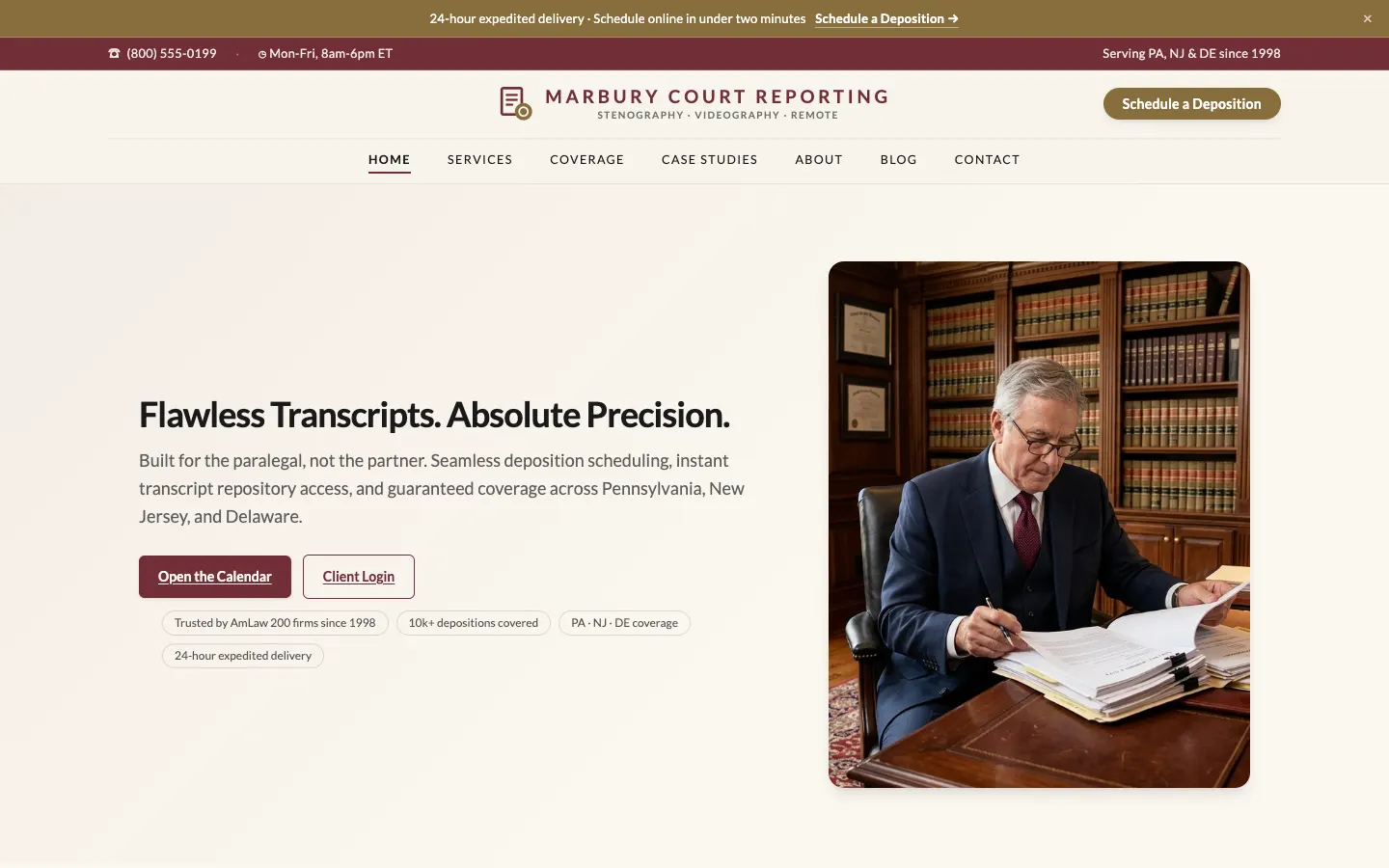
An oxblood and antique-gold court-reporting site for Philadelphia, written for the paralegal doing the booking: certified transcripts and realtime stenography, legal videography, remote depositions, exhibit management, rush and after-hours coverage, and a 24/7 transcript repository, with a dedicated scheduling page that lists exactly what to have ready, a PA/NJ/DE coverage page, five complex-litigation case studies, paralegal testimonials, an FAQ, and a blog.

Deposition Scheduling Request + PA/NJ/DE Coverage Page. Marbury Court Reporting is built the way this vertical needs: a scheduling page written for the paralegal doing the booking, sitting beside a coverage page that names the states plainly.

Open the live demo → Court Reporting websites

Marbury Court Reporting — live court reporting website built on WorkspaceCMS
Where the demand is

How court reporting buyers actually search

The buyer here is not the buyer everyone assumes. Partners rarely search for a court reporter; the paralegal or legal assistant handling the calendar does, and that person is judged on whether the deposition goes off without incident. They are checking coverage, availability on a specific date, turnaround, and whether the agency has handled the format at issue, and they want that visible without a discovery call. Copy written to impress a managing partner talks past the only person who will ever read it.

Volume in this vertical is low and each relationship is worth a great deal. A firm that adds an agency to its approved vendor list may schedule dozens of proceedings a year for years, so the campaign is not chasing a stream of one-time jobs. It is chasing a small number of durable additions, which changes what the site has to do: earn a first booking on a rush or an overflow date, then be effortless enough that the second call skips the search entirely.

Geography and format are both in flux. Remote and hybrid proceedings widened the practical service area well past the courthouse, while realtime, videography, exhibit handling, and interpreter coordination have become the things that actually differentiate agencies. Meanwhile national platforms with sales teams are calling on the same firms. An independent agency competes on coverage that is genuinely specific, named counties and states, stated after-hours and rush capability, and a scheduling path that a paralegal can complete in one pass.

The keyword clusters we build around

  • Deposition scheduling intentThe core term set, searched by staff with a date already in hand. These land on a scheduling page that lists exactly what to have ready, not on a generic contact form.
  • Realtime and rough draftSearched when a proceeding needs live feed or same-day text. A distinct capability that deserves its own page because it is often the reason a firm looks past its usual vendor.
  • Legal videography and synced transcriptsVideo depositions and synchronization requests, frequently booked alongside the reporter. Worth breaking out as a service in its own right.
  • Remote and hybrid proceedingsPlatform, exhibit-sharing, and remote-swearing questions. This content wins work from firms outside the immediate metro.
  • Multi-state coverageSearches naming a state or county other than where the firm sits. Coverage pages make the practical service area explicit rather than implied.
  • Rush and after-hours availabilityDeadline-driven queries with immediate intent, often the first booking a new firm ever places with an agency.
The campaign

Three ways we go get the traffic

Local SEO, AI-assistant visibility and paid media, run by the agency team that has been doing it since long before WorkspaceCMS existed.

Local SEO

Precision beats breadth in a category this small. Coverage pages name the counties and states reporters are actually certified in, rather than implying a footprint that remote proceedings quietly widened. Realtime, rough drafts, legal videography, transcript synchronization, exhibit handling and interpreter coordination each get a page a searcher can land on directly, because any one of them is the reason a firm looks past its usual agency. The scheduling page is treated as a landing page: what to have ready, notice, formats supported and turnaround, all visible before anyone touches a form.

AI search visibility

Legal staff now ask assistants who covers depositions in a particular county, how remote swearing works in a given state, and what adding realtime involves. Agencies that publish structured coverage and service data, reporter certifications, turnaround terms and clear answers about hybrid platforms and exhibit sharing are the ones ChatGPT, Claude, Perplexity and Google AI Overviews hand back to a coordinator. Copy about a commitment to excellence is unusable to an assistant; a plain explanation of how a rough draft differs from a certified transcript is exactly what gets quoted.

Paid media

Volume in this category is thin and intent is sharp, so paid stays deliberately narrow. Weight sits on scheduling, rush and named-county coverage terms rather than broad legal-services keywords, where you would compete with injury advertisers for entirely the wrong reader. Bidding follows the litigation calendar, and the ads speak to a coordinator under a deadline: date availability, formats supported, how quickly a transcript comes back. Paid social carries firm-level awareness and reporter recruiting, which in many markets is the harder shortage of the two.

Campaigns are an add-on to a WorkspaceCMS plan and start from $499/mo. The plan itself is a monthly subscription. The build is included, the platform is not free. Local SEO campaigns are scoped to single and multi-location businesses rather than national or global SEO. Paid search management covers service businesses rather than online stores; ad spend is billed by Google or Meta directly to your own account. Full campaign scope → · Plan pricing →

What gets in the way

Six things that hold court reporting sites back

01

Copy written for partners, read by paralegals

The person searching is coordinating a calendar, not evaluating a firm's prestige. Pages that lead with what to have ready, how to book, and what the turnaround is convert; pages that lead with heritage language do not.

02

Vendor lists that are hard to break into

Most firms already have a reporter they call. The realistic entry point is a conflict, an overflow date, a rush, or an out-of-area proceeding, so the campaign targets those situations specifically rather than trying to unseat an incumbent head on.

03

Service area that no longer matches the courthouse

Remote proceedings extended the practical footprint well past one county, but most agency sites still read like a single-city operation. Coverage pages have to state the real multi-state reach without overclaiming where reporters are actually certified.

04

National platforms calling on your firms

Well-funded national agencies have outbound sales teams working the same accounts. Independents answer with specificity: named coverage, stated rush capability, and a scheduling path that is faster than a sales call.

05

Low search volume, high stakes per lead

There is no traffic-volume story to tell here. A handful of the right visitors a month can change the year, so the campaign is judged on booked proceedings and new firm relationships rather than on sessions.

06

Capabilities buried in a services list

Realtime, videography, exhibit management, and interpreter coordination are often the reason a firm looks elsewhere, yet they get one bullet each on a single page. Each deserves a page a searcher can land on directly.

Campaign add-ons

Pick the campaign that fits the market

Every package below is bought from your dashboard once your site is live. Names, prices and deliverables are read from the catalog at page load, so what you see here is what you would be buying.

Questions

Court Reporting marketing, answered

Is there enough search volume in court reporting to justify a campaign?

Volume is low, and that is the design constraint rather than an objection. One firm added to a vendor list can schedule proceedings for years, so the program is measured in new firm relationships and booked dates instead of sessions.

How do we get onto a firm's approved vendor list?

Rarely by unseating an incumbent. The realistic openings are a conflict, an overflow date, an out-of-area proceeding or a rush, so the campaign targets those situations specifically and lets the first clean job do the rest.

Remote depositions widened our reach. How should coverage be presented?

Carefully. Coverage pages state the counties and states where reporters hold certification and where remote proceedings can be handled, so a coordinator can confirm the jurisdiction without a call and nothing is claimed that a reporter cannot cover.

Should realtime and videography have pages of their own?

Yes. Those capabilities are usually why a firm looks past the agency it already uses, and burying each under a single bullet on a services list means the search that would have found you never lands anywhere.

Who is the copy actually written for?

The paralegal or legal assistant doing the scheduling. Pages lead with what to have ready, notice requirements, formats and turnaround, because heritage language aimed at a managing partner talks past the only person who will read it.

Your free site is one click away

Ready to grow a court reporting business?

Get the site built, then put a campaign behind it. Start online, or talk it through with a strategist first.

Want the full picture? See what a campaign includes