Growth campaigns · National Law Firm

Search Programs for Firms With Practice Groups and Offices to Match

A firm with several offices and several practice groups has a grid of search problems, not one. An employment group competes against a different field than a transactional group does, and every staffed market has its own bar rules and its own referral network to answer to.

Live National Law Firm demo

Alderton & Cole LLP

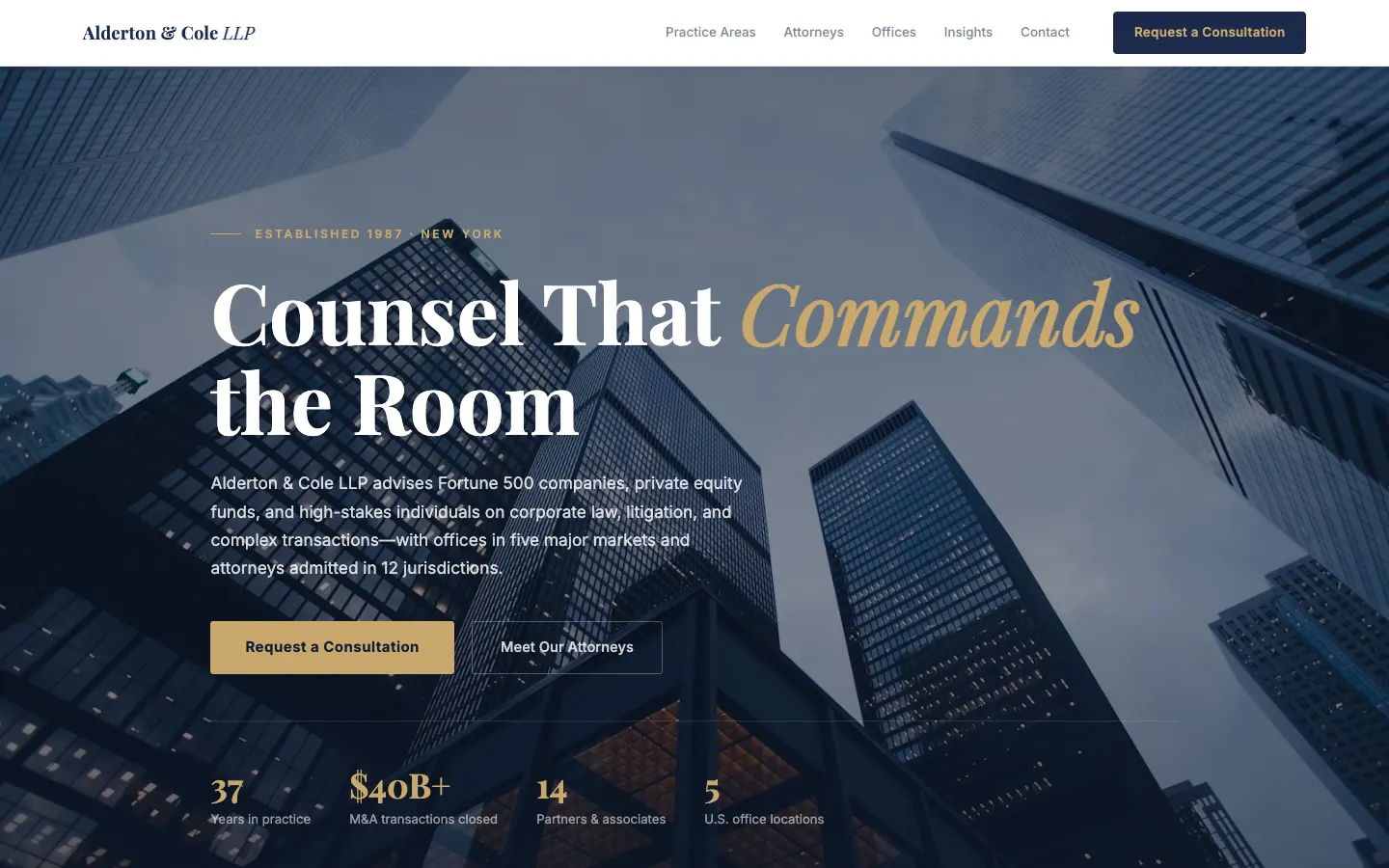
AmLaw 100 national law firm with 200+ attorneys across New York, Chicago, Los Angeles, Houston, and Miami. Corporate law, M&A, litigation, employment, real estate, and IP.

14-Attorney Directory + 5 National Offices + 8 Practice Groups. Alderton & Cole LLP is the structure this plugs into: a full attorney directory, practice groups with pages of their own, and separate office pages, which is exactly the grid a content plan has to cover.

Open the live demo → National Law Firm websites

Alderton & Cole LLP — live national law firm website built on WorkspaceCMS
Where the demand is

How national law firm buyers actually search

Large-firm work is bought through a mix of referral, reputation, and panel selection, and search sits inside that process rather than replacing it. General counsel shortlists a handful of firms from relationships and directories, then researches, and that research is where the site matters: the practice group page, the attorney bio, the representative matters, the published thinking on the specific statute or regulation in play. The search rarely reads like hiring intent. It reads like a question about a rule, asked by someone who is already evaluating you.

The unit of authority is the practice group, not the firm. Corporate, M and A, litigation, employment, real estate, and intellectual property attract different searchers with different vocabularies, and each competes against a different set of firms. Employment content fights a crowded field of firms publishing on every new agency rule; a specialized transactional group may compete with only a few peers nationally. Treating those as one program produces a homepage that ranks for the firm name and practice pages that rank for nothing.

Attorney bios do more work in this vertical than in almost any other. They are the most-visited pages after the homepage, they are what a recruit reads, they are what a journalist checks, and they frequently outrank the practice pages for a named specialty. Add the reality of a multi-office footprint, where each market has its own bar, its own referral network, and its own competitive set, and the honest structure is a set of coordinated per-market local programs plus deep practice content, not a single national push.

The keyword clusters we build around

  • Practice group depthSubstantive terms inside each group, from deal structures to regulatory frameworks. Built out per group because the competitors and the vocabulary differ in each one.
  • Attorney and expertise queriesNamed-attorney and specialty searches. Bios are treated as landing pages, with matters, admissions, publications, and speaking properly structured.
  • Regulatory and statutory questionsThe searches in-house counsel actually run when something changes. Answered with client alerts and explainers that establish the firm as the one reading the rule closely.
  • Per-market office presenceLocal queries in each city where the firm has real staffed offices, run as separate local programs rather than folded into one national footprint.
  • Industry and sector focusSector-led searches from buyers who care that you know their industry as much as the law. These cut across practice groups and deserve their own pages.
The campaign

Three ways we go get the traffic

Local SEO, AI-assistant visibility and paid media, run by the agency team that has been doing it since long before WorkspaceCMS existed.

Local SEO

The plan is drawn group by group and office by office, because the peer set for an employment practice has nothing to do with the peer set for a transactional one. Each group gets substantive depth: dated client alerts that state precisely what changed in a rule, explainers written for in-house counsel rather than for a general reader, and matter-level pages. Attorney bios are treated as ranking pages instead of directory rows, with admissions, representative matters, publications and speaking structured properly, since they draw more readers than anything but the homepage.

AI search visibility

In-house counsel now open a research question with an assistant, and the firms that come back cited are the ones publishing structured practice and attorney data alongside dated alerts naming the statute, the effective date and what changed. A plain-language explanation of a filing deadline or a new agency rule is exactly what ChatGPT, Claude, Perplexity and Google AI Overviews reach for; prose about a commitment to client service is not. All of it stays inside what firm counsel approves under the advertising rules of each jurisdiction where you practice.

Paid media

Paid supports a firm of this size, it does not carry it. Concentration matters more than reach: defined practice areas in the markets where you actually staff an office, rather than firm-name awareness spread thin across the whole footprint. Paid social does the work search cannot, including event and webinar promotion, alert distribution to in-house audiences, and lateral recruiting, which competes for the attention of the same readers. Every line of ad copy goes to firm counsel for review against each jurisdiction's advertising and solicitation rules before it runs.

Campaigns are an add-on to a WorkspaceCMS plan and start from $499/mo. The plan itself is a monthly subscription. The build is included, the platform is not free. Local SEO campaigns are scoped to single and multi-location businesses rather than national or global SEO. Paid search management covers service businesses rather than online stores; ad spend is billed by Google or Meta directly to your own account. Full campaign scope → · Plan pricing →

What gets in the way

Six things that hold national law firm sites back

01

Practice groups competing against different firms each

The peer set for an employment group has nothing to do with the peer set for a transactional group. A single firm-wide strategy averages those out and serves neither, so the program is planned group by group.

02

Content that has to clear conflicts and review

Everything published passes through partners, marketing, and often risk. A publishing cadence that ignores that reality stalls in month two. The workflow is built around review cycles rather than pretending they do not exist.

03

Attorney bios treated as directory entries

Bios are among the highest-traffic pages a firm has and are usually the thinnest. Structured admissions, representative matters, publications, and speaking turn a placeholder into a page that ranks for the specialty it describes.

04

Multi-office presence with no local footing

Five offices on a contact page is not a local presence. Each staffed market needs its own local program, its own profile, and its own content, which is a different scope from a single national campaign.

05

Bar advertising rules that vary by state

Advertising, solicitation, and specialization language are governed differently in every jurisdiction a firm practices in. Copy and disclaimers have to satisfy the strictest applicable rule, and the firm's own counsel signs off before anything runs.

06

Recruiting and client marketing pulling in opposite directions

The same site is read by lateral candidates and by prospective clients, and they want different things from a practice page. The structure has to serve both without the careers narrative diluting the substantive content.

Campaign add-ons

Pick the campaign that fits the market

Every package below is bought from your dashboard once your site is live. Names, prices and deliverables are read from the catalog at page load, so what you see here is what you would be buying.

Questions

National Law Firm marketing, answered

How do you plan search across six practice groups?

Group by group. The vocabulary, the searchers and the competing firms differ in each one, and a single firm-wide plan averages them into a homepage that ranks for your own name and practice pages that rank for nothing.

How is bar advertising review built into the publishing workflow?

It is assumed rather than bolted on. Copy carries no statement about outcomes, results or fees and avoids specialization language where a jurisdiction restricts it, and every page and ad goes to firm counsel before publication, with compliance remaining the firm's responsibility.

Who writes the substantive legal content?

Attorneys own the substance and the review. We handle structure, research into what in-house counsel is actually searching, editing, a cadence built around conflicts and risk review, and the technical work that makes an alert findable and citable.

Do attorney bios really need a strategy of their own?

They are among the most-read pages a firm has and usually the thinnest. A lateral candidate, a journalist and a prospective client all land there, and a properly structured bio frequently outranks the practice page for the specialty it describes.

How are offices in different cities handled?

As separate local programs. A list of addresses on a contact page is not a presence, so each staffed market gets its own profile, its own content and its own referral context, because the bar, the competitors and the searchers differ in each.

Your free site is one click away

Ready to grow a national law firm business?

Get the site built, then put a campaign behind it. Start online, or talk it through with a strategist first.

Want the full picture? See what a campaign includes