Growth campaigns · Specialty Coffee Roaster

Website Marketing for Specialty Coffee Roasters

One site, two businesses. Bags going out to drinkers who read a label the way other people read a spec sheet, and accounts going out to cafes that mostly want to know whether someone will turn up and dial in the grinder.

Live Specialty Coffee Roaster demo

Bali Espresso Coffee Company

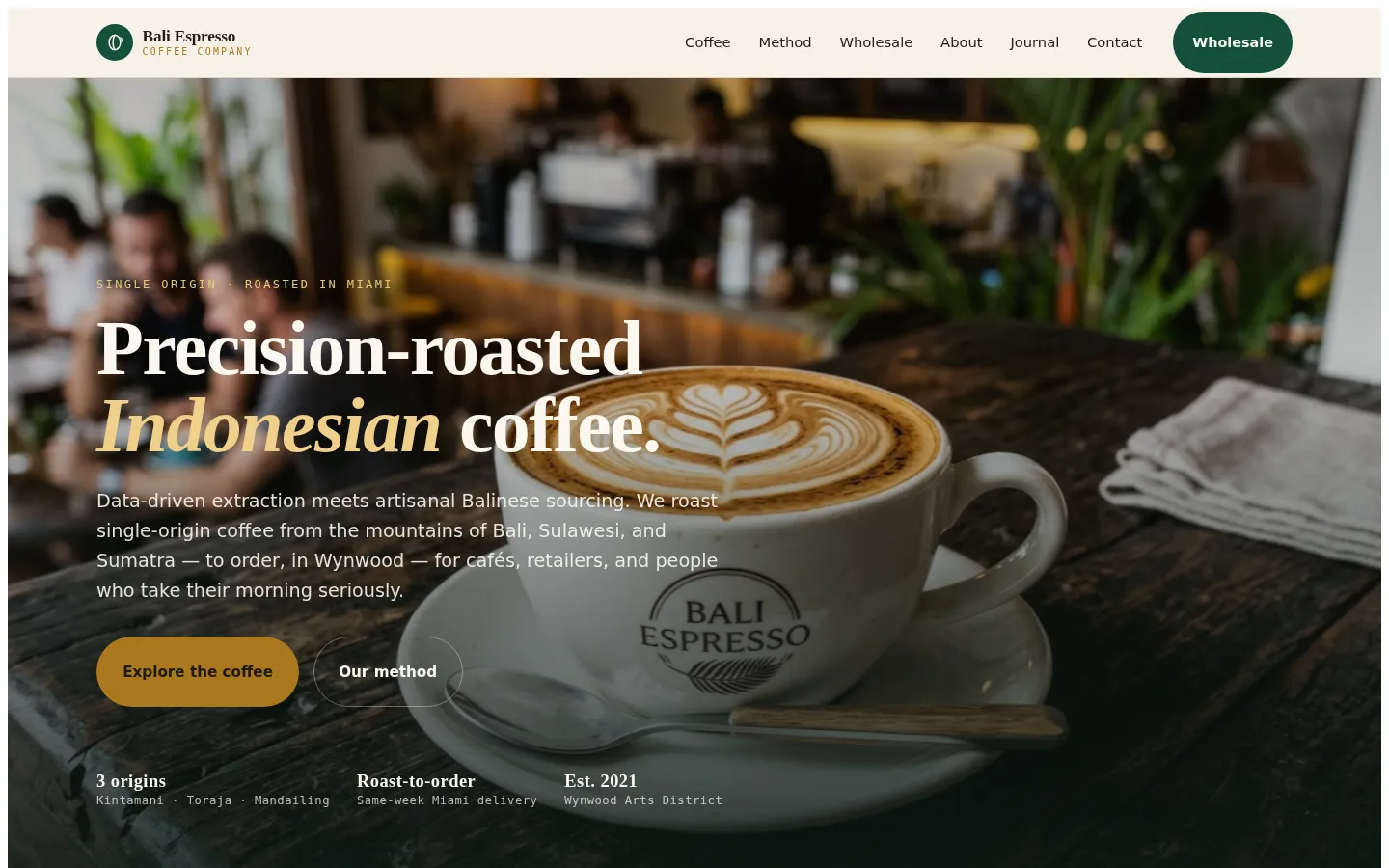
A warm, editorial specialty-coffee site from Miami's Wynwood Arts District: deep pine green, brass, and cream with a Fraunces serif and a monospace spec-sheet layer, built on the brand's own Balinese-batik photography. Shop-by-origin cards (Kintamani / Toraja / Mandailing) with full roast specs, a subscription (The Ritual), a B2B wholesale onboarding flow for cafés and restaurants, a data-driven roasting method, and dial-in brew guides.

Shop-by-Origin Roster + Wholesale Onboarding + Subscription. Bali Espresso Coffee Company shows the two-audience structure, with origin cards carrying full roast specs on one side and a wholesale onboarding path on the other.

Open the live demo → Specialty Coffee Roaster websites

Same business, different design direction: Bali Espresso Coffee Company. Both are real, published builds, useful when you want to see how far the look can move without changing what the campaign targets.

Bali Espresso Coffee Company — live specialty coffee roaster website built on WorkspaceCMS
Where the demand is

How specialty coffee roaster buyers actually search

Retail coffee buyers arrive through vocabulary that is unusually precise. They search origins, processing methods, varietals and roast levels, and they read a bag page the way somebody reads a spec sheet: elevation, producer, process, tasting notes, roast date. Freshness is the differentiator that supermarket coffee cannot claim, so a roaster who publishes roast dates and ships on a schedule has an argument nobody else in the aisle can make. The subscription decision follows the same logic, since it is fundamentally about never running out of fresh coffee.

The wholesale side behaves nothing like that. A cafe owner or restaurant group searching for a coffee supplier is evaluating consistency, delivery cadence, equipment support and whether somebody will come and dial in the grinder when the humidity shifts. That is a relationship sale with a sampling stage in the middle, and it converts on pages that describe onboarding, training and account terms rather than on tasting notes. Roasters routinely bury this under retail content and wonder why the accounts do not come.

Seasonality runs on two clocks at once. Harvest arrivals dictate when a new origin can even be offered, while drinker demand swings toward iced and cold brew in the warm months and toward gifting and holiday blends at the end of the year. In a market like Miami the iced season barely ends, which changes the merchandising calendar entirely. Add the cafe crawl traffic from people searching for coffee in a specific neighborhood, and there is a local layer sitting on top of a national shipping business.

The keyword clusters we build around

  • Origin and processSingle-origin, varietal and processing-method searches from drinkers who know what they want. These land on shop-by-origin pages carrying full roast specs.
  • SubscriptionPeople comparing coffee subscriptions on frequency, flexibility and freshness. The plan page has to answer pausing and switching before it sells romance.
  • Wholesale accountsCafes, restaurants and offices looking for a supplier. Onboarding, training, delivery cadence and account terms are what this reader needs.
  • Brew method guidesDial-in, ratio and equipment questions. High volume, genuinely useful, and the fastest way to build topical authority in coffee.
  • Local roastery and cafeNeighborhood searches for good coffee and for the roastery itself. Worth owning fully if there is a room the public can visit.
  • Gifting and samplerGift sets, samplers and corporate gifting that concentrate in the last weeks of the year.
The campaign

Three ways we go get the traffic

Local SEO, AI-assistant visibility and paid media, run by the agency team that has been doing it since long before WorkspaceCMS existed.

Local SEO

The organic work splits cleanly down the middle. Retail pages carry producer, region, elevation, process and roast level, because that is the vocabulary specialty drinkers actually type, and brew guides go after the dial-in and ratio searches that are the highest-volume content in coffee. Wholesale gets its own path, with pages on sampling, equipment support, delivery cadence and account onboarding, which is what a cafe owner is really evaluating. Rotating lots keep permanent pages that point to what is landing next instead of disappearing with the harvest.

AI search visibility

Assistants get asked for a washed Ethiopian suited to a filter setup, or for a roaster who will supply a cafe in a particular city, and they answer from what has been published. Roast and ship cadence, grind options, producer and elevation data, wholesale minimums and lead times, and brew ratios all get written as text. Product markup on every lot and clear location data give Google AI Overviews something to attribute, and the freshness argument only reaches an assistant if the roast date policy is stated rather than implied on a bag.

Paid media

Coffee creative sells provenance and craft, so paid social leans on the roastery itself: the drum, a cupping table mid-session, a bag of a new arrival being unrolled, the producer named rather than gestured at. Subscription creative is the workhorse and lives or dies on whether it answers frequency and flexibility in the first frame. Gifting and sampler creative gets built well ahead of the end-of-year window, and iced and cold brew creative follows the warm months, which in a market where iced season never really closes shifts the whole calendar. Wholesale moves through samples and relationships, not a feed.

Campaigns are an add-on to a WorkspaceCMS plan and start from $499/mo. The plan itself is a monthly subscription. The build is included, the platform is not free. Local SEO campaigns are scoped to single and multi-location businesses rather than national or global SEO. Paid search management covers service businesses rather than online stores; ad spend is billed by Google or Meta directly to your own account. Full campaign scope → · Plan pricing →

What gets in the way

Six things that hold specialty coffee roaster sites back

01

Wholesale hidden behind a contact link

The account business is the durable revenue and it usually gets one line in the footer. Cafe owners search for a supplier the way any buyer does, and they need onboarding, sampling and delivery detail on a page they can find.

02

Bag pages written as poetry, not as specs

Tasting notes alone match almost nothing anyone types. Producer, region, elevation, process and roast level are what specialty buyers search, and they are what makes a page match the query.

03

Roast date as a claim with no page behind it

Freshness is the roaster's structural advantage over shelf coffee, and it goes unsaid. Publishing the roast and ship cadence converts better than any origin story.

04

Subscription pages that dodge the cancel question

Every subscriber wants to know how to pause, skip and change grind before signing up. Answering it up front raises conversion; hiding it produces cancellations and support email.

05

New arrivals replacing the old page

When an origin sells out and the page is deleted, the accumulated search value goes with it. Rotating lots need permanent pages that say what is next, not a wall of dead links.

06

Brew guides on social, nowhere on the site

Dial-in and ratio content is the most searched thing in coffee. Posted as a video with no article behind it, it entertains an existing audience and reaches nobody new.

Campaign add-ons

Pick the campaign that fits the market

Every package below is bought from your dashboard once your site is live. Names, prices and deliverables are read from the catalog at page load, so what you see here is what you would be buying.

Questions

Specialty Coffee Roaster marketing, answered

What happens to an origin page when the lot sells out?

It stays and changes job. A permanent page explaining the lot, noting it has sold through and pointing at what is arriving keeps every bit of search value it earned and catches the drinker who came looking. Deleting it throws the whole thing away each harvest.

Should wholesale sit on the same site as the retail shop?

Yes, but on its own path with its own pages. A cafe owner is evaluating consistency, delivery cadence, equipment support and training, none of which appears anywhere in a bag page, and burying the account business behind a footer contact link is why the accounts do not arrive.

Does publishing roast dates actually help us?

It is your one structural advantage over shelf coffee and most roasters leave it unsaid. Publishing the roast and ship cadence gives the freshness claim something concrete behind it, and it is a detail both careful drinkers and assistants look for when comparing one roaster against another.

Our tasting notes are beautifully written and nothing ranks. Why?

Because tasting notes match almost nothing anyone types into a search bar. Producer, region, elevation, process and roast level are the terms specialty buyers use, and until those appear as text on the lot page there is nothing for the query to match against.

Cafe owners find us by drinking our coffee. Where does search fit into wholesale?

In the stretch between the first taste and the first order, when someone is quietly checking whether you can supply reliably. Onboarding, sampling, training and delivery pages answer that in private, which is exactly when a cafe owner is deciding without contacting you.

Your free site is one click away

Ready to grow a specialty coffee roaster business?

Get the site built, then put a campaign behind it. Start online, or talk it through with a strategist first.

Want the full picture? See what a campaign includes