
Growth campaigns · Print on Demand

Website Marketing for Print on Demand Brands

Custom printing is bought against a date on a calendar. There is a tournament, a conference or a launch, and the shop that answers turnaround, minimum quantity and file format in plain text usually takes the quote before anyone has built a mockup.

Live Print on Demand demo

Foundry Print Co.

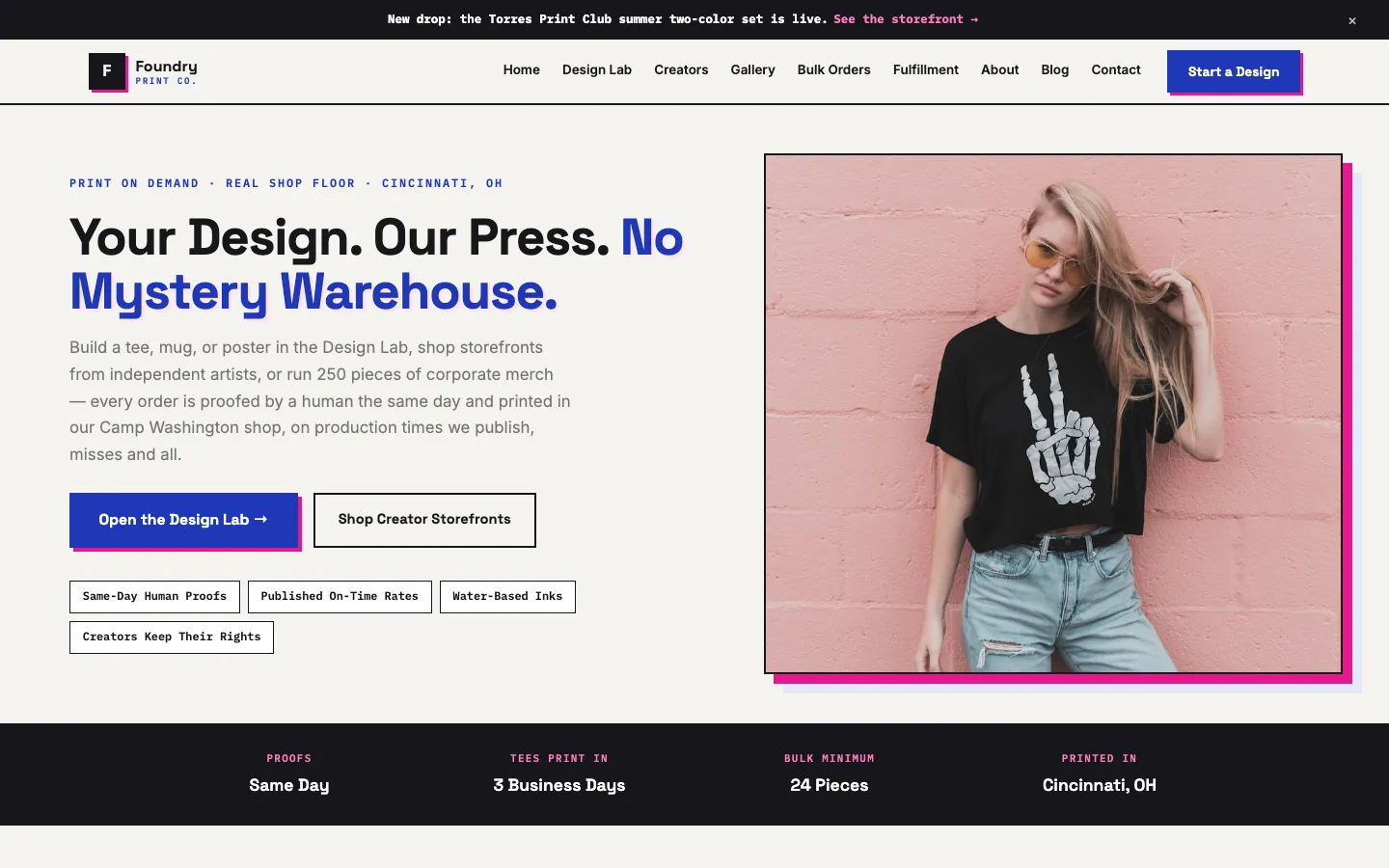
A press-black-and-riso-blue print-shop site from Cincinnati: an interactive design-your-own tee/mug/poster configurator with live pricing, independent creator storefront pages, a bulk & corporate quote flow, an ImageObject-schema design gallery, and a fulfillment page that publishes real production times.

Design-Your-Own Configurator + Creator Storefronts. Foundry Print Co. is the working example, with production windows, minimums and artwork specifications published as pages rather than quoted in a reply once somebody fills in a form.

Open the live demo → Print on Demand websites

Foundry Print Co. — live print on demand website built on WorkspaceCMS
Where the demand is

How print on demand buyers actually search

Print on demand carries a split personality that most marketing plans fail to account for. One buyer is a creator or small brand looking for storefronts, fulfillment and no inventory risk, and they evaluate you on production quality and how the payout works. The other is a purchasing coordinator ordering shirts for a tournament, a conference or a company onboarding kit, and they evaluate you on whether the boxes arrive before the date. Same press, same catalog, completely different pages required.

Deadline pressure shapes the search vocabulary in a way that is easy to exploit. Queries carry timeframes, minimum quantities and file-format anxiety inside them, because the searcher has been burned by a vendor who quoted a week and delivered in three. Publishing real production windows, real minimums and real artwork specifications is not a transparency gesture here; it is the primary conversion lever, and most competitors leave all three vague.

The calendar is brutal and predictable. Spring brings team and tournament ordering, late summer brings school and club season, the holiday quarter brings creator merch drops and corporate gifting, and every one of those windows closes hard on a shipping cutoff. Planning content and landing pages against those cutoffs, rather than reacting once orders arrive, is most of the difference between a busy season and a scramble.

The keyword clusters we build around

  • Bulk and corporate quotesTeam, event, uniform and company-swag searches carrying a quantity. These need a quote flow that asks about deadline and artwork up front.
  • Turnaround and rushDeadline-driven queries about rush production and shipping cutoffs. A published production-time page converts these better than any sales copy.
  • Product and decoration methodSearches naming a garment type or a print method. Buyers want to know which method suits their art and how it wears after washing.
  • Creator storefronts and fulfillmentIndependent creators looking for storefront hosting, print quality and how payouts and returns are handled.
  • Artwork and file preparationResolution, vector and color-matching questions. This content pulls searchers in early and prevents the back-and-forth that kills margin on small orders.
  • Local custom printingCity-attached searches from organizers who want to see a sample or collect an order in person. Worth owning if you have a shop address.
The campaign

Three ways we go get the traffic

Local SEO, AI-assistant visibility and paid media, run by the agency team that has been doing it since long before WorkspaceCMS existed.

Local SEO

Two journeys get built separately: the coordinator ordering shirts against a deadline, and the creator who wants storefronts and fulfillment without holding stock. Each needs its own entry pages and its own proof. Then the three things every buyer searches and most printers withhold, production windows by decoration method, minimum quantities and artwork specifications, get published as pages rather than offered in a reply. Seasonal cutoff pages go up while people are still planning, and where there is a shop address, the sample-and-collect searches from local organizers are unusually easy to convert.

AI search visibility

Find me a printer who can turn around two hundred shirts by Friday is exactly the sort of prompt assistants field, and they can only shortlist a shop that published the constraints. Rush windows, minimums, accepted file formats, color-matching policy and reprint terms therefore get written in the buyer's own phrasing. Method comparisons, screen printing against direct-to-garment against embroidery, and how each survives repeated washing, give AI Overviews something substantive to attribute instead of a design configurator no model can open.

Paid media

Creative here is the finished piece and the press behind it. Paid social performs on a folded stack coming off the dryer, an embroidery stitch-out close enough to count threads, a team opening a box of kit, and it can be aimed at coaches, event planners, school boosters and office managers by role rather than by vague interest. The calendar does most of the work: club and tournament ordering in spring, school and league season in late summer, creator drops and corporate gifting before the holidays, each hung on a rush cutoff. Creator collaborations double as proof and as distribution.

Campaigns are an add-on to a WorkspaceCMS plan and start from $499/mo. The plan itself is a monthly subscription. The build is included, the platform is not free. Local SEO campaigns are scoped to single and multi-location businesses rather than national or global SEO. Paid search management covers service businesses rather than online stores; ad spend is billed by Google or Meta directly to your own account. Full campaign scope → · Plan pricing →

What gets in the way

Six things that hold print on demand sites back

01

Turnaround times that live in an email reply

The single most common question in this category is how fast, and most print sites will not answer it without a form. Publishing real production windows per method turns a research visit into a quote request.

02

A configurator no crawler can enter

An interactive design tool is a fine conversion experience and a terrible landing page. The products, methods and price structure behind it need indexable pages of their own, or the tool is a room with no door.

03

Creator and corporate buyers sharing one page

A homepage that tries to speak to an artist selling forty shirts and a procurement coordinator ordering four hundred convinces neither. These need separate entry points with separate proof.

04

Minimums that only appear at checkout

Discovering a minimum after building a mockup is the fastest way to lose a buyer permanently. Stating it on the product page filters out the wrong orders and builds trust with the right ones.

05

Seasonal cutoffs published too late

Holiday and school-season shipping deadlines are searched weeks before they matter. If your cutoff page goes up the week it applies, the traffic has already been captured by somebody else's page.

06

Design galleries with no readable context

Rows of images with generic file names describe nothing to a search engine or an assistant. Captions naming the garment, the method and the use case turn a gallery into an entry point.

Campaign add-ons

Pick the campaign that fits the market

Every package below is bought from your dashboard once your site is live. Names, prices and deliverables are read from the catalog at page load, so what you see here is what you would be buying.

Questions

Print on Demand marketing, answered

Should we publish our minimums and turnaround times?

Yes, and for most print sites it is the single highest-value change available. Those two facts are what buyers search, what assistants need before they will recommend you, and what filters out the orders you did not want. Vagueness protects nothing here; it simply hands the quote to whoever answered.

How do we stop artwork problems from eating the margin on small orders?

By publishing resolution, vector and color-matching requirements as real content instead of repeating them in email. File-preparation guides pull searchers in early, arrive before the first proof, and remove most of the back-and-forth that makes a modest order unprofitable to produce.

Our design configurator is the best thing on the site. Why does it bring no traffic?

Because an interactive tool is a fine conversion experience and a terrible landing page. Nothing inside it is readable from outside, so the garments, decoration methods and pricing structure behind it need indexable pages of their own or the tool is a room with no door.

When do school and holiday cutoff pages need to be live?

Weeks before they apply, because organizers search shipping deadlines while they are still planning the order. A cutoff page that appears in the week it takes effect is competing for traffic that was captured by somebody else's page a month earlier.

Do creators and corporate buyers really need separate pages?

They do, because they judge you on different things. A creator is evaluating print quality, storefront hosting and how payouts work, while a purchasing coordinator only cares whether the boxes land before the date. One page attempting both convinces neither reader.

Your free site is one click away

Ready to grow a print on demand business?

Get the site built, then put a campaign behind it. Start online, or talk it through with a strategist first.

Want the full picture? See what a campaign includes