
Growth campaigns · Industrial Supply

Website Marketing for Industrial Supply Distributors

A line is down and a supervisor is standing at the machine, reading a number off a broken seal into a phone. The order goes to whoever can prove the fitment and put the part on a counter today, and that is the result this campaign is built to be.

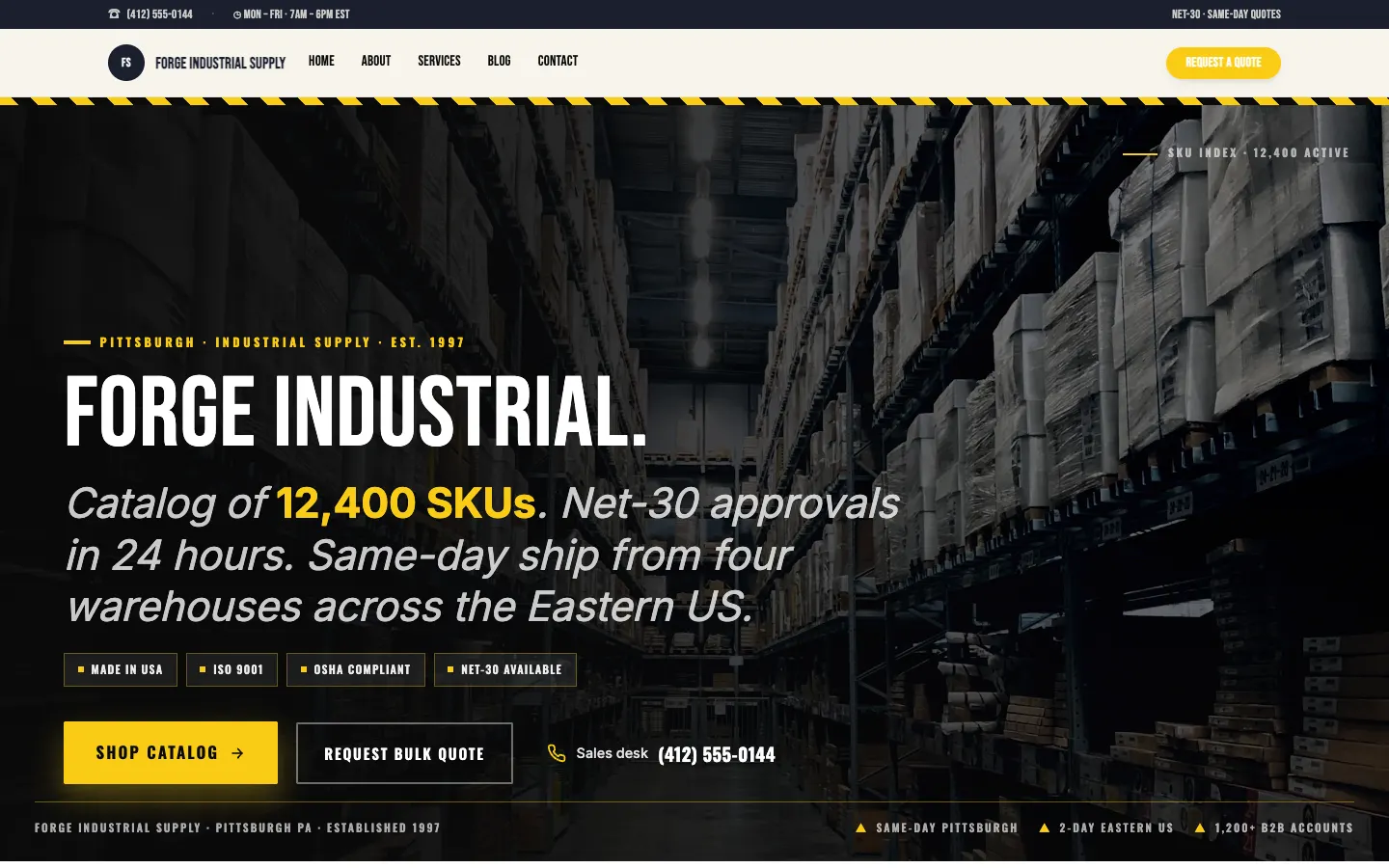
Live Industrial Supply demo

Forge Industrial Supply

Pittsburgh industrial-supply e-commerce with Net-30 quoting, same-day fitment, and a fleet/contractor portal.

Net-30 Quote Builder. Forge Industrial Supply carries the shape this points at, with a quote builder that asks a technician and a buyer different questions and fitment answers sitting on pages a pasted part number can actually land on.

Open the live demo → Industrial Supply websites

Forge Industrial Supply — live industrial supply website built on WorkspaceCMS
Where the demand is

How industrial supply buyers actually search

Almost nothing in industrial distribution starts as a category search. It starts as a string: a manufacturer part number, a cross-reference from a competitor's catalog, or a spec written out longhand because the plate on the equipment is unreadable. The person typing it is a maintenance supervisor, a purchasing agent or a shop foreman, and the query is a lookup, not a comparison. Whoever owns that string in the index gets the order, which is why catalog depth is a marketing asset here and not just an inventory problem.

The buying process then splits in a way consumer retail never does. The person who needs the part is rarely the person authorized to spend, so the site has to serve a technical searcher and a procurement approver from the same page: fitment and specification for one, terms, tax exemption, purchase orders and net billing for the other. A quote flow that captures both readers is worth more than any amount of homepage polish.

Seasonality follows the plant calendar rather than the retail one. Turnaround and shutdown windows generate concentrated bursts of consumables and spares demand, and the closing weeks of a fiscal year push budget-flush purchasing that has to be spent or lost. Meanwhile the national catalog houses outrank everyone on generic terms, so the winnable ground is the intersection of specific part data, local same-day availability, and a contractor or fleet relationship the big houses do not staff for.

The keyword clusters we build around

  • Part number and cross-referenceExact MPN lookups and competitor cross-references. These need indexable product pages carrying the number, the alternates it supersedes and the equipment it fits.
  • Spec-led searchesThread size, material grade, pressure rating and temperature range typed as a phrase. These land best on filtered category pages that read as real pages, not as query strings.
  • Same-day and local availabilitySearches with a city or a will-call intent behind them. The counter, the delivery radius and the cutoff time need to be stated in text.
  • Account and termsNet billing, purchase orders, tax exemption and contractor pricing. Procurement is checking whether you can transact the way their system requires before anyone talks parts.
  • Fleet and contractor programsRecurring-supply and managed-inventory searches from fleets and trade contractors, where the sale is a relationship rather than a single order.
  • Application and troubleshootingHow-to and failure-mode queries from technicians. These build the technical authority that makes the catalog pages credible.
The campaign

Three ways we go get the traffic

Local SEO, AI-assistant visibility and paid media, run by the agency team that has been doing it since long before WorkspaceCMS existed.

Local SEO

Nothing ranks until the catalog escapes the internal search box. Product pages become crawlable with the manufacturer number, the numbers they supersede and the equipment they fit written as text, then spec-led pages get built around thread size, material grade, pressure rating and temperature range the way a foreman types them. Counter and service-area pages state the will-call cutoff and the delivery radius, and troubleshooting guides catch the technician who is still diagnosing a failure mode and has no part number to search yet.

AI search visibility

Buyers increasingly ask an assistant to identify a component from a description, or to name a regional distributor who stocks a line, and assistants read text rather than scanned datasheets. Specification tables therefore get published as text, supersession lists get stated plainly, and freight, minimum order, tax exemption and return handling get written as sentences a model can lift whole. A distributor whose terms and stock depth are readable gets named by Perplexity or an AI Overview; one whose catalog sits behind an account login simply cannot be.

Paid media

Paid social here is account recruitment rather than storefront traffic. The audiences worth buying are maintenance leads, fleet managers and trade contractors on the professional networks, and the creative that reaches them is deliberately unglamorous: a walkthrough of the will-call counter at seven in the morning, a kitted shutdown pallet, a short piece on cross-referencing a number that has been discontinued. Association placements and video timed to turnaround season carry more weight than product photography, and anything pointed at the catalog itself is worth planning with the team before it runs.

Campaigns are an add-on to a WorkspaceCMS plan and start from $499/mo. The plan itself is a monthly subscription. The build is included, the platform is not free. Local SEO campaigns are scoped to single and multi-location businesses rather than national or global SEO. Paid search management covers service businesses rather than online stores; ad spend is billed by Google or Meta directly to your own account. Full campaign scope → · Plan pricing →

What gets in the way

Six things that hold industrial supply sites back

01

A catalog that exists only behind a search box

If products render through an internal search that produces no crawlable page, the entire catalog is invisible to everything outside your site. Every part number you stock is a term you are not competing for.

02

Cross-references nobody wrote down

Your counter staff know which of your items replaces a competitor's number. That knowledge lives in their heads and on paper. Published as alternates on the product page, it is one of the cheapest sources of qualified traffic in this category.

03

Quote flows that ask a technician for procurement data

A form demanding a purchase order number and tax status from someone who just needs a seal kit stops the request cold. Two paths, one technical and one commercial, convert far better than one long form.

04

Terms and account setup buried below the fold

Procurement decides whether you are transactable before anyone evaluates your prices. If net terms, purchase orders and exemption handling are not stated plainly on their own page, you lose accounts you never knew were evaluating you.

05

Competing with national catalogs on generic terms

Trying to outrank the big houses for broad category words burns the whole effort. The winnable positions are specific numbers, specific applications and the local availability those catalogs cannot claim.

06

Shutdown demand hitting a static site

Turnaround season and fiscal year-end produce short, intense buying windows. Without stocking pages and consumables lists prepared in advance, the surge goes to whoever published first.

Campaign add-ons

Pick the campaign that fits the market

Every package below is bought from your dashboard once your site is live. Names, prices and deliverables are read from the catalog at page load, so what you see here is what you would be buying.

Questions

Industrial Supply marketing, answered

Do we have to expose pricing to compete on part-number searches?

No. Plenty of distributors run quote-only pricing and still own their numbers, because the matching signal is the part data rather than the price. What does need to be public is the specification, the fitment, the alternates and how a buyer transacts with you, and if pricing sits behind an account, the page should say so.

Our counter staff know every cross-reference. How does that become traffic?

By being written onto the product page as published alternates. That knowledge currently lives in their heads and in a binder, and each competitor number it replaces is a search somebody is running right now. It is the cheapest qualified traffic available in this category and nobody else in your market has bothered.

How should we prepare for turnaround and shutdown season?

By publishing the stocking lists and consumables pages before the window opens rather than while the phones are ringing. Shutdown demand is concentrated and predictable, and the supplier whose kitting and availability pages were already indexed takes it while everyone else is quoting from a spreadsheet.

Procurement asks about net terms before anyone discusses parts. Where does that live?

On its own page, stated plainly: purchase orders, net billing, tax exemption handling and how an account gets opened. Procurement decides whether you are transactable before they evaluate a single price, and that evaluation happens without anyone contacting you, so burying it below the fold costs accounts you never knew were considering you.

Is there any way to beat the national catalog houses?

Not on broad category words, and chasing them burns the whole effort. The winnable ground is exact manufacturer numbers, competitor cross-references, application queries and anything carrying same-day or local intent, which is precisely the territory a national warehouse cannot claim credibly.

Your free site is one click away

Ready to grow a industrial supply business?

Get the site built, then put a campaign behind it. Start online, or talk it through with a strategist first.

Want the full picture? See what a campaign includes