Growth campaigns · Title & Escrow

Website marketing for title and escrow companies

Most files are directed by a listing agent or a loan officer, while the buyer footing the settlement charge increasingly asks what the policy even covers. The campaign has to satisfy an operator judging turn times and a nervous first-time buyer, without ever resembling an inducement.

Live Title & Escrow demo

Keystone Title & Escrow

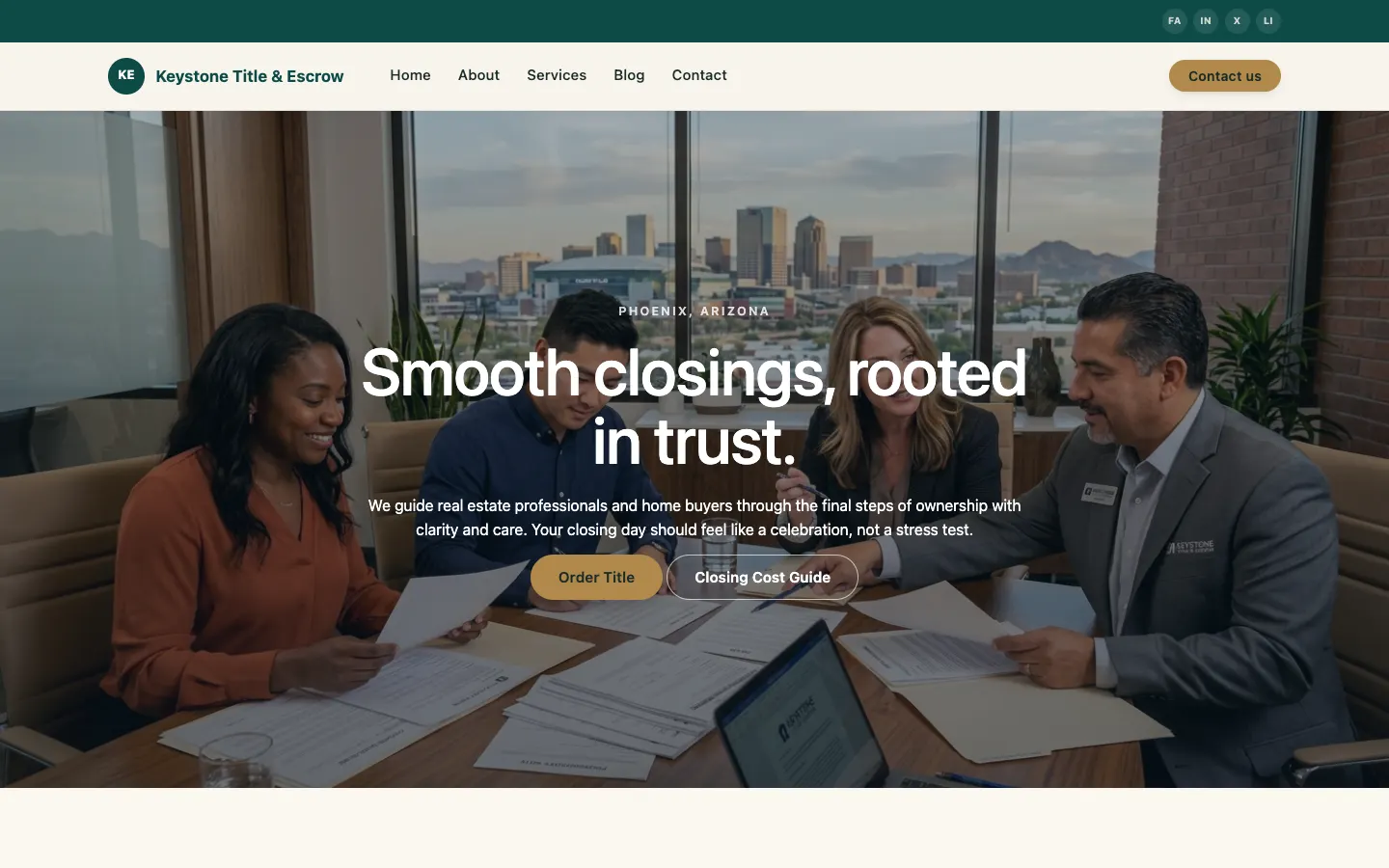
A deep-teal-and-brass title insurance and escrow site for Phoenix, built around the four people in a closing: realtors, lenders, buyers, and sellers. Owner's and lender's policies explained in plain English, a five-step closing timeline, a wire-fraud protection band, a closing-cost line-item breakdown, and an order-title intake form.

Order-Title Intake Form + Five-Step Closing Timeline. Keystone Title and Escrow is the reference build for this campaign: an order intake form that removes friction for referral partners, plus a closing timeline and line-item fee breakdown that answer the consumer searches most title sites ignore.

Open the live demo → Title & Escrow websites

Keystone Title & Escrow — live title & escrow website built on WorkspaceCMS
Where the demand is

How title & escrow buyers actually search

The defining oddity of this vertical is that the consumer usually is not the chooser. Most files are directed by the listing agent or the lender, which means the highest-value marketing audience is a small, known, local set of professionals rather than an anonymous search population. Anything published for that audience is judged on operational credibility: turn times, whether the file is worked by a named escrow officer, how curative issues get communicated, whether wire instructions are handled in a way that will not create a Monday morning emergency. Marketing that reads as consumer advertising simply does not register with them.

At the same time the consumer side has genuinely opened up. Buyers now search whether they can choose their own title company, who pays for the owner's policy in their state, what a closing disclosure line item covers, and whether they need an owner's policy at all. Those questions are asked because the fees are visible and unexplained, and almost no title company answers them in plain language on a public page. The company that does becomes the one the buyer names, and being named by a buyer is the one way to bypass the referral gatekeeping entirely.

There is also a compliance boundary that shapes everything. Federal rules restrict giving anything of value in exchange for settlement service referrals, so the marketing lever cannot be an incentive; it has to be education, service transparency and genuine tools for the professional. Add wire fraud, which is now the first thing an anxious buyer has heard about, and the site's job becomes clear: prove operational competence to referral partners, remove fee mystery for consumers, and make the security posture obvious to everyone before any money moves.

The keyword clusters we build around

  • Closing cost and fee questionsWho pays for the owner's policy, what each settlement line item is, what an escrow fee covers. The highest-volume consumer intent in the vertical and the least well answered.
  • Choice-of-title queriesBuyers and sellers discovering they may select their own settlement provider. Rare, valuable, and the only search path that routes around the referral relationship.
  • Realtor and lender partner termsProfessionals evaluating a title partner on turn times, communication and order convenience. Written for an operator, not a homeowner.
  • Wire fraud and closing securityAnxious buyers and cautious agents searching how funds are transmitted safely. Answering directly builds trust faster than any general reassurance copy.
  • Transaction-type specificsCommercial closings, new construction, refinance transactions, probate or trust sales, exchanges. Each has a distinct process worth its own page.
  • Local market presenceCity and county searches from both buyers and professionals, plus map-pack visibility for the branch that actually handles the closing.
The campaign

Three ways we go get the traffic

Local SEO, AI-assistant visibility and paid media, run by the agency team that has been doing it since long before WorkspaceCMS existed.

Local SEO

Two tracks, kept deliberately apart. The consumer track answers who customarily pays for the owner's policy in your state, what each settlement line item covers, and whether a buyer may select their own provider at all. The professional track speaks to agents and loan officers about curative timelines, how a title issue surfaces mid-escrow, and how an order gets opened. Named escrow officer pages carry the loyalty agents actually feel toward a person, and county pages match the way both audiences search.

AI search visibility

Closing questions are ideal assistant queries because they feel procedural and slightly embarrassing to ask the professional holding your money. A company that has published who pays for what in its state, what an escrow fee covers, and the sequence from opening a file to funding becomes the source an AI Overview or Perplexity lifts from. Reviews, structured service and location markup, and FAQs written as direct answers all help. The wire verification page, phrased as what your office will never do by email, is the one both assistants and anxious buyers reach for.

Paid media

Referral rules set the creative brief before anything else: ads may offer education and service, never anything of value tied to directed business. Inside that, spend stays county-tight and intent-led, covering transaction-type searches, order and branded terms, and the choice-of-provider queries that route around the gatekeeper entirely. A modest presence on paid social around brokerage and association activity reaches the people actually directing files, who are a known local audience rather than an anonymous market.

Campaigns are an add-on to a WorkspaceCMS plan and start from $499/mo. The plan itself is a monthly subscription. The build is included, the platform is not free. Local SEO campaigns are scoped to single and multi-location businesses rather than national or global SEO. Paid search management covers service businesses rather than online stores; ad spend is billed by Google or Meta directly to your own account. Full campaign scope → · Plan pricing →

What gets in the way

Six things that hold title & escrow sites back

01

The buyer is not the one choosing

Most files come directed by an agent or lender, so a site written entirely for homeowners speaks to whoever has the least say. Building a genuine professional section, addressed to the people directing the business, is usually the single highest-value change to make.

02

Referral rules limit the obvious tactics

Settlement service referrals cannot be bought with things of value, which rules out the incentive-based marketing common elsewhere. The compliant lever is education and service quality, and the campaign has to be designed around that constraint rather than tiptoeing near it.

03

Fees presented as a mystery

Buyers see settlement charges on a disclosure and cannot tell what any of them are for. Companies that publish a plain line-item explanation defuse the most common complaint in the vertical and pick up a large body of consumer search at the same time.

04

Wire fraud fear with no visible answer

Every buyer has now been warned about fraudulent wire instructions and arrives nervous. If the site does not state clearly how instructions are verified and what the company will never do by email, that anxiety attaches to the closing itself.

05

No visible escrow officers

Agents work with people, not brands, and they route files to the officer who returns calls. A site that hides the escrow team behind a generic contact address gives a referral partner nothing to attach loyalty to and loses the name searches entirely.

06

Ordering is a phone call and a fax number

When placing an order is harder than at the competitor down the road, convenience quietly decides where files go. A working order-title intake path that captures what the office needs to open a file removes friction from the exact moment a partner is deciding.

Campaign add-ons

Pick the campaign that fits the market

Every package below is bought from your dashboard once your site is live. Names, prices and deliverables are read from the catalog at page load, so what you see here is what you would be buying.

Questions

Title & Escrow marketing, answered

Should the site talk to buyers or to the agents and lenders directing files?

Both, on clearly separate tracks. The professional section influences where files are sent; the consumer section catches buyers researching settlement charges and provider choice on their own. Mixing the two voices on one page is why most title sites persuade neither reader.

Does marketing to referral partners create a compliance problem?

Education, transparency and genuinely useful tools sit well inside the line. Anything resembling payment for directed business does not, and we do not build campaigns around inducements. Partner-facing material goes to your compliance reviewer before it publishes.

Buyers arrive terrified of wire fraud. What should we publish?

A page written from your actual verification procedure: how instructions are confirmed, what your office will never send by email, and what a party should do on receiving suspicious instructions. It calms buyers and gives agents something they can forward before closing week.

Our escrow officers sit behind a general contact address. Does that cost us?

It costs the name searches and some of the loyalty. Agents route files to the officer who returns calls, and when that person has no page, a referral check finds a brand instead of the individual the agent was actually recommending.

Agents say opening an order with us is harder than with the competitor down the street. Is that a marketing problem?

It becomes one at the moment a partner is choosing. An order intake path that captures what your office needs to open a file removes the friction that quietly decides where the next transaction is directed, regardless of how good the closing itself is.

Your free site is one click away

Ready to grow a title & escrow business?

Get the site built, then put a campaign behind it. Start online, or talk it through with a strategist first.

Want the full picture? See what a campaign includes