Growth campaigns · Insurance Agency

Website marketing for independent insurance agencies

Aggregators own the rate-shopping click and resell the same submission to several agencies. An independent wins somewhere else: on the certificate a contractor needs before Monday, on the classes it genuinely writes, and on picking up when a carrier non-renews a whole book.

Live Insurance Agency demo

Heritage Insurance Group

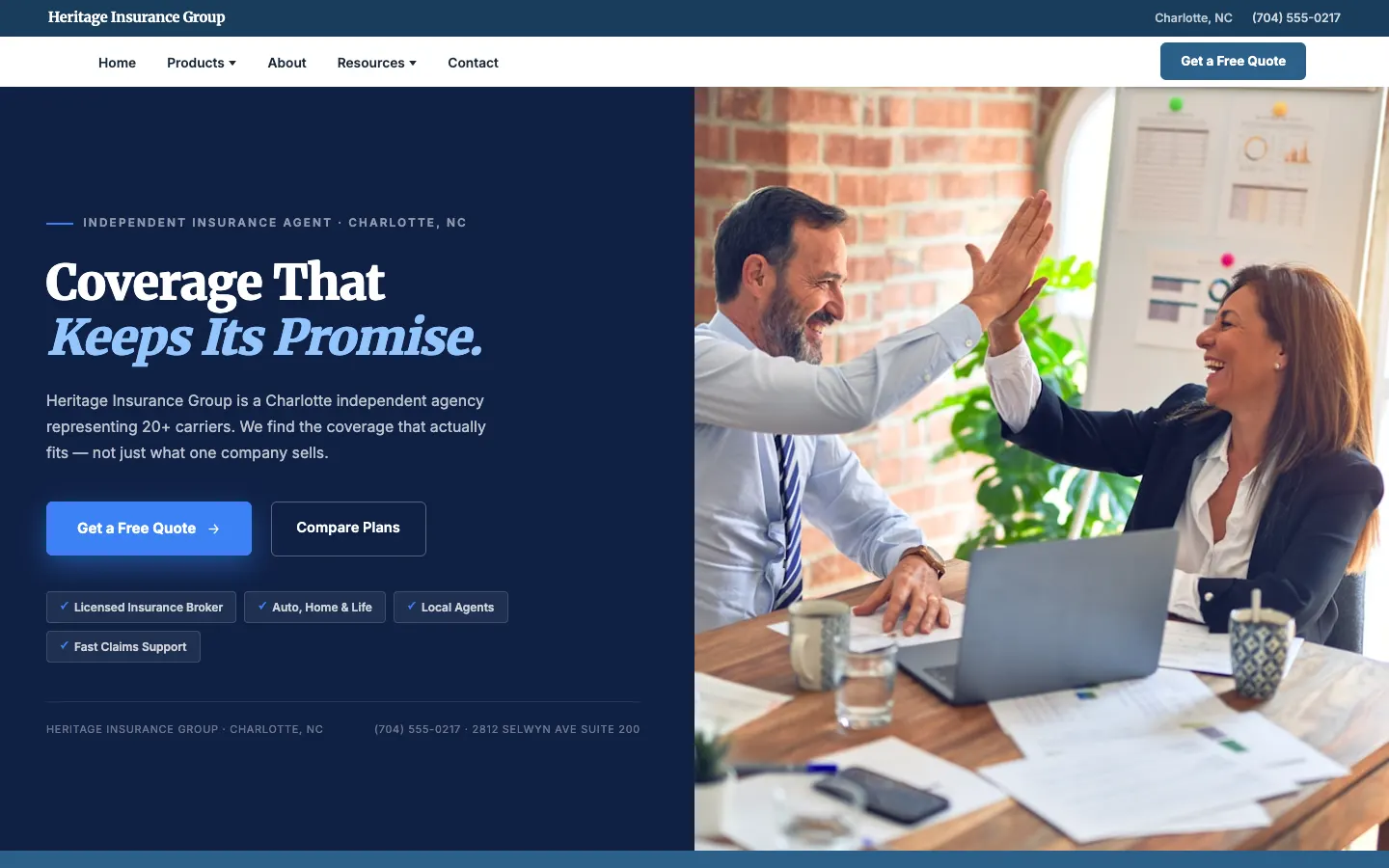
A steady-blue independent insurance site with product comparison cards, agent bios, and trust signals for multi-line coverage.

Multi-Line Product Comparison Cards. Heritage Insurance Group is built the way this campaign wants a site built: multi-line comparison cards that state what the agency actually writes, agent bios that carry producer search, and a contact path that separates a quote from a service request.

Open the live demo → Insurance Agency websites

Heritage Insurance Group — live insurance agency website built on WorkspaceCMS
Where the demand is

How insurance agency buyers actually search

Personal lines and commercial lines behave like two different businesses that happen to share an office. Personal lines search is dominated by rate shopping and by aggregators with budgets no local agency can match, and the intent behind "cheap auto insurance" is exactly what it says. Commercial is the opposite: a contractor searching for general liability with a specific certificate requirement, a restaurant that has just been told it needs liquor liability, a trucking operation looking for a broker who understands its filings. Those searches are narrow, expensive to serve badly, and largely ignored by the aggregators, which makes them the natural centre of an independent agency's campaign.

The market cycle drives demand in a way that is unique to this vertical. When carriers tighten appetite, raise deductibles or non-renew whole books, the phone rings with people who did not choose to shop. Homeowners in wildfire and coastal areas, contractors dropped mid-term, small businesses facing a property increase they cannot absorb. An agency that has published something useful about what to do when a policy is non-renewed captures a wave of demand that arrives without warning and disappears again when the market softens.

The independent agency's actual advantage is choice across carriers, and most agency sites bury it. A visitor cannot tell which carriers are represented, which classes of business the agency writes, or whether their situation is one the agency wants. Meanwhile the same visitor is being retargeted by three aggregators. Making appetite explicit, by line and by class, does more for qualified enquiry volume than any amount of general insurance content, and it also stops the agency wasting service time on submissions no carrier will take.

The keyword clusters we build around

  • Commercial lines by classContractor general liability, restaurant packages, trucking, habitational, professional liability. Specific, high-value, and the ground aggregators do not really contest.
  • Certificate and compliance urgencySomeone who needs proof of coverage to start a job or sign a lease, often today. Fast-converting queries that need a clear same-day contact path rather than a quote form.
  • Non-renewal and market disruption"My insurer dropped me", coastal and wildfire property, mid-term cancellations. Involuntary shoppers who need explanation before they need a quote.
  • Bundling and life-change personal linesNew home, new driver in the household, a move across state lines. Better fit than raw rate shopping because the trigger is a change, not a price comparison.
  • Independent agent and carrier-choice termsPeople specifically looking for someone who can shop multiple carriers rather than a single brand. The clearest expression of what an independent agency is for.
  • Local and map-pack intentCity and neighbourhood searches for an agency someone can visit or call. Still meaningful for personal lines and for small commercial accounts.
The campaign

Three ways we go get the traffic

Local SEO, AI-assistant visibility and paid media, run by the agency team that has been doing it since long before WorkspaceCMS existed.

Local SEO

The map is drawn by line and class rather than by product category. Contractor general liability, restaurant packages with liquor liability, habitational risk, motor carrier filings: naming what you write is what makes appetite searchable. Around that sit coverage explainers for the questions asked before anyone shops, a non-renewal page held ready for the next time carriers tighten in coastal or wildfire territory, producer pages catching specialist and post-referral name searches, and a correctly categorised profile carrying the map pack for small personal lines work.

AI search visibility

Coverage questions feel safer asked of a machine than of someone earning a commission, which is why assistants receive so many of them. Being the cited answer means having written what a class of business actually needs, what an additional-insured endorsement obliges, and why a certificate holder is asking in the first place. Aggregators publish comparison funnels, so the explanatory ground sits empty. Structured service and location data, licensed agent credentials, and honest answers about what you can and cannot place are what put an agency into those responses.

Paid media

What usually goes wrong is bidding on cheap auto insurance against comparison sites with national budgets. Spend concentrates instead on commercial classes, same-day certificate urgency, non-renewal windows when a carrier exits a territory, and defence of the agency and producer names. Paid social carries the life-change targeting personal lines actually deserves: a move across state lines, a teenage driver added to the household, a first commercial lease. Those reach demand at the moment it changes rather than at the moment it price-shops.

Campaigns are an add-on to a WorkspaceCMS plan and start from $499/mo. The plan itself is a monthly subscription. The build is included, the platform is not free. Local SEO campaigns are scoped to single and multi-location businesses rather than national or global SEO. Paid search management covers service businesses rather than online stores; ad spend is billed by Google or Meta directly to your own account. Full campaign scope → · Plan pricing →

What gets in the way

Six things that hold insurance agency sites back

01

Aggregators outbid you on every personal-lines term

Comparison sites bid on the volume keywords and resell each submission to several agencies. Matching them on price shopping terms is not viable for a local agency, so the campaign concentrates on commercial classes, life-change triggers and coverage questions where a real agent is the better answer.

02

The site never states carrier appetite

Visitors cannot tell which lines and classes the agency writes, so unfit submissions arrive and fit prospects assume they will not be helped. Publishing appetite by line and class filters the inbox and gives the SEO programme something specific to rank for at the same time.

03

Quote forms that ask for everything

A long form demanding VINs, prior carrier history and effective dates before anyone has spoken is a wall in front of the enquiry. Splitting the path so an urgent certificate request or a coverage question can be sent in a few fields recovers submissions that were being abandoned halfway.

04

Nothing published for a hard market

When carriers pull back, involuntary shoppers search for explanation first and quotes second. Agencies with no page about non-renewals, deductible changes or coverage gaps miss the entire wave, then see it end before the content is written.

05

Producers with no individual presence

Commercial accounts are placed by people with class expertise, and prospects search producers by name after a referral or an association meeting. When producers have no page, the agency loses both the referral check and the specialist queries their expertise would win.

06

Service work drowns new business

Endorsements, certificates and renewal questions arrive through the same contact form as prospects, so the account team triages instead of the campaign performing. Separating service and sales paths on the site is a marketing fix disguised as an operations one.

Campaign add-ons

Pick the campaign that fits the market

Every package below is bought from your dashboard once your site is live. Names, prices and deliverables are read from the catalog at page load, so what you see here is what you would be buying.

Questions

Insurance Agency marketing, answered

Can an independent agency really compete with the comparison sites?

Not on the price-shopping phrases they dominate, and any agency told otherwise should ask harder questions. The winnable ground is commercial classes, coverage explanation, urgent certificate requests and market-disruption searches, which produce accounts rather than one-term rate shoppers.

Should the campaign lead with commercial lines or personal lines?

Commercial usually leads, because the classes are specific enough to rank for and the aggregators barely contest them. Personal lines is served through life-change triggers and bundling instead of rate terms, unless your book is deliberately built the other way round.

Who checks that the coverage content is technically right?

Your team does, before anything publishes. Coverage explanation has to reflect your carriers, your appetite and your state, so nothing goes live on a technical page without an agency sign-off, and we do not publish comparative or superlative claims about carriers.

Certificate requests and endorsements swamp our contact form. Can that be fixed on the site?

Yes, by splitting service from sales. An existing client needing a certificate today and a prospect asking about restaurant coverage should not arrive through the same inbox, or the account team triages while new business sits behind them.

A carrier just pulled out of our coastal territory. What should the site do about it?

Publish the explanation before the phone starts. Involuntary shoppers search what happened and what their options are before they ask for a quote, and an agency with a written non-renewal page catches a wave that ends before slower competitors finish drafting.

Your free site is one click away

Ready to grow a insurance agency business?

Get the site built, then put a campaign behind it. Start online, or talk it through with a strategist first.

Want the full picture? See what a campaign includes