Growth campaigns · Commercial Solar & Storage

Growth campaigns for commercial solar and storage installers

Facilities managers and energy buyers do not shop for solar the way homeowners do. They shortlist, they ask for engineering detail, and they take it to a committee. This campaign is built for that buyer.

Live Commercial Solar & Storage demo

SunWright Solar — Commercial

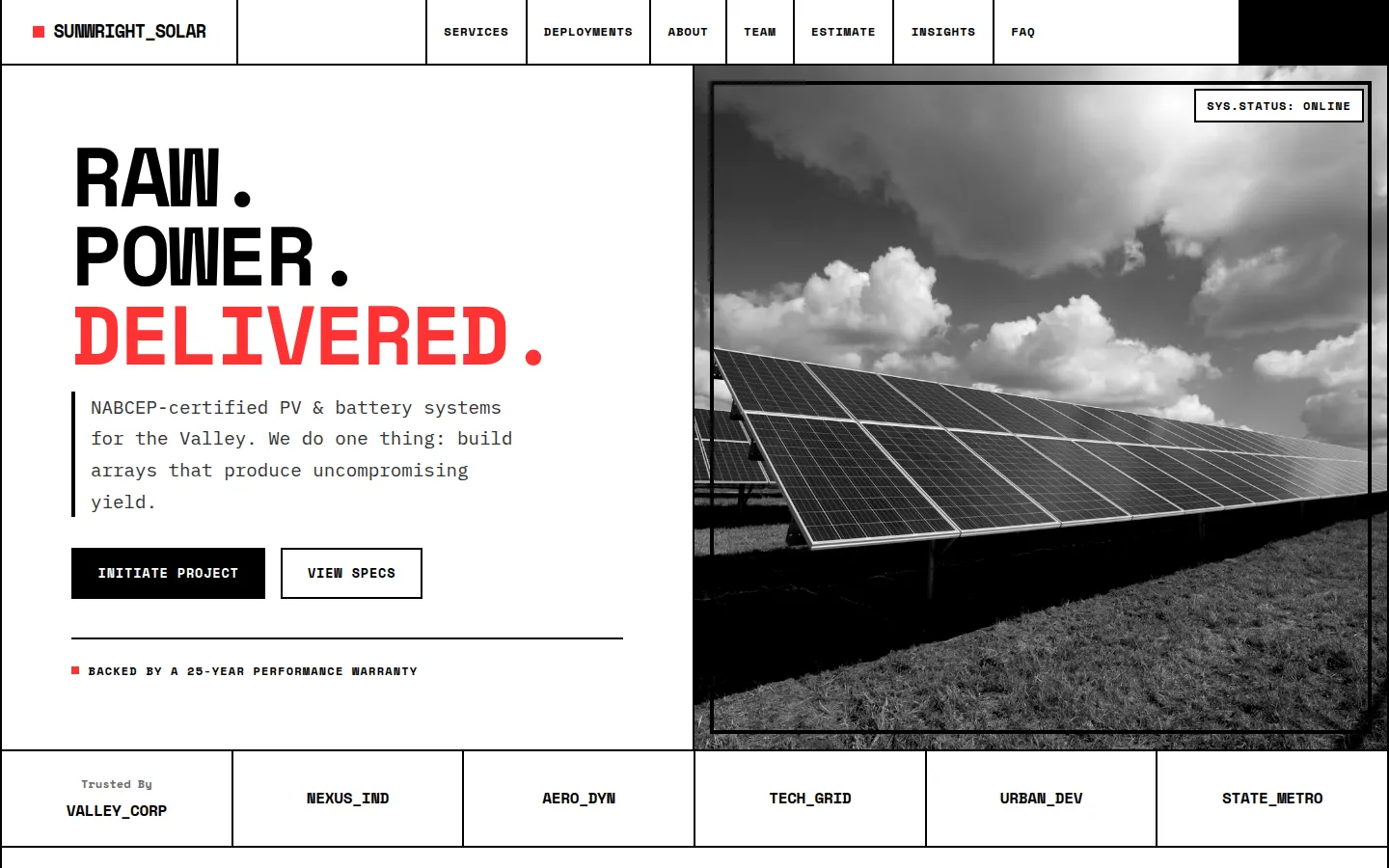
The same Phoenix solar brand rebuilt in a raw brutalist system of hard 2px black rules, monospace spec tables, and a single red accent, aimed at facilities managers rather than homeowners. Per-service and per-deployment detail pages carry full engineering specs, and a Yield Estimator models system size, production, and 25-year value.

Yield Estimator + Engineering Spec Tables. SunWright Solar is the campaign target made visible: a Yield Estimator and full engineering spec tables give a facilities manager something to interrogate and forward, which is exactly what the organic and AI work is built to send them to.

Open the live demo → Commercial Solar & Storage websites

SunWright Solar — Commercial — live commercial solar & storage website built on WorkspaceCMS
Where the demand is

How commercial solar & storage buyers actually search

The commercial solar buyer is almost never the person who pays the bill. A facilities director notices a demand charge climbing, an operations VP hears that a utility has filed for a rate change, or a sustainability lead is handed a reporting target, and the search begins there. What they type reflects the job rather than the product: interconnection queue timelines, demand charge management, peak shaving with storage, whether a roof can carry ballasted racking. Very little of that vocabulary overlaps with residential solar, and a site written for homeowners will not surface for any of it.

The sales cycle runs on the buyer's fiscal calendar, not on weather. Feasibility conversations cluster where capital budgets are being drafted, then go quiet while a board or an ownership group reviews. That gap is the whole marketing problem. A prospect who spoke to you in the spring is still evaluating in the autumn, and in between they are reading your engineering pages, forwarding a spec table to a consulting engineer, and comparing your production modelling against a competitor's. The content has to keep selling with nobody in the room.

You are also bidding against companies with very different economics. National EPCs with in-house development teams, project developers who want to own the asset rather than sell it, and lead brokers reselling the same enquiry to several installers all compete for the same terms. The way a regional installer wins is specificity: named utility territories, real interconnection experience, storage dispatch strategy explained rather than asserted, and modelling a prospect can interrogate instead of a brochure PDF.

The keyword clusters we build around

  • Demand charge and bill reductionAn energy or facilities lead trying to understand what solar plus storage does to a commercial utility bill. Point them at explainer content and the yield modelling tool, not at a contact form.
  • Storage and resilienceSearches about backup power, peak shaving and dispatch strategy. These convert slowly but they are the highest-value projects, and they deserve their own pages rather than a paragraph on the solar page.
  • Engineering and specificationRacking types, module and inverter selection, structural loading, interconnection process. Written for the engineer who will be asked to sanity-check your proposal.
  • Segment and building typeWarehouse, cold storage, manufacturing, agricultural, municipal and school district pages. Each has a different load profile and a different procurement path.
  • Incentive and procurement navigationBuyers searching how the financing and incentive process works, and what a PPA or lease commits them to. Answer plainly; this is where trust is won.
  • Service territoryMetro and utility-territory pages that establish where you actually build, so an enquiry from outside your footprint is filtered before it costs you a site visit.
The campaign

Three ways we go get the traffic

Local SEO, AI-assistant visibility and paid media, run by the agency team that has been doing it since long before WorkspaceCMS existed.

Local SEO

Organic work targets the language of the buyer's job rather than the product category: utility territory pages, building-type pages, and engineering explainers on racking, interconnection and dispatch. Because scope here is local and multi-location rather than national, the structure follows your real service footprint. Deep specification content is what earns links from engineering and industry sources, and it is what keeps a stalled deal warm through a budget cycle.

AI search visibility

Assistants get asked to compare commercial solar approaches and to explain what storage does to a demand charge, and they cite sources that publish real specifics. Structured service and location data, an FAQ that answers procurement questions directly, published module and inverter detail, and modelling assumptions stated in the open all make a firm quotable. Vague sustainability copy gives an assistant nothing to lift, so it lifts a competitor instead.

Paid media

Paid search on commercial solar terms is expensive and heavily brokered, so it is used selectively against high-intent utility and building-type queries rather than broad category terms. Management covers Google Ads, Local Services Ads where eligible, and paid social for segment targeting; the ad budget itself sits in your own advertising account so you keep the history and the audiences. Retargeting matters more here than first-touch, because the buying committee returns repeatedly.

Campaigns are an add-on to a WorkspaceCMS plan and start from $499/mo. The plan itself is a monthly subscription. The build is included, the platform is not free. Local SEO campaigns are scoped to single and multi-location businesses rather than national or global SEO. Paid search management covers service businesses rather than online stores; ad spend is billed by Google or Meta directly to your own account. Full campaign scope → · Plan pricing →

What gets in the way

Six things that hold commercial solar & storage sites back

01

Residential copy suppressing commercial enquiries

Most solar sites were written for homeowners and later had a commercial tab bolted on. Search engines read the site as residential, and the commercial page inherits none of the authority. The fix is a genuine commercial section with its own service pages, its own vocabulary and its own internal linking, not one page hanging off the main navigation.

02

A pipeline that outlasts the campaign report

When a deal takes multiple budget cycles to close, monthly reporting on form fills tells you nothing useful. Attribution has to survive the gap: content engagement, returning visits from the same organisation, and which engineering page the eventual signer read first.

03

Lead brokers reselling your enquiry

Aggregators bid on the same commercial terms and sell the resulting enquiry to several installers at once. Competing on ad spend against that model is a losing trade. Ranking organically for the engineering and utility-specific questions they cannot answer is how you get the enquiry before the broker does.

04

Proposals that cannot be forwarded

The person who contacts you is rarely the decision maker. If your modelling and specification live only in a PDF attached to an email, the internal champion has nothing to circulate. Public, well-structured engineering content lets the buyer sell you internally when you are not there.

05

Territory and utility mismatch

An interconnection process that works in one utility territory means very little in the next one. Traffic from outside where you actually build burns sales time. The campaign needs geography built into the content structure so the enquiries that arrive are ones you can serve.

06

Storage treated as an accessory

Storage is often presented as an upsell on the solar page, so the site never ranks for dispatch, resilience or peak management questions. Those searches come from buyers with an operational problem and a budget already identified, and they are the projects worth building the campaign around.

Campaign add-ons

Pick the campaign that fits the market

Every package below is bought from your dashboard once your site is live. Names, prices and deliverables are read from the catalog at page load, so what you see here is what you would be buying.

Questions

Commercial Solar & Storage marketing, answered

How long is a commercial solar sales cycle, and does that change the campaign?

It changes everything. Procurement runs for months through feasibility, financing and board approval, so the campaign is built to stay present across that whole period with material a committee can circulate internally, rather than to convert somebody on a first visit.

Do utility territories matter more than city names here?

Often they do. Commercial solar economics are set by tariff structure and interconnection rules, so buyers qualify by utility and rate schedule as much as by geography, and content organised that way answers the question they are actually asking.

Our sales cycle is long. How soon does any of this show up?

We do not promise rankings or a date by which you will rank, because nobody honestly can. What we can say is that the early signals in this vertical are engagement signals: engineering pages being read end to end, return visits, and enquiries arriving with better technical questions than before.

Should we publish incentive detail that keeps changing?

Yes, provided it carries a review date and someone maintains it. Incentive content is the most searched and most shared material in this category, and an out-of-date page does more damage here than in almost any other trade because those numbers drive the business case.

How do you handle enquiries from outside our territory?

Geography is built into the content and the campaign targeting, so out-of-footprint traffic is reduced rather than filtered after the fact. Forms can also qualify by site address and building type before the enquiry reaches your sales team.

Your free site is one click away

Ready to grow a commercial solar & storage business?

Get the site built, then put a campaign behind it. Start online, or talk it through with a strategist first.

Want the full picture? See what a campaign includes