Growth campaigns · Concrete Contractor

Growth campaigns for concrete contractors

Concrete work is sold on finish and on trust that the slab will not crack. This campaign puts your poured work in front of homeowners and builders in your pour radius, and answers the questions that decide the bid.

Live Concrete Contractor demo

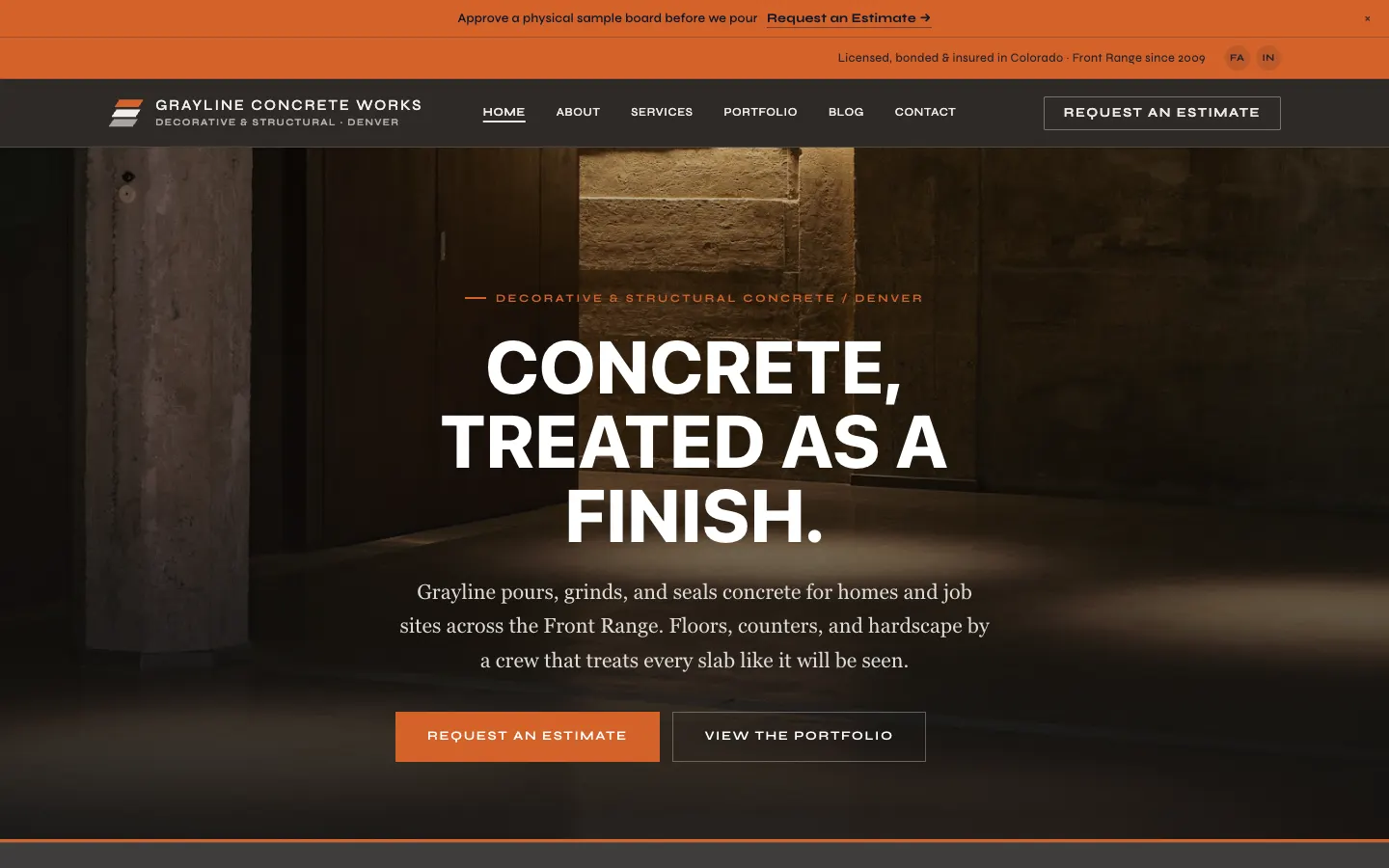
Grayline Concrete Works

A concrete-grey and rust-orange site for a Denver Front Range finisher: polished floors, microcement wall finishes, cast countertops, stamped flatwork, epoxy coatings, and structural foundations, with a six-system finishes page, a selected-work portfolio, contractor and designer testimonials, a six-stage sample-board process, an FAQ, a blog, and an estimate request form.

Six Finish Systems + Sample-Board Approval Process. Grayline Concrete Works shows the payoff directly: a finish gallery of poured projects and a dedicated decorative-concrete deep dive give the decorative searcher somewhere to browse and the repair searcher somewhere to trust.

Open the live demo → Concrete Contractor websites

Same business, different design direction: Grayline Concrete Works. Both are real, published builds, useful when you want to see how far the look can move without changing what the campaign targets.

Grayline Concrete Works — live concrete contractor website built on WorkspaceCMS
Where the demand is

How concrete contractor buyers actually search

Almost every concrete enquiry starts with a visible defect or a visible ambition. A driveway spiders with cracks after a hard freeze, a patio settles at one corner, a homeowner sees a stamped border on a neighbour's walkway and wants to know what it costs. That means demand is split between repair urgency and aesthetic desire, and those two searchers behave nothing alike. The repair searcher wants reassurance and a fast site visit. The decorative searcher wants photographs, finish names, and colour options, and will browse for weeks before contacting anyone.

Weather sets the calendar in a way it does not for most trades. Enquiries build as the ground thaws, peak hard through the pour season, and collapse when overnight temperatures make placing and curing risky. A campaign that spends evenly across the year wastes budget in the months when nobody can pour, and misses the narrow window when your schedule fills. The work is to front-load visibility ahead of the season, capture the estimate requests while the calendar is still open, and use the off months for content and gallery building rather than for chasing clicks.

The competitive set is unusually mixed. You are bidding against established concrete outfits, against general contractors subbing the flatwork, and against unlicensed crews who quote a square-foot number over the phone and vanish if the slab fails. Homeowners cannot tell you apart from a listing alone, so they compare on the only evidence they can see: photographs of finished pours, whether the site explains base preparation and control joints, and whether the reviews describe a job that held up. Publishing the craft detail is the differentiator, because the low-cost crews will not.

The keyword clusters we build around

  • Flatwork by surfaceDriveways, patios, walkways, garage and shop slabs. Separate pages, because a driveway replacement and a back patio are different budgets, different searchers and different photographs.
  • Decorative finishesStamped, stained, broom, exposed aggregate and polished. Highly visual, long browse, and the searches that most reward a real finish gallery over stock imagery.
  • Structural and site workFoundations, footings, retaining and grade walls, drainage correction. Higher ticket, often referred by builders and engineers, and usually written badly by competitors.
  • Repair and failure diagnosisCracking, settling, spalling, heaving. The searcher wants to know whether it can be repaired or must be replaced, and will call whoever explains it honestly.
  • Cost and estimating questionsHow pricing is built up, what changes it, and what a site visit covers. Answering the shape of the estimate without quoting figures moves people to the request form.
  • Neighbourhood and pour radiusCity and suburb pages covering the area a truck can reach inside the working time of the mix, which is the real limit on where you should be marketing.
The campaign

Three ways we go get the traffic

Local SEO, AI-assistant visibility and paid media, run by the agency team that has been doing it since long before WorkspaceCMS existed.

Local SEO

The organic programme is built around the pour radius and around finish. Service pages by surface and by finish, city and suburb pages inside real driving distance, and diagnostic content on cracking, settling and drainage give the site something to rank for in both the repair and the decorative half of demand. Project pages built from your own poured work carry photographs, finish names and locations, which is the local ranking signal competitors using stock imagery cannot reproduce.

AI search visibility

When someone asks an assistant whether a spidered driveway can be resurfaced or has to be replaced, the answer is assembled from sources that explain the failure mode clearly. Publishing finish comparisons, base and jointing practice, and a genuine FAQ on how estimates are built makes your site the quotable one. Structured service and location data plus a real review corpus give assistants the confidence to name you when the follow-up question is who does this nearby.

Paid media

Paid search works hardest in the weeks either side of season opening, concentrated on repair urgency and on high-value decorative terms rather than the category as a whole. Flatwork bids down fast against every small crew in the metro, so budget is better aimed at stamped, polished and structural work where the job value carries the click. Weather cancels demand outright for weeks at a time, so pacing follows the forecast rather than a monthly plan.

Campaigns are an add-on to a WorkspaceCMS plan and start from $499/mo. The plan itself is a monthly subscription. The build is included, the platform is not free. Local SEO campaigns are scoped to single and multi-location businesses rather than national or global SEO. Paid search management covers service businesses rather than online stores; ad spend is billed by Google or Meta directly to your own account. Full campaign scope → · Plan pricing →

What gets in the way

Six things that hold concrete contractor sites back

01

A gallery that proves nothing

Most concrete sites show a handful of wide shots with no location, no finish name and no context. Buyers cannot tell whether the work is yours or a supplier's stock photo. A gallery organised by finish and by project type, with the specifics written out, does more for close rate than any other single change to the site.

02

The pour season squeeze

Demand arrives in a compressed window and your capacity is fixed by crew and weather. Campaigns that ignore this either overspend in dead months or arrive too late to fill the calendar. Seasonality has to be planned into the budget and the content schedule, not discovered in it.

03

Competing with a phone quote

Crews quoting a square-foot price sight unseen will always sound cheaper than a contractor who insists on measuring base and drainage. If the site does not explain why base preparation and jointing decide whether a slab lasts, price is the only comparison the homeowner has.

04

Builder and GC referral work is invisible online

Foundations and structural flatwork often come through relationships, so the pages that would win that work never get written. Builders do search, especially when a regular sub is booked out, and a serious foundations page is what they find when they do.

05

Repair searchers landing on installation pages

Someone searching about a cracking driveway has a diagnostic question, not a purchase intent. Sending them to a services page loses them. Repair and failure content earns the visit, and it is also what an AI assistant quotes when asked whether a crack is structural.

06

Service area drawn wider than the truck

Concrete has a working time, and marketing beyond it produces estimate requests you cannot profitably serve. Pages that claim a whole region dilute local ranking and generate travel time nobody is paying for.

Campaign add-ons

Pick the campaign that fits the market

Every package below is bought from your dashboard once your site is live. Names, prices and deliverables are read from the catalog at page load, so what you see here is what you would be buying.

Questions

Concrete Contractor marketing, answered

Can you get us ranked first for concrete contractor in our city?

We do not guarantee a position or a date, and any agency that does is selling something they cannot control. What the campaign does is build the pages, the local signals and the review presence that make a strong result achievable, and reports honestly on movement.

Is decorative work worth separating from flatwork?

It is a different buyer entirely. Stamped and polished work is chosen on appearance and researched through images over weeks, while a driveway repair is a practical purchase decided quickly, and mixing them buries the higher-value work inside the cheaper enquiry.

Should we advertise through the winter?

Usually not at full weight. Paid budget is better concentrated ahead of and during pour season, while the off months go into gallery building, project pages and review collection so the site is ranking strongly when the ground thaws.

How much does weather really affect the campaign?

Enough to plan around. Pours are impossible in the wrong conditions, so demand and delivery both cluster into a limited window, and spending evenly through the year funds enquiries you cannot service while underfunding the weeks that decide the season.

How do you keep us from getting estimate requests too far away?

Location pages are drawn to your actual pour radius rather than to a whole region, campaign targeting matches, and the request form captures the job address early so anything outside the radius is obvious before a crew is dispatched.

Your free site is one click away

Ready to grow a concrete contractor business?

Get the site built, then put a campaign behind it. Start online, or talk it through with a strategist first.

Want the full picture? See what a campaign includes