
Growth campaigns · Fence Installation

Growth campaigns for fence installation companies

Fence buyers arrive already arguing with themselves about material and cost per foot. This campaign meets that comparison head on, then hands the visitor an estimate flow instead of a contact form.

Live Fence Installation demo

Ironwood & Cedar Fence Co.

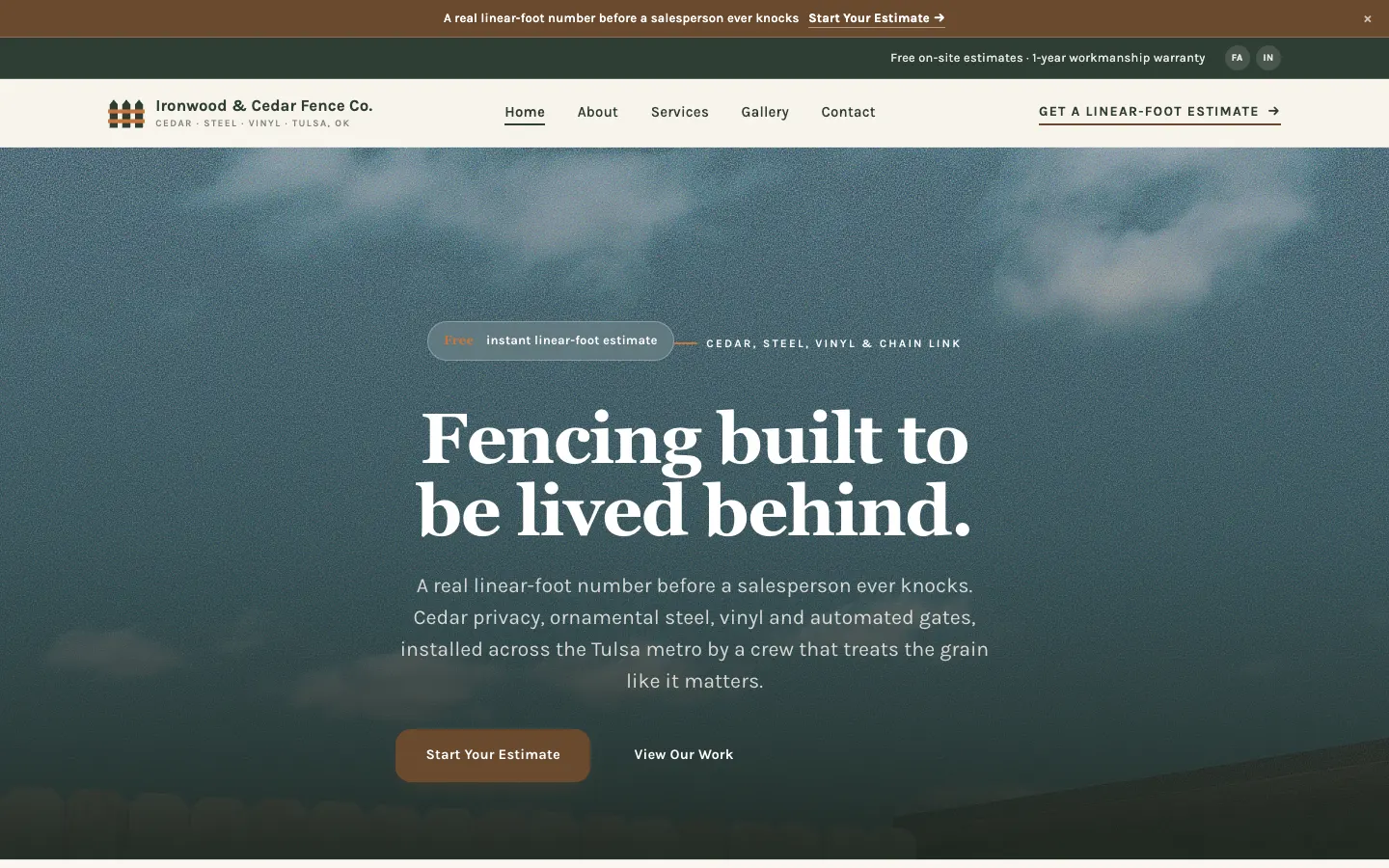
A sage-green, cedar-brown and ember site for a Tulsa fence builder: cedar privacy, ornamental steel, vinyl, chain link, automated gates, and storm repairs, with a linear-foot estimate flow, a four-material comparison table, a filterable install gallery, homeowner reviews, an FAQ page, and a contact form.

Linear-Foot Estimate Flow + Material Comparison Table. Ironwood & Cedar Fence Co. is the campaign endpoint made real: the material comparison table holds the buyer through the research stage and the linear-foot estimate flow turns that same visit into something an estimator can price.

Open the live demo → Fence Installation websites

Same business, different design direction: Ironwood & Cedar Fence Co.. Both are real, published builds, useful when you want to see how far the look can move without changing what the campaign targets.

Ironwood & Cedar Fence Co. — live fence installation website built on WorkspaceCMS
Where the demand is

How fence installation buyers actually search

Very few people wake up wanting a fence. Something happens first: a dog arrives, a pool goes in and an inspector requires an enclosure, a neighbour's tree comes down across the old panels, a property changes hands and the line needs marking. Each trigger produces a different search and a different urgency. Storm damage is a same-week problem. A pool enclosure has a permit and an inspection date attached. A privacy fence for a new puppy is a comfortable browse that can stretch across a month of comparing cedar against vinyl.

Material comparison dominates the middle of that journey more than in any neighbouring trade. Buyers want to know how cedar weathers, whether vinyl really goes brittle, what ornamental steel costs against aluminium, and how chain link looks when it is done well. They are also quietly trying to convert everything into a number they can compare, which is why linear foot is the unit that runs the whole category. A site that publishes a straight material comparison and explains how footage, gates, terrain and post depth change a price will hold a visitor through that entire comparison stage.

Then there is the permission layer nobody outside the trade thinks about. Homeowner associations dictate height, style and colour. Municipalities regulate setbacks and corner sight lines. Surveys settle property line disputes that get heated fast. Installers who publish local rules by neighbourhood become the obvious call, because the buyer has just discovered that their preferred design might not be allowed. Meanwhile the competition is a mix of dedicated fence companies, landscapers adding fencing as a side line, and big-box install programmes subcontracting the work, and the buyer cannot distinguish them from a listing alone.

The keyword clusters we build around

  • Material selectionCedar, vinyl, ornamental steel and aluminium, chain link, composite. Comparison content that keeps the buyer on your site through the stage where most of them leave to research elsewhere.
  • Purpose-driven installsPrivacy, pet containment, pool code compliance, security. Buyers describe the job by its reason rather than by its material, and pages framed that way catch searches competitors miss.
  • Gates and automationDriveway gates, automated openers, access control. Higher ticket, more technical, and usually underserved by fence company sites that treat gates as a footnote.
  • Repair and storm damageLeaning posts, downed sections, rot and rust repair. Urgent, often insurance-adjacent, and a reliable source of work between installation seasons.
  • Rules and permittingAssociation restrictions, height limits, setbacks, property line and survey questions. Genuinely local content that nobody national can write.
  • Estimate and footage questionsHow linear foot pricing is built, what gates and slope add, what a site measure covers. Answered without quoting figures, it moves people into the estimate flow.
The campaign

Three ways we go get the traffic

Local SEO, AI-assistant visibility and paid media, run by the agency team that has been doing it since long before WorkspaceCMS existed.

Local SEO

The organic structure follows the two ways buyers describe the job: by material and by purpose. Comparison pages, purpose pages for privacy, pets and pool code, gate and automation content, and repair pages that are already ranking when weather hits. Local association and permit content by suburb is the strongest differentiator available, because it is genuinely local knowledge. Everything stays inside your install radius rather than reaching for regional terms.

AI search visibility

Assistants get asked which fence material suits a climate, whether a pool enclosure needs a specific height, and what an association is likely to allow. The businesses cited are the ones publishing structured comparisons, real specifications, local rule detail and honest FAQs about how estimates are built. Add structured service and location data and a genuine review corpus, and the assistant has both an authoritative explanation and a nearby company to name.

Paid media

Repair urgency converts fastest, so search budget concentrates there: storm damage, a leaning run, a gate that no longer latches. Broad material browsing sits months from a decision and rarely earns its click. Social is unusually strong in this trade for a plain reason, which is that a finished cedar or ornamental run photographs well and the catchment is small enough to target street by street. Seasonal swing is sharp, so budget follows the first dry weeks rather than sitting level.

Campaigns are an add-on to a WorkspaceCMS plan and start from $499/mo. The plan itself is a monthly subscription. The build is included, the platform is not free. Local SEO campaigns are scoped to single and multi-location businesses rather than national or global SEO. Paid search management covers service businesses rather than online stores; ad spend is billed by Google or Meta directly to your own account. Full campaign scope → · Plan pricing →

What gets in the way

Six things that hold fence installation sites back

01

Losing the buyer during material research

The comparison stage is where fence enquiries evaporate. If your site has one paragraph per material and a phone number, the visitor goes to a manufacturer site or a forum and comes back to whoever they land on next. A real comparison table, weathering behaviour included, keeps the research on your own pages.

02

Contact forms where an estimate flow belongs

Asking a homeowner to describe their fence in a free-text box produces vague enquiries and a lot of phone tag. A structured flow capturing approximate footage, material interest, gate count and terrain turns the same visitor into a quotable request your estimator can price before leaving the office.

03

Association and permit questions unanswered

Height rules, approved styles and setback requirements are the first hard obstacle most buyers hit, and almost no fence site addresses them by neighbourhood. Publishing that detail converts a frustrated searcher into a call, and it is exactly the material AI assistants pull from when asked about local restrictions.

04

Storm work arriving faster than it can be captured

A wind event produces a burst of repair searches inside a day or two, and campaigns configured for steady installation demand cannot respond in time. Repair pages need to exist and rank before the storm, because there is no time to publish them after it.

05

Undifferentiated from landscapers and box store installers

Buyers cannot tell a specialist fence builder from a landscaper subcontracting the job. Post depth, concrete practice, hardware grade and warranty terms are the details that separate you, and they only work if they are published where the comparison happens.

06

Galleries without material or location context

A wall of fence photographs proves nothing if the visitor cannot filter to the material they are considering in a neighbourhood they recognise. Filterable, tagged install galleries do double duty as conversion evidence and as local ranking signal.

Campaign add-ons

Pick the campaign that fits the market

Every package below is bought from your dashboard once your site is live. Names, prices and deliverables are read from the catalog at page load, so what you see here is what you would be buying.

Questions

Fence Installation marketing, answered

Should we publish prices per linear foot on the site?

We do not put figures into campaign copy, and we would advise against fixed public pricing anyway, because slope, gates and post depth move a real estimate too much. Explaining what drives the price, and then handing the visitor an estimate flow, converts better than a number they will treat as a quote.

How do we capture storm repair work when it happens?

By having the repair pages built and ranking before the weather arrives. Storm demand appears and disappears inside a week, so it is won by existing organic position and a fast paid adjustment, not by content published after the fact.

How do we stop quoting fences we will never win?

By putting the qualifying detail on the page before the form: materials you install, heights, permit handling and the areas you actually serve. Fewer enquiries arrive, and the ones that do already accept how you work, which is what makes the estimating time pay.

Can you market us across the whole state?

No. The campaigns are scoped to local and multi-location businesses, which suits a fence company with one yard or several. Statewide or national programmes are outside what we do, and for a trade limited by crew travel time they would not be a good investment anyway.

Do we need to publish which materials we install?

It is the fastest way to stop quoting jobs you will never win. Somebody set on vinyl will not be talked into cedar, and stating what you install and how tall you build filters the enquiry list before it costs anyone a site visit.

Your free site is one click away

Ready to grow a fence installation business?

Get the site built, then put a campaign behind it. Start online, or talk it through with a strategist first.

Want the full picture? See what a campaign includes