Growth campaigns · Media Advisory

Visibility for founder-led media advisory firms

Advisory work is bought on judgment, and judgment is hard to search for. A founder who heard your name from an investor will read a few pages before replying to the introduction. This campaign makes your point of view findable, quotable and worth the meeting.

Live Media Advisory demo

Harlow Media Partners

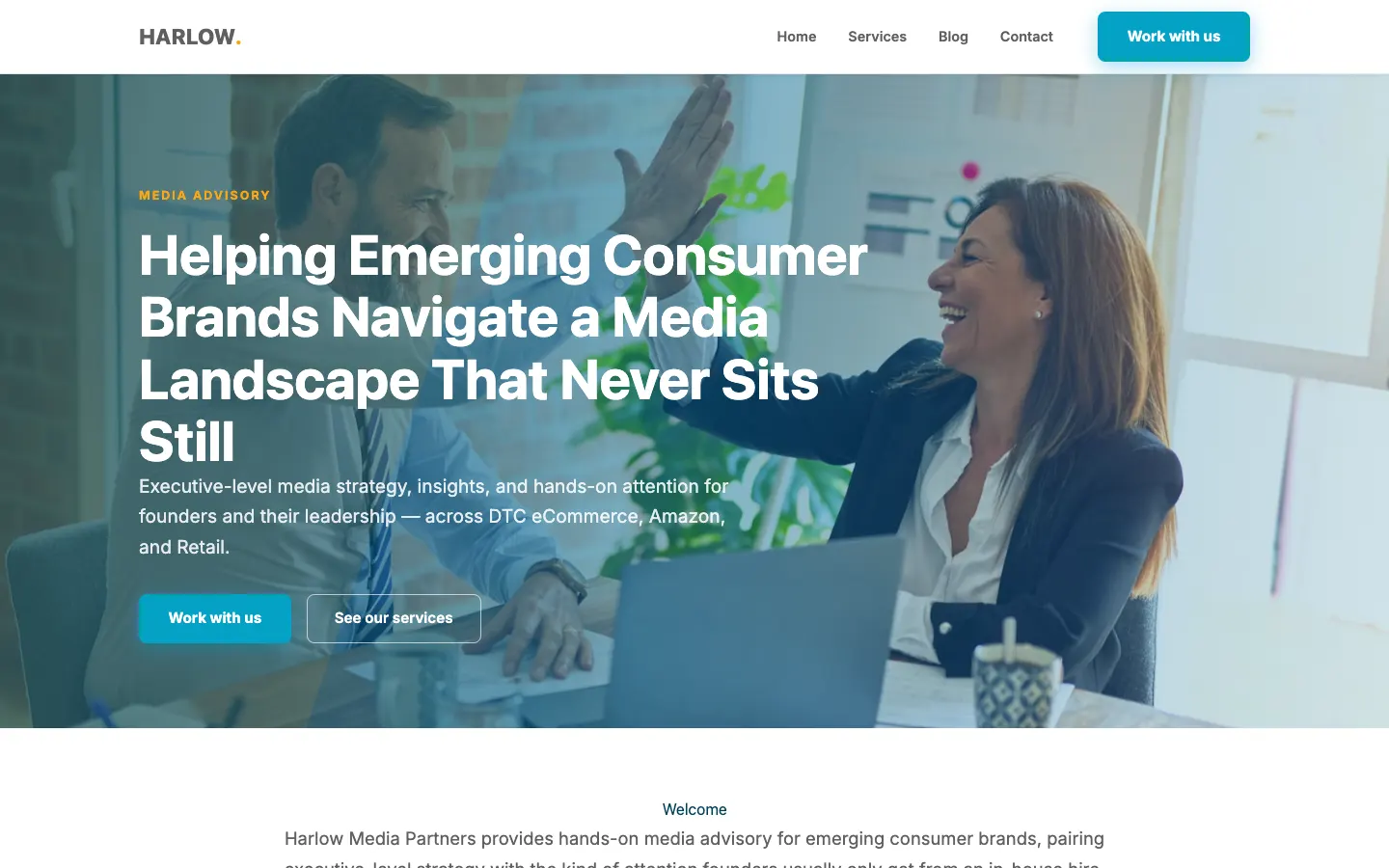
Cyan-and-orange boutique media advisory site for emerging consumer brands. Sora display type, diagonal-cut hero motif, and founder-forward positioning across DTC eCommerce, Amazon, and Retail.

Essentials: Founder-Led Media Advisory Positioning. Harlow Media Partners is the live reference: its founder-forward positioning across DTC, marketplace and retail is what a warm introduction reads before deciding to take the call.

Open the live demo → Media Advisory websites

Harlow Media Partners — live media advisory website built on WorkspaceCMS
Where the demand is

How media advisory buyers actually search

Advisory demand starts as a referral far more often than as a search, and that shapes everything downstream. A founder hears your name from another founder, an investor or a former colleague, and the search that follows is your firm's name plus a channel word. What that person then reads decides whether the introduction turns into a call. So the highest-leverage query for this business is not a category term at all, and a site optimized purely for category discovery misses the traffic that actually matters most.

The category searches that do exist are triggered by a stall or by a stage change. A brand whose paid efficiency has slipped after a strong run, a team preparing for a first retail meeting, or a founder deciding whether their marketplace channel needs an operator or an advisor. Those searches are made once, by a person with a specific question, and they are contested by two very different competitor types: large performance agencies bidding aggressively on channel terms, and individual practitioners who cost a fraction of a firm retainer.

The buying cycle is short in meetings and long in calendar time, because it moves at the pace of a founder's attention. Retainers are considered, deferred, and revived a quarter later when something breaks. The client base is national by nature rather than tied to a metro, which is worth saying plainly, because it changes which parts of a growth campaign apply and which do not. Positioning content, not geography, is what does the work here.

The keyword clusters we build around

  • Branded and referral-check searchSomeone who already has your name and is deciding whether to take the call. Your positioning, point of view and team pages are the conversion surface, and they deserve as much care as any acquisition page.
  • Channel-specific expertiseMarketplace, DTC and retail phrasing from founders diagnosing which channel is the problem. Each channel needs its own page written in that channel's vocabulary, not a combined services list.
  • Advisor versus agency versus hireComparison searches from founders weighing a retainer against an in-house hire or a full-service agency. Answer the comparison honestly on the page rather than dodging it.
  • Stage and readiness questionsSearches about whether a brand is ready for retail, for a marketplace push, or for outside help at all. Readiness content attracts exactly the pre-decision reader advisory work is sold to.
  • Founder point of view and commentaryTopical searches around channel shifts and category dynamics. This is where a boutique out-argues a large agency, because a named founder can hold an opinion a committee cannot.
The campaign

Three ways we go get the traffic

Local SEO, AI-assistant visibility and paid media, run by the agency team that has been doing it since long before WorkspaceCMS existed.

Local SEO

The most valuable query a boutique advisory firm has is its own name, typed by a founder who just took an introduction and wants to know how you think before answering it. So the work starts with the pages that reader opens: positioning, the principal, and the shape of an engagement. Around those we build channel pages written in marketplace, DTC and retail vocabulary rather than one blended services list, plus an insights cadence that keeps a published argument attached to each channel. Technical health and structured data make sure the commentary is discoverable at all.

AI search visibility

Founders now ask assistants who to talk to about a marketplace channel that has stalled or a first retail meeting, and a named principal holding a stated position is far more quotable than a firm that says it drives growth. A described engagement shape, channel pages that answer a diagnostic question directly, real background for the people doing the work, and commentary that takes a side give ChatGPT, Claude, Perplexity and Google AI Overviews something to attribute. A committee cannot hold an opinion; a founder can, and that is the advantage here.

Paid media

Bidding against performance shops on channel keywords is a losing trade for a firm whose entire product is one person's attention. Budget goes to founder audiences on paid social and to promoting the commentary that already turns readers into calls, where an argument does work no keyword bid can. Retargeting matters more here than acquisition, because advisory retainers get considered, deferred, and revived a quarter later when something breaks. The firm still visible across that gap is the one who gets the note.

Campaigns are an add-on to a WorkspaceCMS plan and start from $499/mo. The plan itself is a monthly subscription. The build is included, the platform is not free. Local SEO campaigns are scoped to single and multi-location businesses rather than national or global SEO. Paid search management covers service businesses rather than online stores; ad spend is billed by Google or Meta directly to your own account. Full campaign scope → · Plan pricing →

What gets in the way

Six things that hold media advisory sites back

01

The buyer is national, and local packages do not fit

Consumer brands hire advisors regardless of city, so the local campaign scope that serves a plumber or an MSP does not map cleanly here. Being honest about that up front is more useful than selling a geographic strategy your buyer will never search in.

02

Judgment does not photograph well

The product is a way of thinking about a channel, which is genuinely hard to put on a page. Firms fall back on service lists that read identically to every competitor, and the one thing that would differentiate them, an actual argument, never gets published.

03

Referral traffic lands on a page built for strangers

Warm introductions arrive at a home page written to explain what a media advisory firm is. That reader already knows. What they need is the founder, the point of view and the shape of an engagement, and burying those costs deals nobody ever counts.

04

Big agencies outbid you on every channel term

Performance shops with large budgets own the obvious paid keywords, and matching them is a losing trade for a boutique. The alternative is winning the narrower, more opinionated searches those agencies produce nothing for.

05

Engagement scope is deliberately vague, and buyers stall on it

Advisory retainers resist description because every engagement differs. But a founder cannot approve what they cannot picture, so refusing to describe a typical shape turns interest into a postponed decision rather than a call.

06

Founder attention is the bottleneck for content

The only genuinely differentiated content comes from the principal, who is busy delivering client work. Without a production process that extracts a point of view in an hour a month, the insights section stalls and the firm looks dormant.

Campaign add-ons

Pick the campaign that fits the market

Every package below is bought from your dashboard once your site is live. Names, prices and deliverables are read from the catalog at page load, so what you see here is what you would be buying.

Questions

Media Advisory marketing, answered

Most of our work arrives by referral. What is a campaign actually adding?

Referrals still look you up before they reply. Making the principal, the argument and the engagement shape easy to find raises the rate at which introductions become meetings, which is usually the fastest return available to a firm this size.

How much of the principal's time does publishing a point of view take?

Less than firms expect, because the aim is extraction rather than writing. A short recurring conversation about what you are seeing in a channel produces enough raw material for commentary, channel page updates and the answers assistants tend to quote.

Should we write one services page or a page per channel?

A page per channel, in that channel's vocabulary. A founder diagnosing whether marketplace or retail is the problem cannot see themselves in a combined list, and the combined list is also the version that reads identically to every competitor.

Individual practitioners charge a fraction of a firm retainer. How does the site answer that?

By being explicit about what a firm gives that a solo operator cannot: continuity when someone is unavailable, exposure across many brands in the same channel, and a view of what is working right now rather than what worked at one company.

Can we describe a typical engagement when every engagement genuinely differs?

Describe the shape rather than the scope: how it opens, what the first weeks look like, who is in the room, what changes hands. A founder cannot approve something they cannot picture, so refusal to describe it postpones decisions rather than protecting flexibility.

Your free site is one click away

Ready to grow a media advisory business?

Get the site built, then put a campaign behind it. Start online, or talk it through with a strategist first.

Want the full picture? See what a campaign includes