Growth campaigns · Digital Design Studio

Growth campaigns for digital design studios

The reader who pays is a product director with a deadline and three studios in a spreadsheet. They are not admiring the craft. They are checking whether you have shipped something like their problem inside an organisation the size of theirs.

Live Digital Design Studio demo

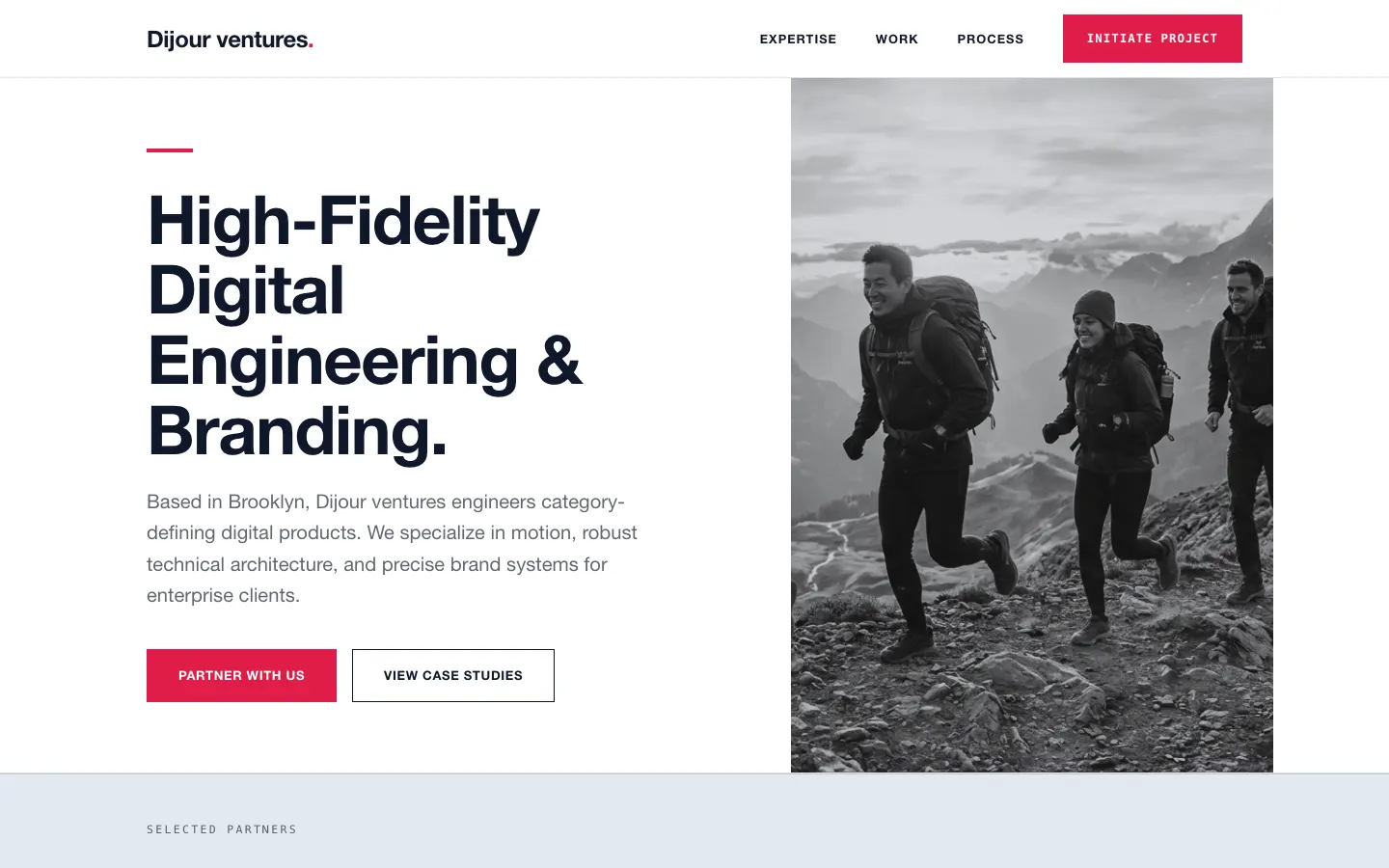
Dijour ventures

A Brooklyn digital engineering and brand consultancy, written for the enterprise buyer weighing a firm rather than the browser skimming a portfolio. Helvetica Neue in near-black and crimson on cool grey. Four full case-study pages: a 60fps motion system for a set-top streaming platform, a data-layer rebuild of a nine-second dashboard, an identity system, and an in-place product redesign. Each carries the problem and what was left behind. Plus a four-stage engagement protocol, a capabilities breakdown across motion, brand architecture, UI/UX engineering and technical consultation, a careers page, and a consultation request in place of a generic contact form.

Four Full Case Studies + Four-Stage Engagement Protocol. Dijour ventures is this built correctly: full case studies with the problem and the handover written out, a stated engagement protocol, and a consultation request standing in for a general contact form.

Open the live demo → Browse all demos

Dijour ventures — live digital design studio website built on WorkspaceCMS
Where the demand is

How digital design studio buyers actually search

Two completely different readers hit a studio site and the copy usually serves only one of them. The first is a peer or a junior designer admiring the craft. The second is a product director or a marketing lead with a budget, a deadline and three other studios in a spreadsheet. The second reader is the revenue, and they are scanning for scope, team composition, engagement model and whether the studio has worked inside a company the size of theirs. Portfolio-first sites are optimised for the first reader almost by accident.

Search behaviour is capability-plus-qualifier. Design system work, motion, a redesign of an existing product rather than a greenfield build, front-end engineering paired with design, brand architecture for a company that has outgrown its identity. Buyers also search by their own constraint: an existing stack, a regulated industry, a platform. Very few search the phrase "design agency" alone, and the ones who do tend to be the least qualified traffic the studio will see all quarter.

The evaluation itself is unforgiving. A case study that shows the finished screens and skips the problem is treated as a mood board. Enterprise buyers want the brief, the constraint, what was traded away, how the team was staffed, and what the client was left holding when the engagement ended. There is also a hiring dimension that pure lead-generation thinking misses: the same pages that convince a buyer convince a senior candidate, and studio capacity is a sales constraint.
The keyword clusters we build around

  • Discipline plus deliverableDesign systems, product redesign, motion, brand architecture, design engineering. The searcher already knows the deliverable they need bought.
  • Buyer constraintExisting platform, regulated sector, in-house team augmentation. The studio that names the constraint gets the shortlist slot.
  • Engagement modelRetainer versus project, embedded teams, discovery sprints. Directors search this while writing an internal justification.
  • Studio versus in-house versus freelanceComparison searches from someone deciding whether to hire, contract or engage a firm. Addressing it honestly wins more than avoiding it.
  • City and named-studio searchReferral and event-driven traffic checking that the studio is real, staffed and reachable.
The campaign

Three ways we go get the traffic

Local SEO, AI-assistant visibility and paid media, run by the agency team that has been doing it since long before WorkspaceCMS existed.

Local SEO

Directors search the deliverable they have been told to buy: a design system, a redesign of an existing product rather than a greenfield build, motion work, brand architecture for a company that outgrew its identity. Capability pages get written in that vocabulary instead of in studio taxonomy. Case studies are restructured so the brief, the constraint and the handover exist as readable text rather than image captions, because an enterprise buyer needs something they can paste into an internal justification. Pages addressing the hire-in-house-or-engage-a-studio decision reach the director before the shortlist is drawn.

AI search visibility

A lead assembling a shortlist now asks an assistant to name studios doing design systems for a regulated product, or embedded teams working alongside an in-house group. The answer draws on services stated as services, team composition described plainly, engagement models named, and case studies whose problem and outcome exist as sentences. A studio whose entire expertise lives inside image files, a reel and a password-protected deck is functionally absent from ChatGPT, Claude, Perplexity and AI Overviews, however good the work behind the password happens to be.

Paid media

Broad category bidding is a trap here, because the people typing design agency are mostly freelancers, students and companies with nothing to spend. What earns its place is narrow: the studio name, which marketplaces and competitors bid on, plus a few deliverable phrases a director would only type mid-procurement. Paid social usually carries more weight than search in this category, since the work is visual and the targeting can be a job title at a company stage rather than a query somebody had to think of first.

Campaigns are an add-on to a WorkspaceCMS plan and start from $499/mo. The plan itself is a monthly subscription. The build is included, the platform is not free. Local SEO campaigns are scoped to single and multi-location businesses rather than national or global SEO. Paid search management covers service businesses rather than online stores; ad spend is billed by Google or Meta directly to your own account. Full campaign scope → · Plan pricing →

What gets in the way

Six things that hold digital design studio sites back

01

Case studies read as galleries

Beautiful frames, no problem statement, no constraint, no handover. An enterprise buyer cannot use it to argue internally for your fee, so it does not travel past the person who found you.

02

Capabilities are described in studio language

Buyers search for what they need to buy, not for the studio's internal taxonomy. Craft nouns that mean something to designers and nothing to a director quietly remove the studio from the search results the director is actually running.

03

The inquiry form asks for a brief nobody has yet

A single contact form demanding budget, timeline and objectives filters out the director who is still scoping. A qualifying path with a lower first step converts far more of the same traffic.

04

Feast and famine drives the marketing on and off

Studios market hard when the pipeline is thin and stop the moment a project lands, which resets the compounding every time. Search work is worth least when it is switched on and off.

05

Everything hinges on the founder's network

When work comes exclusively through one person's relationships, the studio's growth is capped by their calendar and exposed to their next sabbatical.

06

Recruiting and selling fight over the same site

Careers content and buyer content compete for the same real estate, and a site that tries to speak to both in one voice usually convinces neither the candidate nor the client.

Campaign add-ons

Pick the campaign that fits the market

Every package below is bought from your dashboard once your site is live. Names, prices and deliverables are read from the catalog at page load, so what you see here is what you would be buying.

Questions

Digital Design Studio marketing, answered

Most of our strongest work is under NDA. What is left to publish?

The structure of the problem, almost always. Sector generalised a step, the constraint described, the approach and the handover written out, visuals abstracted or held back. That still reads as a case study to a director who has to argue internally for your fee.

Our pipeline swings between overloaded and empty. Does that change the plan?

It changes what you must not do, which is switch the programme off the week a large project lands. Capability pages compound slowly, and a studio that resets them every time it gets busy pays the ramp cost again on the other side.

Will this help us hire senior designers as well?

Indirectly, yes. The published depth that convinces a buyer convinces a candidate. We keep careers content off the same pages as the sales path, because a director and a designer want opposite things from the same case study.

Everything arrives through our founder's network. Is that a problem?

It caps growth at one person's calendar and exposes the studio to their next sabbatical. Search builds a second intake that does not require the founder to have met the buyer at a conference eighteen months earlier.

Our inquiry form asks for budget, timeline and objectives. Why is it silent?

Because a director still scoping the work has none of the three yet, so the form tells them to come back later and they do not. A lower first step converts the same traffic without changing anything upstream of it.

Your free site is one click away

Ready to grow a digital design studio business?

Get the site built, then put a campaign behind it. Start online, or talk it through with a strategist first.

Want the full picture? See what a campaign includes