Growth campaigns · Executive Advisory

Growth campaigns for executive advisory practices

A sitting chief executive will not be seen shopping for an advisor. They read at night, from a personal device, across several visits, and then send one message from an address that is not their work one. The site has to earn that message.

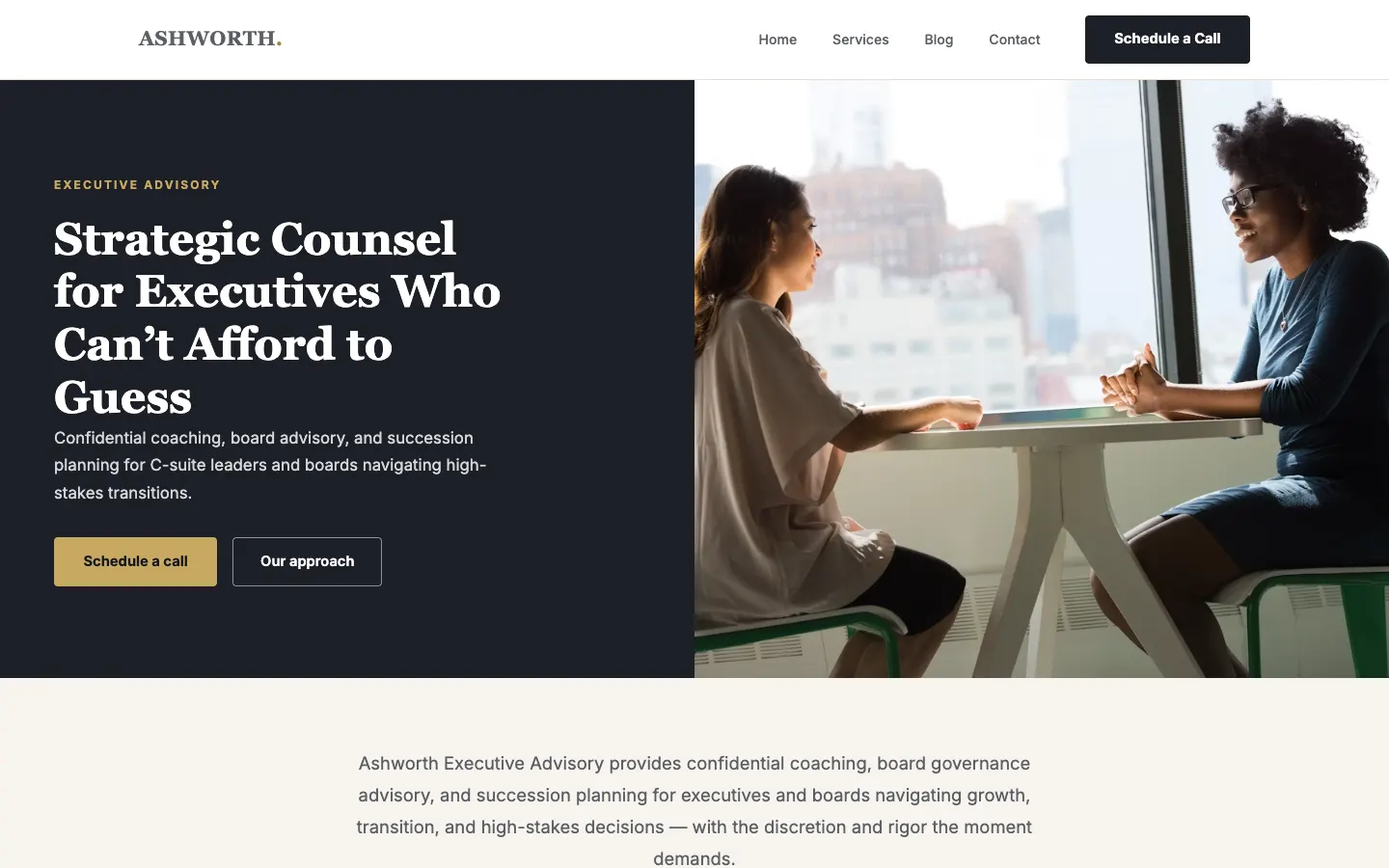
Live Executive Advisory demo

Ashworth Executive Advisory

Editorial charcoal-and-gold executive coaching & board governance site. Fraunces serif, split-panel photo hero (not full-bleed), numbered ledger-style services page.

Essentials: Split-Panel Hero + Confidential Advisory Positioning. Ashworth Executive Advisory is the restrained end done properly, with confidential advisory positioning and a ledger-style services page a cautious reader can move through without ever being sold to.

Open the live demo → Executive Advisory websites

Ashworth Executive Advisory — live executive advisory website built on WorkspaceCMS
Where the demand is

How executive advisory buyers actually search

Discretion shapes everything about this funnel. A chief executive weighing an advisor is not going to be seen shopping for one, so the research happens privately and the first contact is deliberately low-commitment. Long dwell times, repeat visits, no form fill, then an email from a personal address weeks later. Analytics reads that pattern as failure. It is actually the normal shape of the buying process, and designing the site around immediate conversion actively suppresses it.

There are two funding routes and they behave nothing alike. Sponsored engagements come through an organisation, where a chief people officer or a board chair is comparing providers, wants credentialing, methodology and something to present internally. Self-funded engagements come from an individual executive in transition, in a new mandate, or carrying something they cannot discuss internally. Same advisor, entirely different objection, entirely different page. Practices that write only for one leave the other with nothing to read.

The credibility signals are also specific to this work. Board experience, operating history, governance credentials and the level at which the advisor has actually sat matter more than qualifications, and prospective clients read biography pages with unusual care. Chemistry is the deciding factor, so the practical job of the site is to get someone comfortable enough to request a conversation. Anything that reads as high-pressure marketing does the opposite, because the buyer is judging judgement.

The keyword clusters we build around

  • Role-level advisory searchChief executive, founder and board-level advisory terms. Low volume, extremely high value, and the phrasing signals the seniority of the searcher.
  • Situation-led searchA new mandate, a succession, a founder transition, a governance issue. The searcher has an event they cannot discuss with their own team.
  • Sponsor and programme searchPeople officers and board chairs comparing providers for a leadership programme. Wants methodology, credentials and something presentable.
  • Governance and board readinessDirectors preparing for board service or a committee role. A distinct discipline from coaching and worth its own pages.
  • Advisor name and credentialPost-referral verification. Biography depth, published thinking and speaking history do the persuading here.
The campaign

Three ways we go get the traffic

Local SEO, AI-assistant visibility and paid media, run by the agency team that has been doing it since long before WorkspaceCMS existed.

Local SEO

Two funnels, and they must not share a page. Sponsored engagements arrive through a chief people officer or a board chair comparing providers, wanting methodology and something presentable to a committee. Self-funded engagements arrive from an individual in a new mandate, or carrying something they cannot raise internally. Role-level and situation-led pages serve the second; programme and credentialing pages serve the first. Underneath both sits a biography section built to be read slowly: governance credentials, operating history, and the level at which this advisor has genuinely sat.

AI search visibility

A people officer and a cautious executive now ask assistants what an advisory engagement involves, what is reported back to a sponsor, and who actually works at board level. Citability comes from stating what a crowded field leaves vague: credentials and operating history written out, engagement formats named, confidentiality terms described plainly, and person markup tying the advisor to real governance roles. A practice whose site is mostly atmosphere and photography leaves ChatGPT, Claude, Perplexity and AI Overviews nothing they can attribute to a named practitioner.

Paid media

Restraint is the strategy. The coaching-certification auctions are loud and crowded with training providers, and appearing beside them costs an advisory practice credibility with the very buyer it wants. What is worth covering is the practice name, so a referred executive does not land on a competitor first, and a short list of situation and role phrases, succession, founder transition, a first hundred days in a new mandate, that only a senior searcher would type. LinkedIn suits the sponsored side, where targeting is a job title rather than a query.

Campaigns are an add-on to a WorkspaceCMS plan and start from $499/mo. The plan itself is a monthly subscription. The build is included, the platform is not free. Local SEO campaigns are scoped to single and multi-location businesses rather than national or global SEO. Paid search management covers service businesses rather than online stores; ad spend is billed by Google or Meta directly to your own account. Full campaign scope → · Plan pricing →

What gets in the way

Six things that hold executive advisory sites back

01

The buyer will not identify themselves early

Sitting executives research anonymously and contact late. A site built on gated downloads and demo forms measures the wrong thing and discourages the exact behaviour that precedes an engagement.

02

Sponsored and self-funded clients get one page

An organisation buying a programme and an individual buying discretion have opposite concerns about confidentiality, reporting and price. Blending them produces copy that reassures neither.

03

Testimonials are largely unavailable

Clients who value discretion will not appear in a quote box, so the usual social proof is off the table and the practice has to prove itself through published thinking and stated credentials instead.

04

The category is crowded with the uncredentialed

Anyone may call themselves an executive coach, so serious practices carry the burden of distinguishing themselves from a very large field, and it has to be done without disparaging it.

05

Confidentiality questions go unanswered in public

What is shared with a sponsor, what never leaves the room, how records are handled. These are the first questions a cautious executive has and most sites make them ask.

06

The practice is one person and scales like one

Capacity is the constraint, so the goal is not more inquiries but better-matched ones, which is a different marketing brief from almost every other vertical.

Campaign add-ons

Pick the campaign that fits the market

Every package below is bought from your dashboard once your site is live. Names, prices and deliverables are read from the catalog at page load, so what you see here is what you would be buying.

Questions

Executive Advisory marketing, answered

Our clients will never appear in a testimonial. Can we prove anything without them?

Credibility in this field rests on operating history, governance credentials and published judgement far more than on quotes. What you can state about yourself, and how you write about the work, carries a cautious executive further than a wall of client logos.

Analytics says our visitors never convert. Are we wasting the traffic?

Long dwell, repeat visits and no form fill is the normal shape of this purchase, not a failure. Executives research anonymously for weeks and make contact once, so designing for immediate conversion suppresses the behaviour that precedes an engagement.

Anyone can call themselves an executive coach. How do we separate ourselves?

Not by disparaging the field, which reads badly at this level. By stating the board seats held, the mandates run and the accreditations earned, in specifics an uncredentialed practitioner could not simply copy onto their own page.

Will marketing make the practice look less serious?

It can, if it borrows consumer devices. No countdowns, no urgency, no retargeting a chief executive around the internet. Restrained pages and an inquiry that reads as a request for a conversation are part of the brief, because the buyer is judging judgement.

How do we stop sponsors and private clients reading the wrong page?

Separate entry points and separate language. A board chair needs methodology, reporting boundaries and something to present upward. An individual needs to know what never leaves the room. Blended copy reassures neither of them.

Your free site is one click away

Ready to grow a executive advisory business?

Get the site built, then put a campaign behind it. Start online, or talk it through with a strategist first.

Want the full picture? See what a campaign includes