Growth campaigns · Staffing & Recruiting

Growth campaigns for staffing and recruiting agencies

Two people land on your site with nothing in common: an operations manager short twelve pickers by Monday, and a candidate looking for a shift tonight. Only one of them is revenue. This campaign builds, routes and measures the two paths separately.

Live Staffing & Recruiting demo

Bridgepoint Staffing Group

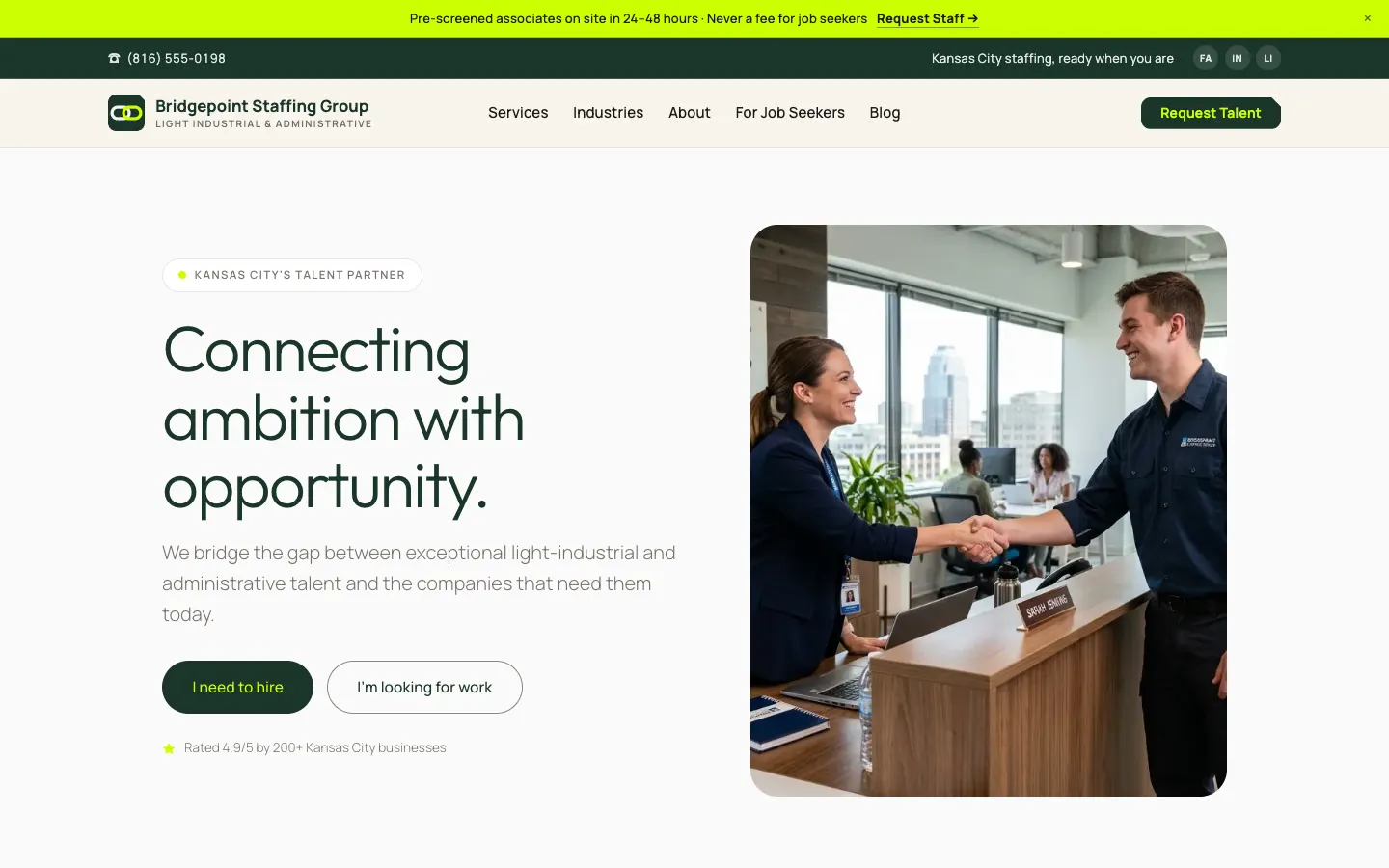
A forest-green and acid-lime staffing site for Kansas City, built around the fact that two very different visitors arrive on the same page. Employers get a request-staff path with a four-stage intake-to-scale process and three engagement models (temporary, temp-to-hire, direct placement), job seekers get an apply-in-minutes path across warehouse & logistics, assembly & production, and administrative roles. Plus an industries page, three challenge-solution-result placement case studies, employer testimonials, an FAQ, a blog, and a contact form.

Split Employer / Job-Seeker Paths + Placement Case Studies. Bridgepoint Staffing Group is the live reference: its split employer and job-seeker paths show how each audience is routed without either one diluting the other.

Open the live demo → Staffing & Recruiting websites

Bridgepoint Staffing Group — live staffing & recruiting website built on WorkspaceCMS
Where the demand is

How staffing & recruiting buyers actually search

Two entirely different demand curves run through a staffing agency's website, and confusing them is the classic failure. Job seekers generate the overwhelming majority of search volume, arriving on shift and role queries at all hours, mostly from phones. Employers generate far fewer searches but each one is worth an order of magnitude more, and they search in a completely different register: agency, contract, temp-to-hire, industry and city. An agency that celebrates traffic growth without separating the two is usually just celebrating applicant volume it already had.

Employer demand is triggered by a production event. A contract lands, a line runs a second shift, a peak season starts, or three people quit in a week. When it hits, the buyer is under real operational pressure and calls whoever appears credible fastest, which makes response speed part of the marketing rather than a sales detail. They want to know fill times, whether you actually staff their role type, how markup works, and what happens if a placement does not last the week.

Seasonality is sharper here than in most professional services. Warehouse and logistics demand builds hard into peak retail months, manufacturing follows its own contract cycles, and administrative hiring lifts at the start of budget years. Candidate supply moves opposite to that in the tightest periods, so the campaign has to flex: pushing employer acquisition when candidate supply is comfortable, and pushing recruitment when a contract is signed and the roles are unfilled.

The keyword clusters we build around

  • Employer hiring intentAgency, contract, temp-to-hire and direct placement searches by city and industry. These are the revenue queries, and they belong on a request-staff page with a short intake form.
  • Role and sector specificityWarehouse, assembly, production and administrative phrasing. Sector pages let you speak to the actual role a manager is trying to fill instead of describing staffing in general.
  • Job seeker acquisitionShift, pay-frequency and location searches from candidates. High volume, mobile, and worth treating as a supply pipeline with its own fast apply path rather than as a nuisance.
  • Engagement model questionsSearches comparing temporary, temp-to-hire and direct placement, often asked by a manager who has not used an agency before. Explaining the models is what converts a first-time buyer.
  • Peak and surge staffingSeasonal ramp queries concentrated in a few months. Publishing early and keeping the pages live year-round is what gets you found when the ramp actually starts.
The campaign

Three ways we go get the traffic

Local SEO, AI-assistant visibility and paid media, run by the agency team that has been doing it since long before WorkspaceCMS existed.

Local SEO

Applicant volume will always dwarf employer volume, so the architecture separates them before anything is published: an employer side built around request-staff intent, a candidate side built for a phone at eleven at night. City and sector pages carry genuine branch detail, cold storage, assembly, production, clerical, rather than one template with the city name swapped. Internal linking keeps job listings from bleeding authority into the employer pages, which is the quiet reason so many agency sites rank beautifully and produce almost no hiring inquiries.

AI search visibility

A plant manager asks an assistant which agencies staff second shift assembly in their city, and the model answers from whoever explained it. Sector pages with real role detail, temporary versus temp-to-hire versus direct placement written in plain terms, a stated replacement policy, service area markup and placement stories framed as problem and outcome all give ChatGPT, Claude, Perplexity and Google AI Overviews liftable material. A site offering only quality candidates and dedicated service contributes nothing an assistant can attribute, so a competitor gets named.

Paid media

Employer and candidate campaigns never share a budget, because the cheaper, higher-volume side will eat it inside a week. Employer search runs on role and sector phrasing by city and lands on the request-staff intake rather than the home page. Recruitment runs on paid social, where hourly candidates actually are, and lifts hardest when a contract has been signed and the roles are still open. Pacing follows the season rather than the calendar: warehouse builds into peak retail, manufacturing follows its own contract cycles.

Campaigns are an add-on to a WorkspaceCMS plan and start from $499/mo. The plan itself is a monthly subscription. The build is included, the platform is not free. Local SEO campaigns are scoped to single and multi-location businesses rather than national or global SEO. Paid search management covers service businesses rather than online stores; ad spend is billed by Google or Meta directly to your own account. Full campaign scope → · Plan pricing →

What gets in the way

Six things that hold staffing & recruiting sites back

01

Applicant traffic drowns the employer signal

Candidates outnumber employers by a wide margin in every analytics view, which makes reporting look strong while employer inquiries stay flat. Without separate tracking for the two paths, nobody notices that the revenue side of the site is underperforming.

02

One home page has to serve opposite intents

A manager needing crew by Monday and a candidate needing work today want different first screens. Sites that compromise between the two serve neither, and the employer, the one with money, is usually the one who leaves.

03

Employer inquiries expire in hours

A production manager short-staffed contacts several agencies at once and commits to whoever responds first with a credible answer. A form that sits until the next morning has effectively lost the deal before anyone reads it.

04

Sector proof is missing where it matters

Managers want evidence you have staffed their exact environment, whether that is a cold storage facility, an assembly line or a clerical department. Generic reassurance about quality candidates does not survive contact with a skeptical operations buyer.

05

Peak season plans start too late

Ramp content and candidate pipelines built when the ramp begins are already behind. The pages, the pipeline and the paid campaigns need to exist before the season, or the agency spends the peak reacting.

06

Markup and turnover objections go unanswered

Every employer is quietly worried about cost and about a placement walking off in the first week. If the site never addresses guarantees, replacement policy or how engagement models differ in cost, those doubts get resolved by the competitor who did.

Campaign add-ons

Pick the campaign that fits the market

Every package below is bought from your dashboard once your site is live. Names, prices and deliverables are read from the catalog at page load, so what you see here is what you would be buying.

Questions

Staffing & Recruiting marketing, answered

Should employers and job seekers share one website?

One site, two clearly separate paths. Two entry points, two content sets, two sets of campaigns and tracking. What fails is a blended message that asks a hiring manager and an hourly candidate to read the same page and act on it.

How fast does an employer inquiry actually need answering?

Same sitting, if you can manage it. A manager short-staffed for Monday contacts several agencies at once and commits to whoever comes back first with a credible answer, so a form landing in an unwatched inbox has lost the order before anyone reads it.

We open new branches. What has to exist before a new market produces inquiries?

Branch-specific location content with real addresses, staffed sectors and local proof, published early enough to be discovered. A new branch folded into a national page is invisible to the city-level searches a hiring manager actually runs.

Our traffic keeps climbing but employer inquiries stay flat. What is going on?

Almost certainly candidate volume masking the commercial side. Applicants outnumber employers heavily in every analytics view, so unless the two paths are tracked separately, a reporting line can rise for months while the revenue side of the site is dying quietly.

When should peak-season ramp content go live?

Well before the ramp. Pages published as the season starts are already behind, and the same is true of the candidate pipeline, which needs to be filling while supply is still comfortable rather than when every warehouse in the county is hiring.

Your free site is one click away

Ready to grow a staffing & recruiting business?

Get the site built, then put a campaign behind it. Start online, or talk it through with a strategist first.

Want the full picture? See what a campaign includes