
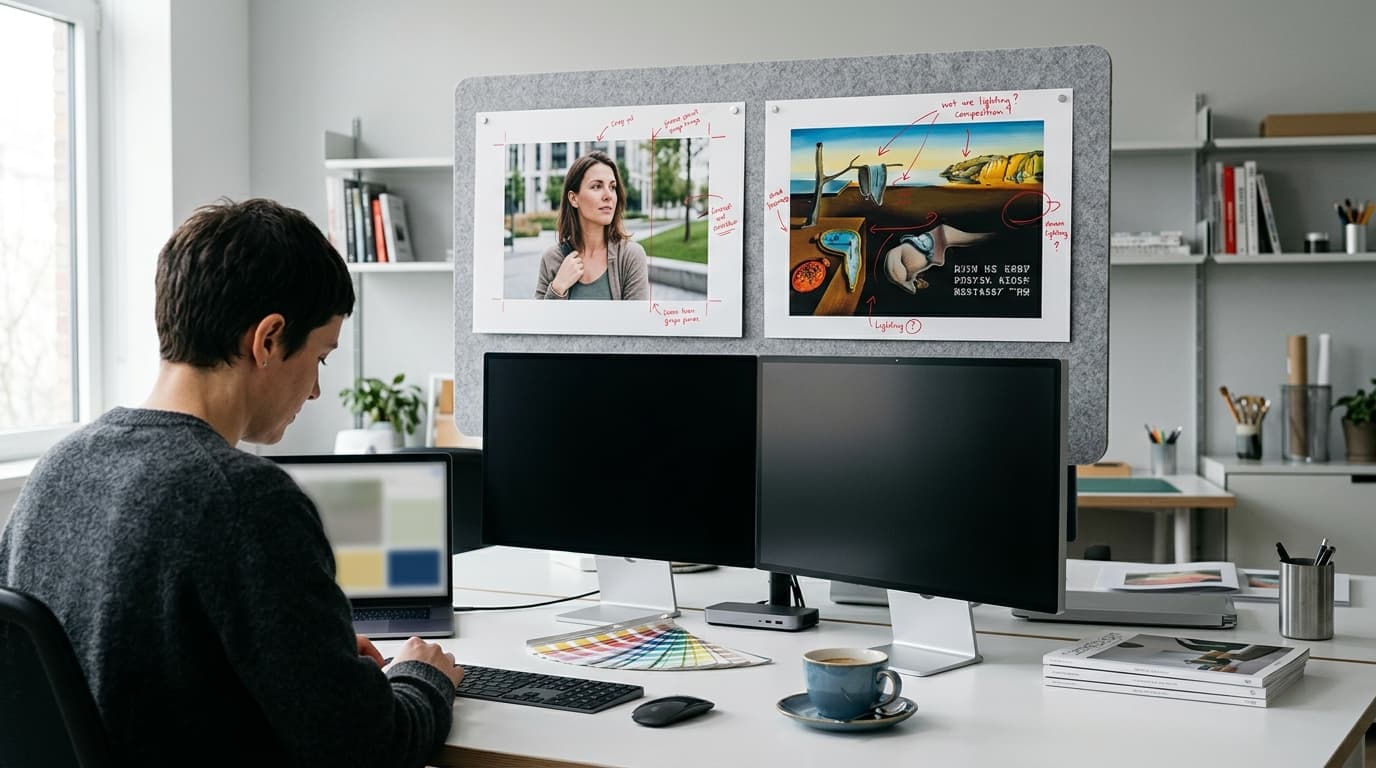
AI-Generated Images vs. Stock Photos: Which is Better for Your Business?
AI-generated images offer limitless customization and on-demand creation for your brand visuals, while stock photos provide proven, high-quality images with predictable licensing. The best choice depends on your specific needs for brand consistency, creative control, and budget. For unique hero images and conceptual art, AI excels. For straightforward depictions of people and real-world scenarios, stock photography often remains the more reliable option.
What Are AI-Generated Images?
AI-generated images are visuals created by artificial intelligence models known as generative adversarial networks (GANs) or diffusion models. You provide a text prompt describing what you want to see - from "a photorealistic image of a team collaborating in a sunlit office" to "a surrealist painting of a clock melting over a keyboard" - and the AI builds a unique image from scratch based on its training data. This process is a core part of modern AI content creation.
Platforms like Midjourney, DALL-E 3 (integrated into tools like ChatGPT Plus and Microsoft Designer), and Stable Diffusion have made this technology accessible. Instead of searching a library for an existing photo, you become the director, creating a net-new visual asset that has never existed before. This puts incredible creative power directly into the hands of marketing teams, eliminating the need for a graphic designer or photographer for many day-to-day tasks.
What Are Stock Photos?
Stock photos are professional-quality photographs, illustrations, and videos created by photographers and artists that are licensed for use by others. Instead of commissioning a custom photoshoot, you can browse massive libraries like Getty Images, Adobe Stock, or Shutterstock and purchase a license for an existing image that fits your needs.
These images are typically categorized by their licensing models:
- Royalty-Free: You pay a one-time fee to use the image multiple times across different projects without paying additional royalties. This is the most common model for business use.
- Rights-Managed: You license the image for a specific use, time period, industry, and geographic location. This is more expensive but offers a degree of exclusivity.
- Public Domain: These images have no copyright restrictions (like those in the CC0 license) and can be used for free for any purpose.
For decades, stock photography has been the go-to solution for businesses needing high-quality visuals for their websites, ads, and presentations without the high cost of a custom shoot.
Head-to-Head: AI Images vs. Stock Photos
When you're trying to choose the right visual for your next blog post or ad campaign, the decision isn't always simple. Here’s a direct comparison of how AI-generated images and stock photos stack up across the five factors that matter most to your business.
1. Cost and Budgeting
AI-Generated Images: The cost model for AI image generation is typically subscription-based. For a monthly fee, you get a certain number of "credits" or "fast hours" to generate images. A Midjourney plan starts around $10 per month for a limited number of generations, while higher-tier plans offering more capacity run from $30 to $120 per month. Once you pay the subscription, you can generate hundreds or even thousands of images, making the per-image cost extremely low.
Stock Photos: Stock photo pricing varies dramatically. You can find free images on sites like Unsplash or Pexels, but the selection can be limited and overused. On paid platforms, a single royalty-free image can cost anywhere from $10 to $500, depending on the resolution and license. Subscription plans, which offer a set number of downloads per month, can bring the per-image cost down to a few dollars, but high-quality or exclusive images from premium collections remain expensive.
The Verdict: For sheer volume and a low cost per image, AI generation is the winner. If you have a constant need for new and varied visuals for blog posts and social media, an AI subscription offers unparalleled value. However, if you only need a few high-impact images per year, purchasing them individually from a stock site might be more economical than a recurring AI subscription.
2. Creative Control and Customization
AI-Generated Images: This is where AI truly shines. Your imagination is the only limit. You can specify the exact subject, style, color palette, lighting, camera angle, and mood. Need a picture of an astronaut riding a bicycle on Mars in the style of Van Gogh? You can generate it in seconds. This level of control allows you to create visuals that are perfectly aligned with your brand identity and the specific message of your content. You can maintain a consistent aesthetic across all your marketing materials - something nearly impossible with stock photos.
Stock Photos: With stock photos, you are limited to what someone else has already created. You might find a photo that is almost perfect, but the model is wearing the wrong color shirt, the office doesn't look like yours, or the overall mood isn't quite right. While you can perform minor edits, you cannot fundamentally change the image's content. You're forced to fit your message to the image, rather than creating an image that fits your message.
The Verdict: AI-generated images win by a landslide. The ability to craft a perfectly tailored visual on-demand gives you creative freedom that stock photography can never match. This is a crucial advantage when building a strong, unique brand identity.
3. Time and Efficiency
AI-Generated Images: While generating a single image is fast (often under a minute), the overall process can be time-consuming. It requires skill to write effective prompts (a practice known as "prompt engineering"). You'll often need to generate dozens of variations and refine your prompt multiple times to get the desired result. This iterative process can take anywhere from a few minutes to over an hour for a complex scene, especially if you're aiming for a very specific outcome.
Stock Photos: Finding the right stock photo can also be a time sink. You might spend hours scrolling through pages of search results, using different keywords to find an image that fits your needs and doesn't look overly staged or generic. However, the asset itself is finished. Once you find it, you can download it and use it immediately. The process is one of discovery, not creation.
The Verdict: It's a tie, depending on the task. For a straightforward concept like "business team at a whiteboard," searching a stock photo library is often faster than trying to generate a realistic-looking group of people with AI. For a unique, abstract concept, creating it with AI is faster than trying to find a stock photo that doesn't exist.
4. Quality and Realism
AI-Generated Images: The quality of AI images has improved exponentially, but it is not yet consistently perfect. While AI is excellent at creating artistic styles, landscapes, and abstract concepts, it still struggles with certain details, particularly human anatomy. You'll often see images with people who have six fingers, strange-looking teeth, or limbs that bend at unnatural angles. Spotting and correcting these flaws adds an extra step to your workflow.
Stock Photos: Stock photos are created by professional photographers with high-end equipment. The technical quality - in terms of resolution, lighting, and composition - is consistently high. When you license a stock photo of a person, you know they will have the correct number of fingers. For photorealistic depictions of real-world scenarios, stock photography is still the most reliable source of high-quality, believable visuals.
The Verdict: Stock photos have the edge for realism and technical perfection. While AI is catching up quickly, professional photography remains the gold standard when you need a flawless, true-to-life image, especially one featuring people.
5. Legal and Ethical Considerations
AI-Generated Images: This is a complex and evolving area. The copyright status of AI-generated images is still being debated in courts worldwide. As of 2026, the U.S. Copyright Office has stated that works created solely by AI without human authorship are not eligible for copyright protection. Furthermore, since AI models are trained on vast datasets of existing images scraped from the internet, there are ongoing lawsuits from artists who claim their work was used without permission. Using AI images opens your business up to a degree of legal ambiguity and potential risk.
Stock Photos: Reputable stock photography sites handle the legalities for you. They secure model releases from any identifiable people in the photos and property releases for any recognizable private property. When you purchase a license, you are granted clear and specific rights to use the image, protecting you from copyright infringement claims. This legal clarity is a major advantage.
The Verdict: Stock photos are the clear winner for legal safety and peace of mind. The established licensing framework provides a legal shield that the world of AI imagery does not yet offer.
AI for Marketing Beyond Just Images
While the AI vs. stock photo debate focuses on visuals, it's just one piece of a much larger shift. AI is transforming how businesses create content, manage social media, and streamline operations. Automating business processes with AI is no longer a futuristic concept; it's a practical strategy available today.
Inside WorkspaceCMS, we’ve integrated these capabilities directly into your website management workflow. Our platform uses AI to help you not just create images, but to build out your entire content pipeline.
- AI-Assisted Writing: Move from a blank page to a finished draft faster. Our tools help you brainstorm blog post ideas, generate outlines, write paragraphs, and even create different versions of headlines and social media copy.
- SEO-Ready Out of the Box: Our AI can analyze your text and suggest keywords, generate SEO-friendly meta descriptions, and check for readability, helping your content rank higher without needing a separate SEO tool.
- Blog Automation: Connect your entire content workflow. Once your AI-assisted post is written and your AI-generated image is created, you can add it to the content calendar. WorkspaceCMS will publish automatically on the scheduled date, share it to your social channels, and even queue it up for your email newsletter. It’s a true schedule and forget system, all from one dashboard.
How to Choose: A Practical Guide for Your Business
So, which should you use? The answer is almost always "both." A smart content strategy uses AI-generated images and stock photos for what they do best. Here’s a framework to help you decide on a case-by-case basis.
When to Use AI-Generated Images:
- For Blog Post Hero Images: Create a unique, eye-catching image that perfectly matches the topic of your article.
- For Abstract Concepts: When you need to visualize ideas like "data security," "synergy," or "innovation," AI can create compelling metaphors that stock photos can't.
- For Consistent Brand Visuals: Generate a suite of icons, spot illustrations, or backgrounds in your brand's specific color palette and style.
- For Social Media Content: Quickly create a high volume of unique visuals for daily posts on platforms like Instagram and LinkedIn, keeping your feed fresh and engaging.
- When Your Budget is Tight: If you need a large number of images, a monthly AI subscription is far more cost-effective than buying stock photos individually.
When to Use Stock Photos:
- For Images of People: When you need authentic, realistic photos of people for testimonials, team pages, or product-in-use shots, stock photos are more reliable and avoid the "uncanny valley" effect.
- For Real-World Locations and Objects: If you need a picture of the Eiffel Tower, a specific car model, or a generic hospital room, a stock photo is your fastest and most accurate option.
- For Legally Sensitive Campaigns: In high-stakes advertising or when legal indemnity is critical, the clear licensing of stock photos from a reputable source is non-negotiable.
- When You Need Guaranteed Quality: For a print brochure or a major website banner, the guaranteed high resolution and professional quality of a premium stock photo is the safest choice.
- When You Have No Time to Iterate: If you need a good-enough image in five minutes, searching a stock library is more predictable than wrestling with AI prompts.
By blending both approaches, you get the best of both worlds: the creative freedom and cost-effectiveness of AI for your high-volume daily content, and the quality, realism, and legal safety of stock photos for your most important, customer-facing assets.
AI vs. Stock Photos FAQ
Is it legal to use AI-generated images for my business?
Yes, it is generally legal to use AI-generated images commercially, but the legal framework is still evolving. Major AI platforms like Midjourney and DALL-E 3 grant you broad commercial rights to the images you create. However, the images themselves may not be protectable by copyright, meaning a competitor could potentially use an image you generated. You also carry the risk, however small, of future legal challenges related to the data the AI was trained on.
Can people tell if an image is AI-generated?
Sometimes. While AI image quality has improved dramatically, there are still telltale signs, especially in images of people. Look for inconsistencies in hands, teeth, eyes, and reflections. Other giveaways can be text that looks like nonsense script or strange blending of objects in the background. For abstract or artistic images, it is often impossible to tell.
Will AI replace stock photographers?
AI is unlikely to completely replace stock photographers, but it will certainly change the market. AI will likely absorb the lower end of the market - generic concepts and simple object photos. However, there will always be a demand for authentic, high-quality photography of specific people, events, and locations that require the skill and vision of a professional photographer.
What is the best AI image generator for marketing?
The "best" tool depends on your needs. As of 2026, Midjourney is widely considered to produce the most artistic and highest-quality images, but it operates through a Discord chat interface. DALL-E 3, integrated into tools like ChatGPT Plus, is extremely user-friendly and excels at understanding natural language prompts. Stable Diffusion offers the most control for technical users who want to run models locally. We recommend trying a few to see which workflow you prefer.
How can I ensure AI images match my brand?
Consistency is key. Develop a "style prompt" that you include in all your image requests. This prompt should include details about your brand's color palette (using hex codes), desired mood (e.g., "bright and optimistic," "professional and serious"), and artistic style (e.g., "photorealistic," "flat vector illustration," "watercolor style"). Using this consistent modifier will help the AI produce a coherent set of visuals that align with your brand identity.

Liked this? Talk to the team that wrote it.
Book a free 30-minute call. Our strategy team runs a live audit of your site, your PageSpeed, your llms.txt, and your AI visibility, then tells you what we'd do.
Want the full picture? Browse more posts