
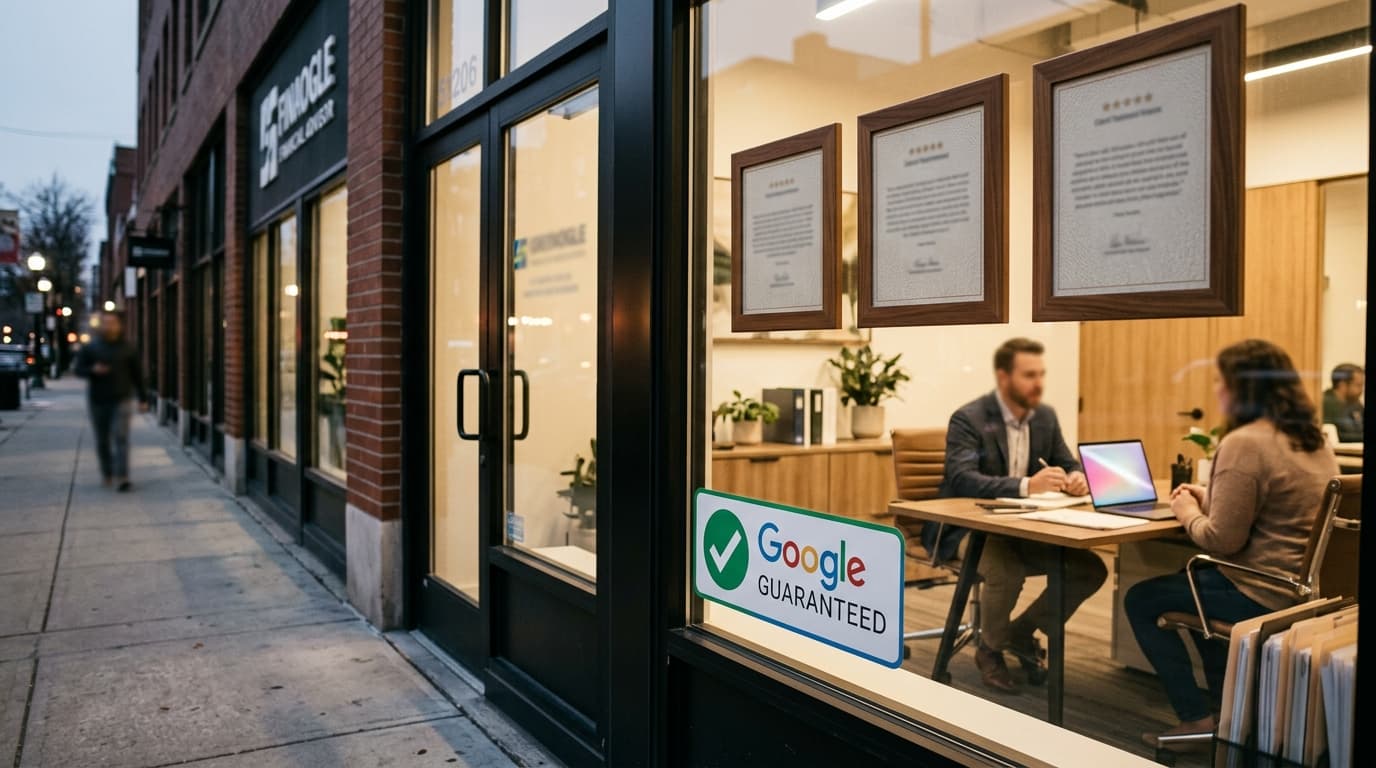
What is Social Proof? 5 Examples for Service Business Websites
Social proof is the psychological and social phenomenon where people assume the actions of others reflect correct behavior for a given situation. In marketing, it means using third-party influence like reviews, testimonials, case studies, and endorsements to build trust and persuade potential customers.
For service businesses, social proof isn't just a nice-to-have marketing tactic: it's a foundational requirement for growth. Unlike a physical product you can see and touch, your services are intangible. A potential customer can’t hold your legal advice, test-drive your plumbing repair, or try on your financial planning before buying. They are buying a promise of a future outcome. This makes their decision much riskier. Social proof bridges this trust gap by showing that other people, just like them, have already taken that risk and were happy with the result.
In 2026, customers are more skeptical than ever. They are bombarded with marketing messages and have learned to tune out direct advertising. Instead, they turn to their peers and trusted sources to make decisions. A 2025 study by the Online Trust Institute confirmed that 93% of consumers read online reviews before purchasing a local service. Without a strong, visible layer of social proof on your website, you are essentially invisible to the modern buyer. This guide covers the five most effective types of social proof for service businesses and provides practical steps to start using them today.
Five Essential Types of Social Proof for Service Businesses
Not all social proof is created equal. Different formats serve different purposes and appeal to different customer mindsets. A successful strategy combines several types to build a comprehensive case for why a prospect should choose you. Here are the five most impactful examples for any service-based company.
1. Customer reviews and ratings
Reviews are the most common and powerful form of social proof. They are direct, unfiltered feedback from actual customers that new prospects see as highly authentic. Star ratings provide an immediate at-a-glance signal of quality, while written reviews offer detailed context about the customer experience.
Why they work: Reviews tap into the "wisdom of the crowds" principle. If hundreds of people rate a dentist 4.9 stars, a new patient feels confident that they will also have a positive experience. The sheer volume of positive feedback creates a powerful signal of reliability and quality that is difficult for a business to fake. Specific details mentioned in reviews, such as a friendly staff member or a fast response time, make the service feel more tangible and relatable.
How to get them:
- Ask at the right time. The best moment to ask for a review is immediately after a successful service delivery. For a plumber, it’s after the leak is fixed. For a consultant, it’s after a project milestone is achieved. The positive feelings are fresh, making the customer more likely to share them.
- Automate the request. Manually emailing every customer is not sustainable. Use your CRM or a tool like WorkspaceCMS to trigger an automated email or SMS message 24–48 hours after a service is completed. The message should be simple: thank them for their business and provide a direct link to your preferred review platform (like Google Business Profile or Capterra).
- Make it easy. Reduce friction. Don't ask customers to find your review page themselves. Provide direct links. A message that says, "If you have 30 seconds, we'd appreciate you leaving a review on Google," with the link right there, gets much better results than a generic "review us online" plea.
Where to display them:
- Homepage: Feature a rotating carousel of your best four- and five-star reviews prominently on your homepage.
- Service pages: Embed relevant reviews on specific service pages. A customer looking at your "emergency AC repair" page will find a review about a fast, late-night repair far more compelling than a generic one.
- Dedicated testimonials page: Create a single page that aggregates all your best reviews, which also helps with SEO.
2. In-depth case studies
While reviews are short and emotional, case studies are detailed, data-driven stories. They are the ultimate form of social proof for high-value B2B services or any business with a long sales cycle. A great case study follows a classic narrative structure: it presents a client's problem, details the solution you provided, and showcases the measurable results you achieved.
Why they work: Case studies allow prospects to see themselves in the story. When a marketing agency manager reads a case study about how you helped a similar agency increase leads by 40%, they can easily envision you doing the same for them. The inclusion of specific data, metrics, and quotes from the client transforms a vague marketing claim ("we get results") into a verifiable fact ("we increased their qualified leads from 50 to 70 per month").
How to create them:
- Identify happy clients. Look for clients who have seen significant, quantifiable results and have a good relationship with your team.
- Get their permission. Always ask for permission to feature them in a case study. Explain the process and how it will benefit them (e.g., a backlink to their site, positive exposure).
- Interview them. Schedule a 30-minute call to ask structured questions. Focus on the "before" state, the challenges they faced, why they chose you, the implementation process, and the "after" state with specific numbers.
- Write the narrative. Structure the case study with clear sections: The Client, The Challenge, The Solution, and The Results. Use direct quotes to add authenticity.
- Get final approval. Send the draft to the client for their review and approval before publishing.
Where to display them:
- A dedicated library: House all your case studies in an easily searchable "Case Studies" or "Success Stories" section of your website.
- Service pages: Link to relevant case studies from the service pages they relate to.
- Sales proposals: Include one or two highly relevant case studies in every proposal you send to new prospects.
3. Client logos and testimonials
Client logos are a quick, visual form of "borrowed credibility." Displaying the logos of well-known and respected companies you've worked with sends an immediate signal of trust and authority. If these respected brands trust you, a new prospect will feel more comfortable doing so, too. Testimonials are the "greatest hits" version of reviews: short, powerful quotes that directly endorse your value proposition.
Why they work: Logos work on the principle of association. A prospect might not know your small consulting firm, but if they see you've worked with industry giants like Microsoft or Salesforce, they instantly perceive you as more credible and established. Testimonials work because they are concise and impactful. A quote like, "Working with ABC Corp doubled our lead flow in just six months," is a powerful statement that can be easily absorbed by a visitor scanning your homepage.
How to get them:
- Logos: Simply ask your clients for permission to use their logo on your website. Most companies are happy to agree, especially if you offer a backlink in return. Add this request to your project off-boarding checklist.
- Testimonials: Don't wait for them to come to you. When a client sends a positive email ("Thanks so much, the team loved the workshop!"), reply immediately and ask, "That's great to hear! Would you mind if we used that as a testimonial on our website?" You can also pull powerful quotes directly from longer reviews or case study interviews. Always attribute the testimonial with a full name, title, and company for maximum credibility.
Where to display them:
- "As Seen On" logo bar: Place a strip of client logos near the top of your homepage, just below the main hero section.
- In-line testimonials: Sprinkle pull-quotes and testimonials throughout your service pages to break up text and reinforce key selling points.
- Call-to-action sections: Place a strong testimonial right next to a "Request a Quote" or "Schedule a Consultation" button to reduce last-minute hesitation.
4. Certifications and industry awards
Expert social proof comes from recognized authorities in your field. This includes industry-specific certifications (e.g., Google Premier Partner, Certified Financial Planner), awards you've won ("Best Web Design Agency 2025"), and affiliations with professional associations. This type of proof demonstrates that your expertise has been vetted and approved by a neutral, respected third party.
Why they work: This form of proof appeals to a prospect's desire for safety and competence. Choosing a service provider is risky, but choosing one that has been officially certified or awarded feels much safer. It signals that your business adheres to a high standard of quality and ethics, which is a powerful differentiator in a crowded market. It shows you are committed to your craft and recognized by your peers.
How to leverage them:
- Get certified. Actively pursue relevant certifications in your industry. This not only provides you with a social proof asset but also improves your team's skills.
- Apply for awards. Keep an eye out for local and industry-specific business awards and make a point to apply. Even being a finalist can be a valuable marketing asset.
- Join associations. Become a member of your industry's main professional organizations.
Where to display them:
- Website footer: The footer is a standard, trusted location for certification badges and association logos.
- About us page: Detail your awards and certifications on your "About Us" page to build your company's story and credibility.
- Email signatures: Adding a key certification badge to your email signature reinforces your expertise in every communication.
5. User-generated content and social media mentions
User-generated content (UGC) is any content: photos, videos, or text: created by your customers rather than your brand. This could be a client posting a photo of their newly landscaped yard on Instagram and tagging your company, or a B2B client sharing your latest blog post on LinkedIn with a positive comment. These organic mentions are incredibly powerful because they are seen as completely authentic and unsolicited endorsements.
Why they work: UGC acts as word-of-mouth marketing at scale. When a person's friends or followers see them endorse a service, it carries more weight than a branded ad. The recommendation comes from a trusted source within their own network. It shows that your clients are not just satisfied: they are happy enough to become public advocates for your brand, which is the strongest signal of quality you can send.
How to encourage it:
- Create shareable moments. For B2C services, think about the finished product. A home organizer can encourage clients to post "before and after" photos. A caterer can create a beautiful food display that people will naturally want to photograph and share.
- Run a contest or giveaway. Encourage customers to share a photo or post related to your service using a specific hashtag for a chance to win a prize.
- Engage with every mention. Use social listening tools to monitor mentions of your brand. When someone posts something positive, thank them, and ask if you can feature their post on your website.
Where to display them:
- Social media feed on your website: Use a tool to embed a live feed of Instagram or LinkedIn posts that mention your brand or use your hashtag.
- Gallery or "Inspiration" page: Create a page dedicated to showcasing photos of your work in the real world, as shared by your clients.
- Product/service pages: If a customer shares a photo of a specific service (e.g., a new deck your construction company built), embed that post on the "Deck Building" service page.
Building Your Social Proof Pipeline
Collecting social proof shouldn't be a one-time project. It needs to be an ongoing process integrated into your daily operations. You need a system: a repeatable, automated way to generate reviews, identify case study candidates, and request testimonials. We call this a "social proof pipeline."
Many businesses struggle here because they rely on manual, inconsistent efforts. A project manager remembers to ask for a review one week but forgets the next three. This approach leads to a trickle of feedback, not a steady stream. A modern approach uses automation to ensure no opportunity is missed.
At WorkspaceCMS, our platform is designed for this. We provide built-in tools to create a seamless content pipeline for social proof. For example, you can set up an automated workflow that does the following:
- When a project is marked "complete" in your project management tool, it triggers an action in WorkspaceCMS.
- An automated, personalized email is sent to the client 48 hours later, thanking them and asking for a review with direct links to Google and your industry-specific review site.
- If the client clicks the link and leaves a four- or five-star review, a second automated email is triggered a week later, asking if they would be willing to provide a more detailed testimonial or participate in a case study.
This "schedule and forget" system ensures a constant flow of fresh reviews and identifies your happiest customers who are prime candidates for deeper marketing assets. This is how you move from passively hoping for social proof to actively manufacturing it as a core part of your marketing engine, all from one dashboard.
What About Negative Reviews? An Online Reputation Management Strategy
No business is perfect, and eventually, every service business will receive a negative review. Many owners panic, but a bad review is not a disaster. It is an opportunity. How you respond to public criticism says more about your business than a dozen five-star reviews combined.
A solid online reputation management strategy has three key components:
1. Respond quickly and professionally. A fast response shows you are listening and you care. Address the reviewer by name, thank them for their feedback, and apologize that their experience did not meet their expectations. Never get defensive or make excuses. Your audience is not just the unhappy customer: it's every future prospect reading the review.
2. Take the conversation offline. Provide a direct point of contact. Say something like, "We are committed to making this right. Please contact our manager, Jane, at [email] or [phone number] so we can learn more and find a solution." This moves the specific resolution out of the public eye while demonstrating your commitment to solving the problem.
3. Use feedback to improve. Every negative review contains a kernel of truth. Is your communication slow? Is your billing confusing? Use the feedback to identify weak spots in your service delivery and fix them. A business that visibly learns and improves from criticism earns immense respect and trust.
Remember, a profile with 100% perfect five-star reviews can actually look less trustworthy than one with a 4.8-star average and a handful of thoughtfully-addressed negative reviews. It shows you're a real, human business operating in the real world.
Comparing Social Proof Automation Tools
To effectively manage your social proof pipeline, you'll need the right tools. While manual methods can work when you're starting, they don't scale. Here’s a comparison of three popular approaches in 2026 for service businesses.
| Feature | WorkspaceCMS | Multiple Standalone Plugins (e.g., on WordPress) | Manual Process (Email & Spreadsheets) |
|---|---|---|---|
| Review Requests | Built-in and automated, triggered by project status. | Requires a dedicated review plugin (e.g., Trustpilot, Yotpo). | Requires manual tracking and sending of individual emails. |
| Displaying Reviews | Drag-and-drop widgets to embed filtered reviews on any page. | Each review platform plugin has its own separate widget and style settings. | Requires manually copying and pasting text into your website editor. |
| Case Study Publishing | Part of the all-in-one blog and content calendar system. Publish automatically. | Published as standard blog posts. No specialized management tools. | Manual upload of PDF or creation of a new webpage for each one. |
| Cost & Complexity | Included in one platform subscription. One dashboard, no version conflicts. | Multiple plugin subscriptions, potential for plugin conflicts and security risks. | No direct cost, but extremely high time cost and prone to human error. |
| Best For | Businesses wanting an all-in-one website management and marketing solution. | Businesses with an existing WordPress site and technical staff to manage plugins. | New businesses with very few clients and a minimal budget. |
The key takeaway is that an integrated system saves time and prevents things from falling through the cracks. Using an all-in-one platform like WorkspaceCMS means your social proof strategy is part of your core website management, not a separate task you have to remember to do. The system is SEO-ready out of the box, ensuring your case studies and testimonials pages are indexed and found by search engines.
Social proof is the engine of trust for modern service businesses. By systematically collecting and strategically displaying reviews, case studies, testimonials, and expert endorsements, you give prospects the confidence they need to choose you. Stop leaving it to chance. Build a pipeline, automate the process, and turn your happy customers into your most powerful sales team.
Social Proof Marketing FAQ
What is the most important type of social proof?
For most local and B2C service businesses, customer reviews on trusted third-party platforms like Google are the most important. For high-value B2B services, in-depth case studies often have the most impact because they provide the detailed, data-backed evidence that business buyers need to make a decision.
How many reviews do I need to get started?
You don't need hundreds. A good starting goal is to get 10–15 recent, high-quality reviews on your most important platform (usually your Google Business Profile). Momentum is key: it's better to have 15 reviews from the last six months than 50 reviews that are all over three years old. Recency matters to prospects.
Is it okay to offer an incentive for a review?
This is a tricky area. You should never offer an incentive for a *positive* review, as this violates the terms of service for most platforms (like Google and Yelp) and misleads customers. However, offering a small, neutral incentive for leaving *any* review (e.g., entry into a drawing for a gift card) is sometimes acceptable, but you must check the specific platform's policies first.
How can I use social proof if my business is brand new?
If you're brand new, you can leverage "expert" social proof. Display your personal certifications, degrees, or years of experience in the industry. You can also offer your service to a few initial "beta" clients at a discount in exchange for detailed testimonials and permission to create a case study. This helps you build your initial library of proof.
What's the difference between social proof and a testimonial?
A testimonial is a specific *type* of social proof. "Social proof" is the broad psychological concept, while a testimonial is a specific asset: a direct quote or statement from a happy customer endorsing your business. Case studies, reviews, and client logos are also types of social proof.

See how WorkspaceCMS compares.
Book a growth call. We'll show you a live demo of WorkspaceCMS running on a site in your industry.
Want the full picture? Browse more posts