
Growth campaigns · Managed IT & Cybersecurity

Growth campaigns for managed IT and cybersecurity providers

Your best-fit prospect is not shopping for IT. They are stuck on question fourteen of a cyber insurance renewal, or holding a customer's vendor security questionnaire that nobody in the office can answer. This campaign puts your firm in front of both moments.

Live Managed IT & Cybersecurity demo

Northgate Managed IT

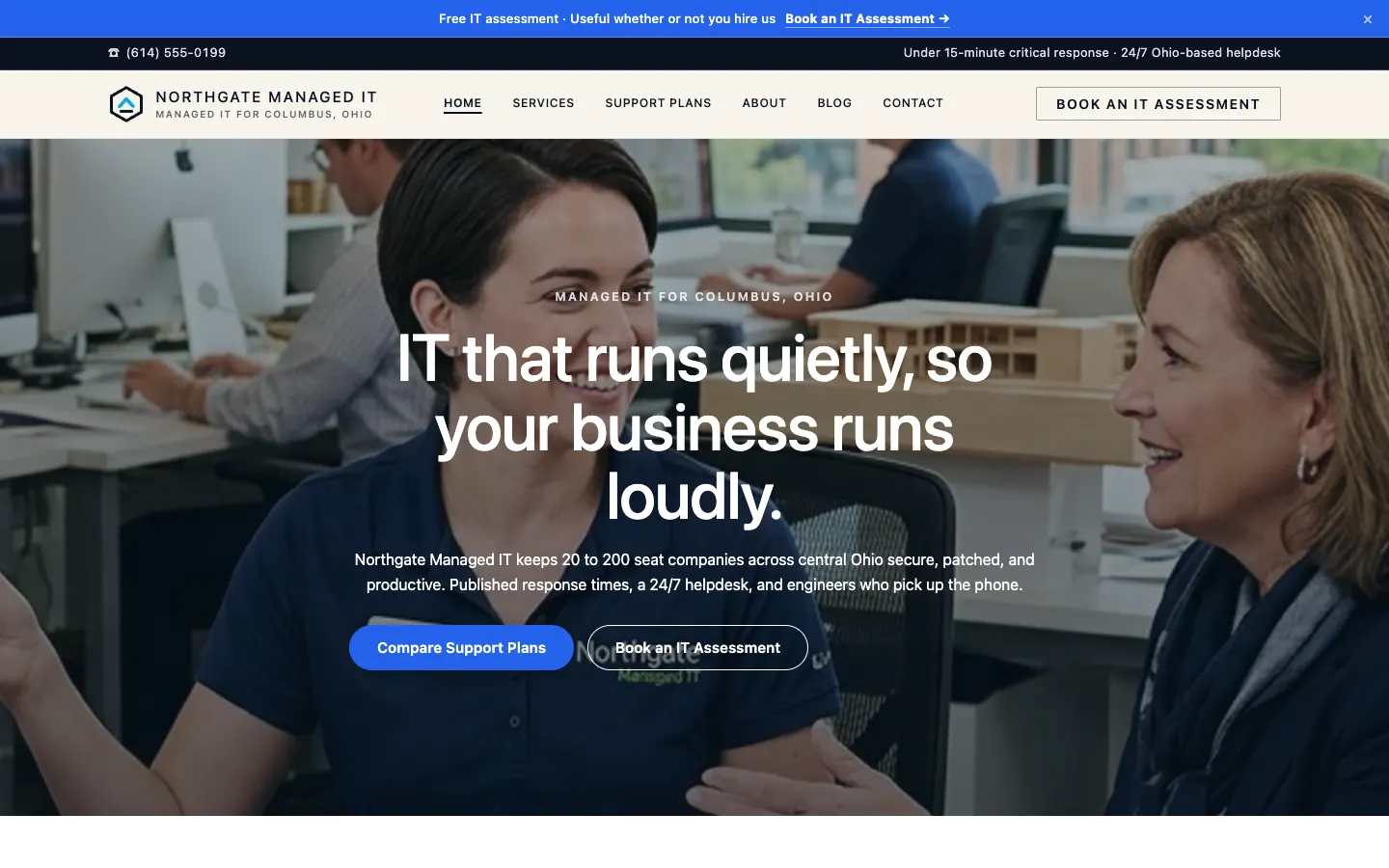
A near-black navy and electric-blue managed-IT site for a Columbus MSP serving 20–200 seat businesses: fully managed IT, co-managed IT, cybersecurity & compliance, and cloud migration, each with its own page, plus three support plans with published response times and a four-level ticket-triage table, a week-by-week first-month onboarding timeline, an assume-breach incident-response walkthrough, two Ohio client results, testimonials, an FAQ, a blog, and a contact form.

Published Response-Time Plans + First-Month Onboarding Timeline. Northgate Managed IT is the live example: its published response-time tiers and first-month onboarding timeline are the pages a controller reads before agreeing to meet.

Open the live demo → Managed IT & Cybersecurity websites

Northgate Managed IT — live managed it & cybersecurity website built on WorkspaceCMS
Where the demand is

How managed it & cybersecurity buyers actually search

Most search that reaches a security-led MSP begins with paperwork, not with a crashed server. A cyber insurance renewal asks whether multi-factor authentication is enforced on every remote entry point. A customer sends over a vendor security questionnaire that the office manager cannot answer. A regulator or a prime contractor names a framework by acronym and the business owner types that acronym into a search box along with the name of their city. The queries look nothing like IT support queries: they are compliance nouns attached to a geography, searched by someone who has been handed a deadline and does not yet know what they are buying.

The second entry point is the incident, and it behaves completely differently. Those searches are short, phrased in plain panic language, made from a phone at an hour nobody staffs a sales desk, and decided in a single sitting. Whoever has a page explaining what the first hour of an engagement looks like gets the call, because the alternative is calling a number and hoping.

Then there is the slow lane. A twenty-to-two-hundred-seat business replacing an incumbent provider assembles an informal committee: the owner, the controller who owns the invoice, and one internal person who has strong opinions about the current help desk. They read for weeks before any form is filled. Seasonality is mild but real, tied to insurance renewal months and fiscal year ends rather than to weather, and the deals that close fastest are the ones where the site had already answered the controller's question about what happens when a ticket goes unanswered.

The keyword clusters we build around

  • Framework and questionnaire intentSearchers naming a compliance framework or an insurance requirement next to a city. Point them at a plain-language page for that framework that explains what an assessment covers and what evidence you produce.
  • Incident and breach urgencyRansomware, business email compromise and account-takeover searches made in the moment. These need an incident-response page that states how contact works after hours and what the first hour looks like.
  • Provider replacementPeople searching to switch away from a current MSP, often phrased as complaints. Meet them with your support-plan and response-time pages rather than a capabilities overview.
  • Co-managed and internal-IT supportAn internal admin looking for backup on security tooling, not a full outsource. Needs its own page, because a site that only sells full outsourcing reads as irrelevant to them.
  • Cloud and workload migrationProject-shaped searches around moving file servers, mail and line-of-business apps. Project work is the common front door to a managed agreement, so treat it as an entry point, not a sideline.
The campaign

Three ways we go get the traffic

Local SEO, AI-assistant visibility and paid media, run by the agency team that has been doing it since long before WorkspaceCMS existed.

Local SEO

Framework acronyms are the queries that matter here. We publish a plain-language page for each standard you assess against, whether that is HIPAA, CMMC, PCI or a carrier's own questionnaire, and pair them with pages for every metro and county your engineers genuinely cover. The response-time page and the incident-response page get internal links from every service page, because those are the two documents a controller opens before agreeing to a call. Technical work keeps them fast and crawlable at two in the morning, which is exactly when breach traffic arrives.

AI search visibility

Ask an assistant which providers nearby can help with a cyber insurance questionnaire and it will quote whoever wrote down an actual answer. Framework pages phrased as answers, a support-plan page with stated escalation paths, a written ticket-triage process and structured service and location markup give ChatGPT, Claude, Perplexity and Google AI Overviews text worth lifting. A site that says only that your firm is proactive and trusted is unquotable, so the model names the provider down the road who published their after-hours process instead.

Paid media

Most MSP ad accounts burn through budget on broad IT support terms that pull in home users with a slow laptop. Spend goes instead to the two searches that carry a decision: ransomware and business email compromise queries typed at midnight, and the grievance phrasing of someone who has already decided to leave their current provider. Those clicks land on the incident-response page and the support-plan page, never the home page, and after-hours scheduling stays switched on because that is when the panic searches happen.

Campaigns are an add-on to a WorkspaceCMS plan and start from $499/mo. The plan itself is a monthly subscription. The build is included, the platform is not free. Local SEO campaigns are scoped to single and multi-location businesses rather than national or global SEO. Paid search management covers service businesses rather than online stores; ad spend is billed by Google or Meta directly to your own account. Full campaign scope → · Plan pricing →

What gets in the way

Six things that hold managed it & cybersecurity sites back

01

Compliance questions arrive before capability questions

The first thing a prospect wants to know is whether you can get them through a questionnaire or an audit item by a date. Sites organized around services rather than around obligations make that person guess, and guessing loses to the competitor whose page names the framework.

02

The security practice hides behind the help desk

Most MSP sites bury real security work under a generic support banner. Buyers who came in through a breach or a renewal cannot tell whether you run monitoring and response yourself or resell it, and they will not call to find out.

03

Every provider promises proactive, responsive and trusted

Three adjectives that appear on nearly every competitor site say nothing a buyer can compare. Published response commitments and a ticket-triage explanation give a controller something concrete to weigh, which is precisely what the adjective version denies them.

04

After-hours searches meet a nine-to-five site

Incident traffic arrives at night and on weekends. If the only path forward is a contact form promising a reply during business hours, the urgent lead, which is also the highest-value one, is handed to whoever states an after-hours process.

05

Co-managed prospects assume you want to replace them

Internal IT staff read managed services as a threat to their job and bounce. Without a page that describes the co-managed split in terms of who owns which tickets, an entire buyer segment self-selects out before you know they visited.

06

Onboarding fear kills otherwise-won deals

Businesses stay with a provider they dislike because migration sounds like a month of outages. A week-by-week account of what changes and when removes the objection while the prospect is still reading, rather than in a sales call you never get.

Campaign add-ons

Pick the campaign that fits the market

Every package below is bought from your dashboard once your site is live. Names, prices and deliverables are read from the catalog at page load, so what you see here is what you would be buying.

Questions

Managed IT & Cybersecurity marketing, answered

Should our incident-response page publish an after-hours phone number?

If you can honestly staff it, yes. Breach searches happen at night and on weekends, and a page offering a reply during business hours hands the most valuable inquiry you will ever get to the competitor who stated a process.

We resell parts of our security stack. How much of that should the site say?

Say what you operate and what you orchestrate, in those terms. Buyers arriving from a renewal or an incident want to know who watches the alert at three in the morning, and vagueness there reads as reselling whether or not it is.

Do co-managed prospects need their own pages, or will our managed services pages do?

They need their own. An internal systems administrator reads a full-outsource pitch as a threat to their job and leaves, so the page has to describe the split by who owns which tickets before it describes any capability.

We assess against several frameworks. Which ones deserve a page?

The ones your prospects get handed by somebody else: an insurance carrier, a prime contractor, a regulator or a customer's procurement team. Those searchers arrive typing an acronym they do not understand next to their city, which is very winnable traffic.

Our engineers write the case studies. Why do they not move the controller?

Because the controller signs and does not read packet captures. The same engagement needs a second telling in operational terms, framed around what stopped breaking, what the help desk queue looked like afterwards and what the finance team stopped hearing about.

Your free site is one click away

Ready to grow a managed it & cybersecurity business?

Get the site built, then put a campaign behind it. Start online, or talk it through with a strategist first.

Want the full picture? See what a campaign includes