
Growth campaigns · Escape Rooms

Filling weekend slots and corporate bookings for escape rooms

Nobody books an escape room alone. One person searches, herds a group chat, and books for everyone, so the campaign is aimed at an organizer who needs difficulty, run time, minimum players, and an open slot before they can send the message.

Live Escape Rooms demo

Vault Escape Experiences

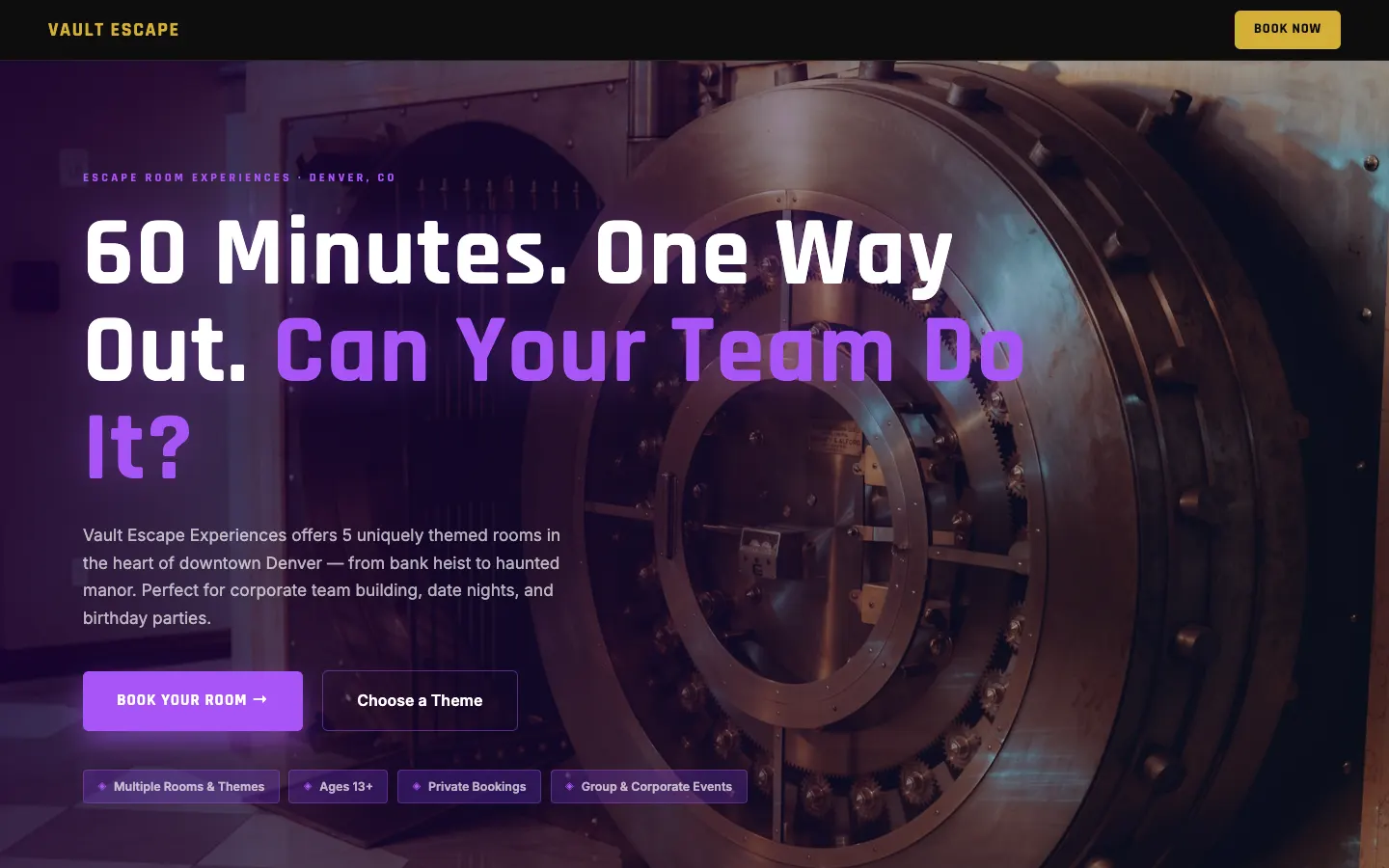
A high-intensity dark purple escape room site with Rajdhani headings, themed room cards with difficulty ratings, and group event packages.

Themed Room Roster + Group Booking Flow. Vault Escape Experiences is the setup we like to campaign into, with themed room cards carrying difficulty and player counts, a live booking flow, and event packages that give a corporate inquiry somewhere real to land.

Open the live demo → Escape Rooms websites

Vault Escape Experiences — live escape rooms website built on WorkspaceCMS
Where the demand is

How escape rooms buyers actually search

Almost all of this demand starts one step upstream of your category. The searcher types something about what to do this weekend, or a birthday activity, or a team outing, and only narrows to escape rooms once they have seen options. That means the campaign has to contest the activity-level query, not just the category one, and it has to survive being compared against axe throwing, mini golf, and a restaurant on the same results page.

The organizer is a distinct buyer with a distinct checklist. They are coordinating a group calendar, so date and time availability outranks theme quality in the decision; they need to know the minimum and maximum players before they know who is coming; and they will abandon a site that makes them call to find out. Every hour the booking widget cannot answer those questions is an hour a competitor with live availability takes the booking.

Inventory is fixed and perishable in a way that shapes the whole plan. A Saturday evening slot sells itself and a Tuesday afternoon never will, so the marketing job is not raw volume but shifting demand into weak slots and into higher-value corporate blocks. Corporate team-building runs on a completely different cycle from consumer bookings, with a longer lead time, a procurement-flavored comparison, and a budget-holder who wants an invoice and a private buyout rather than a promo code.

The keyword clusters we build around

  • Things to do intentWeekend activity, date night, rainy day, and visitor searches that have not narrowed to escape rooms yet. Content that competes at this level pulls in demand before your category competitors ever see it.
  • Occasion bookingsBirthday parties, bachelor and bachelorette groups, graduations, family reunions. Each occasion has different group sizes and add-on expectations and deserves its own landing page.
  • Corporate team buildingA separate buyer entirely, searching for team events, private buyouts, and invoiced group activities. Longer cycle, larger booking, and worth a dedicated page with capacity and billing details.
  • Room and theme discoverySearches for horror, heist, family-friendly, or beginner rooms. Themed room pages with difficulty and player counts are what make the site rankable beyond a single homepage.
  • Group logistics questionsMinimum players, age limits, accessibility, how long it takes, whether strangers are combined. These practical questions decide the booking and are heavily quoted in AI answers.
The campaign

Three ways we go get the traffic

Local SEO, AI-assistant visibility and paid media, run by the agency team that has been doing it since long before WorkspaceCMS existed.

Local SEO

Most of this demand starts one step upstream, at what a group should do on a Saturday, so occasion pages for birthdays, bachelor parties, reunions, and team outings get built alongside the room roster, plus a corporate events page that is more than a paragraph on the homepage. Room pages carry theme, difficulty, run time, and player range as readable facts. When a room retires, the redirect is planned in advance so its replacement inherits the position the old page spent a year earning rather than starting from nothing.

AI search visibility

Assistants get asked what a visiting group can do in your city tonight, and they answer by naming venues that published the practical detail. An escape room becomes quotable through room themes and difficulty, run time, minimum and maximum players, age policy, whether strangers are combined into a booking, accessibility, and how private buyouts work. Those are the questions an organizer asks anyway, so answering them plainly serves both readers. We structure it so ChatGPT, Claude, Perplexity, and Google AI Overviews recommend your venue with details that are actually correct.

Paid media

Volume is not the goal, because Saturday evening sells itself. Campaigns are dayparted toward the slots that sit empty, weekday afternoons and early evenings, and pointed at the audiences with flexible calendars: students, visitors, shift workers, and corporate teams. The corporate side runs as its own campaign with its own landing page and inquiry form, since a budget holder wants capacity, buyout terms, and an invoice rather than a consumer booking widget. Paid social takes room launches, where the set photography does the persuading better than any headline.

Campaigns are an add-on to a WorkspaceCMS plan and start from $499/mo. The plan itself is a monthly subscription. The build is included, the platform is not free. Local SEO campaigns are scoped to single and multi-location businesses rather than national or global SEO. Paid search management covers service businesses rather than online stores; ad spend is billed by Google or Meta directly to your own account. Full campaign scope → · Plan pricing →

What gets in the way

Six things that hold escape rooms sites back

01

You are competing with every other activity, not other rooms

The organizer's shortlist includes bowling, a brewery tour, and a restaurant. Ranking well against other escape rooms is only half the job; the site has to win the earlier, broader activity search, which needs content built around occasions and group types rather than around your room roster.

02

Weekend slots sell out while weekdays sit empty

Revenue is capped by the hours nobody wants. Blanket campaigns simply add competition for the Saturday slot you were going to sell anyway. Effective work targets the weak windows specifically, through weekday-oriented offers, corporate blocks, and content aimed at groups with flexible schedules.

03

Room rotation resets your search equity

Retiring a room and launching a new one is necessary to keep repeat customers coming, but it quietly deletes a page that had spent a year earning position. Without a deliberate plan for redirects and for building the new room's page early, every refresh costs visibility that took months to accumulate.

04

Repeat customers run out of inventory

Unlike most local businesses, a delighted customer can only buy so many times before they have played everything. Growth therefore depends more heavily on continuously reaching new groups and on corporate demand than on loyalty, which changes how budget should be split.

05

Aggregator and ticketing platforms sit above you

Experience marketplaces bid on your brand terms and list you next to every competitor while taking a cut of the booking. The counter is to make direct booking obviously better, with live availability, clear pricing, and content those platforms cannot reproduce, then to protect your own brand search.

06

Corporate inquiries are handled like consumer bookings

A company planning a team event needs capacity, private buyout options, catering compatibility, invoicing, and a human to talk to. Routing them through the same public booking widget as a birthday group loses the largest bookings on your calendar to a competitor with a proper corporate page.

Campaign add-ons

Pick the campaign that fits the market

Every package below is bought from your dashboard once your site is live. Names, prices and deliverables are read from the catalog at page load, so what you see here is what you would be buying.

Questions

Escape Rooms marketing, answered

Can you help us fill weekday afternoons rather than weekends?

That is where the work pays. We aim content and campaigns at groups with flexible schedules, students, visitors, and corporate teams, and schedule bidding toward your empty windows instead of competing hardest for the Saturday slot that was going to sell anyway.

We are retiring a room and opening a new one. When should marketing start?

Before the door opens. The retiring room page has spent a year earning position, and a planned redirect hands that to the new room, while the new page needs lead time to be indexed and cited. Publishing it during opening week is how that equity gets thrown away.

Should corporate team building be handled separately from birthday groups?

Completely separately. A corporate buyer works a longer cycle and needs capacity, private buyout terms, catering compatibility, and invoicing, none of which fit a consumer booking widget. A dedicated page with a human inquiry route usually protects the largest bookings on your calendar.

Experience marketplaces list us beside every competitor. What can we do?

Make direct booking obviously better and defend your own brand search. Live availability, honest player-count guidance, and room detail those platforms cannot reproduce give an organizer a reason to finish the booking on your site rather than in a marketplace basket.

Our regulars have played every room. Where does growth come from?

New groups and corporate blocks, mostly. Unlike a repair trade, a delighted customer eventually runs out of inventory here, so the plan leans on occasion-level content and team-building demand, and on giving past players a reason to come back when a new room opens.

Your free site is one click away

Ready to grow a escape rooms business?

Get the site built, then put a campaign behind it. Start online, or talk it through with a strategist first.

Want the full picture? See what a campaign includes