
Growth campaigns · Childcare / Preschool

Enrollment campaigns for preschools and childcare centers

Choosing a preschool is the highest-trust purchase most parents ever make, and they screen licensing records, ratios, room photos, and rate structure long before anyone books a tour. The campaign wins by answering all of that on the page.

Live Childcare / Preschool demo

Sunflower Learning Center

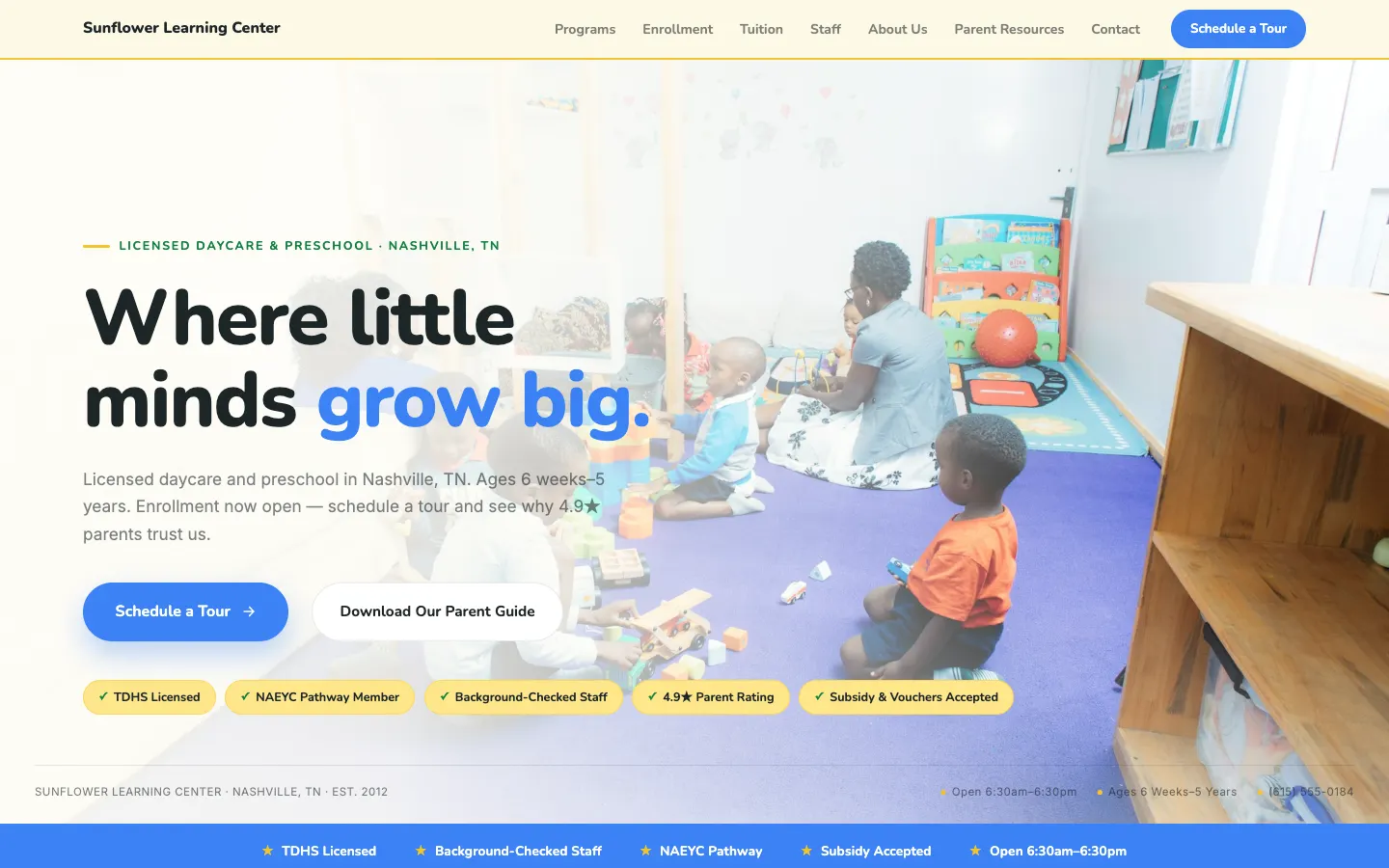
Nashville daycare and preschool: program tiers by age, tuition table, enrollment flow, parent-resources blog, and trust-builder safety section.

Enrollment Funnel + Parent Trust Signals. Sunflower Learning Center shows the enrollment path we campaign into, with programs split by age room, a published tuition table, a licensing and safety section, and a tour booking a searching parent can complete unaided.

Open the live demo → Childcare / Preschool websites

Sunflower Learning Center — live childcare / preschool website built on WorkspaceCMS
Where the demand is

How childcare / preschool buyers actually search

Enrollment demand is governed by two clocks at once. The academic clock drives a heavy inquiry season in late winter and spring as families plan for fall placement, and a second smaller wave around the calendar year when parental leave ends. The individual clock is whenever a family's arrangement breaks: a nanny leaves, a job changes, a move completes. A center that only markets during enrollment season is absent for every family in the second category, which is a meaningful share of the year's fills.

What parents do before they call is unusually specific to this industry. They check the state licensing record, they read the most recent reviews rather than the average, they look for photos of the actual rooms, and they hunt for tuition. Centers that hide tuition behind a form lose a large fraction of that traffic to whichever competitor published a rate table, because the parent is screening for affordability before they will spend an hour on a tour.

Availability is the constraint that makes this vertical unlike most local services. Infant rooms run at capacity with waitlists while a preschool room sits open, so undifferentiated marketing generates inquiries the center cannot serve and misses the ones it can. Campaigns worth running are segmented by age room, because the parent of an infant and the parent of a four-year-old are searching different terms, on different timelines, with different anxieties.

The keyword clusters we build around

  • Age-room searchesInfant care, toddler program, two-year-old class, pre-K. Each maps to a distinct room, ratio, and price point, and each deserves its own page so the campaign can be pushed toward whichever rooms have openings.
  • Tuition and affordabilityParents searching for what care costs in their area, plus subsidy and assistance program questions. A published tuition table captures this traffic instead of losing it to a directory site.
  • Safety, licensing, and credentialsQueries about licensing status, staff background checks, ratios, and security. These convert slowly but they are the questions that decide the tour, and they are heavily cited by AI assistants.
  • Schedule shapePart-time, half-day, extended hours, and drop-in searches from parents whose work pattern will not fit a standard day. Naming what you actually offer separates you from centers that only publish a single schedule.
  • Neighborhood and commuteParents search along the commute, not around the home. Pages built for the neighborhoods on the way to the employment centers you draw from match how the query is really phrased.
  • Waitlist and enrollment timingWhen to apply, how the waitlist works, what a deposit holds. Answering this openly turns a family that cannot start now into a family who joins the list instead of leaving.
The campaign

Three ways we go get the traffic

Local SEO, AI-assistant visibility and paid media, run by the agency team that has been doing it since long before WorkspaceCMS existed.

Local SEO

Parents search by the room their child needs rather than by your brand, so infant, toddler, two-year-old, and pre-K each get a page carrying that room's ratio, daily rhythm, and rate structure. Neighborhood pages follow the commuting corridor rather than the home address, because that is how the query is actually phrased. Licensing status, hours, and review data are structured so your own site argues alongside the state listing and the aggregator profiles instead of sitting beneath them, and internal links steer visitors toward whichever rooms have space this month.

AI search visibility

Assistants are asked constantly how to judge a daycare, and they answer with whichever centers state verifiable facts. Yours becomes citable when licence number and status, staff credentials, caregiver-to-child ratios, opening hours, age ranges by room, tuition structure, and the waitlist process are published plainly instead of gated behind a tour request. Real parent questions answered on the page and a current review corpus do the rest. We write and mark up that material so ChatGPT, Claude, Perplexity, and Google AI Overviews can quote your center accurately.

Paid media

The common failure is one campaign for the whole center, which buys infant inquiries you have to decline while the pre-K room stays half empty. Search campaigns are split by age room and by schedule shape, part-time, half-day, and extended hours, with weight shifted toward whatever has openings. Geofencing follows the corridors your families drive to work, Local Services Ads run where they are available to you, and paid social carries open-house and enrollment-season awareness for parents already anxious about the autumn who have not searched yet.

Campaigns are an add-on to a WorkspaceCMS plan and start from $499/mo. The plan itself is a monthly subscription. The build is included, the platform is not free. Local SEO campaigns are scoped to single and multi-location businesses rather than national or global SEO. Paid search management covers service businesses rather than online stores; ad spend is billed by Google or Meta directly to your own account. Full campaign scope → · Plan pricing →

What gets in the way

Six things that hold childcare / preschool sites back

01

Inquiries arrive for the rooms that are already full

Infant demand outruns capacity almost everywhere while older rooms have space, so a general campaign produces a queue of families the center has to turn away and no lift where it needs one. The fix is age-room segmentation across pages, ads, and content, so budget can be steered toward whatever is actually open this month.

02

Tuition is hidden and parents screen it out

Centers withhold rates hoping to get the tour first, but a parent comparing options will simply choose the site that published a table. Publishing pricing structure openly filters out families who were never going to enroll and raises the quality of everyone who does book a tour.

03

Directory sites outrank the center itself

Aggregators and state listing sites often occupy the results for the exact term a local parent types, and they list every competitor alongside you. Winning back that traffic takes neighborhood pages and content depth those directories cannot match, plus a review presence strong enough that your own listing wins the comparison inside them.

04

One bad review outweighs a long good record

In no other local vertical is review sensitivity this severe, because the stakes are a child. Recency matters more than the average, so the campaign has to include a steady, compliant way of asking satisfied families rather than a single push after a problem appears.

05

Photos are the proof and most sites have none

Parents want to see the actual rooms, the playground, the sign-in area, the staff. Stock imagery reads as evasion in this industry specifically. Getting real photography onto program pages, with the privacy considerations handled properly, moves tour bookings more than another paragraph of copy will.

06

Tour requests go unanswered past the decision window

A parent solving a childcare gap is contacting several centers the same evening and enrolling with whoever responds first with a real time slot. A form that lands in an inbox nobody checks until Monday loses to a competitor with online tour scheduling, regardless of which center is better.

Campaign add-ons

Pick the campaign that fits the market

Every package below is bought from your dashboard once your site is live. Names, prices and deliverables are read from the catalog at page load, so what you see here is what you would be buying.

Questions

Childcare / Preschool marketing, answered

Our infant room has a waitlist. Should we advertise it at all?

Keep a light presence on infant terms but route it to a waitlist page rather than a tour request, and move the working budget to the rooms with space. That banks demand you can fill when a place opens instead of forcing your director to decline inquiries every week.

Do parents really check the state licensing record before they call?

Routinely, and they read the most recent inspection rather than the overall history. Publishing your licence status, your ratios, and how you handle corrective items keeps that research on your own site instead of ending on a state portal that lists your competitors beside you.

How much does photography of the actual rooms matter?

In this vertical stock classroom imagery reads as evasion. Parents want the real nap room, the playground gate, the sign-in desk, and the faces of the teachers. Getting genuine photos onto the room pages, with photo consent handled properly, moves tour bookings further than another paragraph of copy will.

We answer evening tour requests the next morning. Is that a problem?

It is often the whole problem. A family solving a childcare gap contacts several centers the same night and enrolls with whoever offers a real time slot first, so self-service tour scheduling usually outperforms any wording change we could make to the form above it.

Should the daily schedule be on the site, or saved for the tour?

Put it on the site. Drop-off routine, nap window, meals, outdoor time, and the pickup cutoff are exactly what a parent is trying to picture, and publishing them screens out families whose shift pattern was never going to fit your hours.

Your free site is one click away

Ready to grow a childcare / preschool business?

Get the site built, then put a campaign behind it. Start online, or talk it through with a strategist first.

Want the full picture? See what a campaign includes