
Growth campaigns · Childcare Services

Local campaigns for childcare services with a full program ladder

A family childcare service competes on continuity: the same caregiver, a small group, and a program that keeps going as the child grows. The campaign makes that ladder visible, so a family arriving for infant care already sees summer camp waiting at the top.

Live Childcare Services demo

Tiny Hearts Childcare -

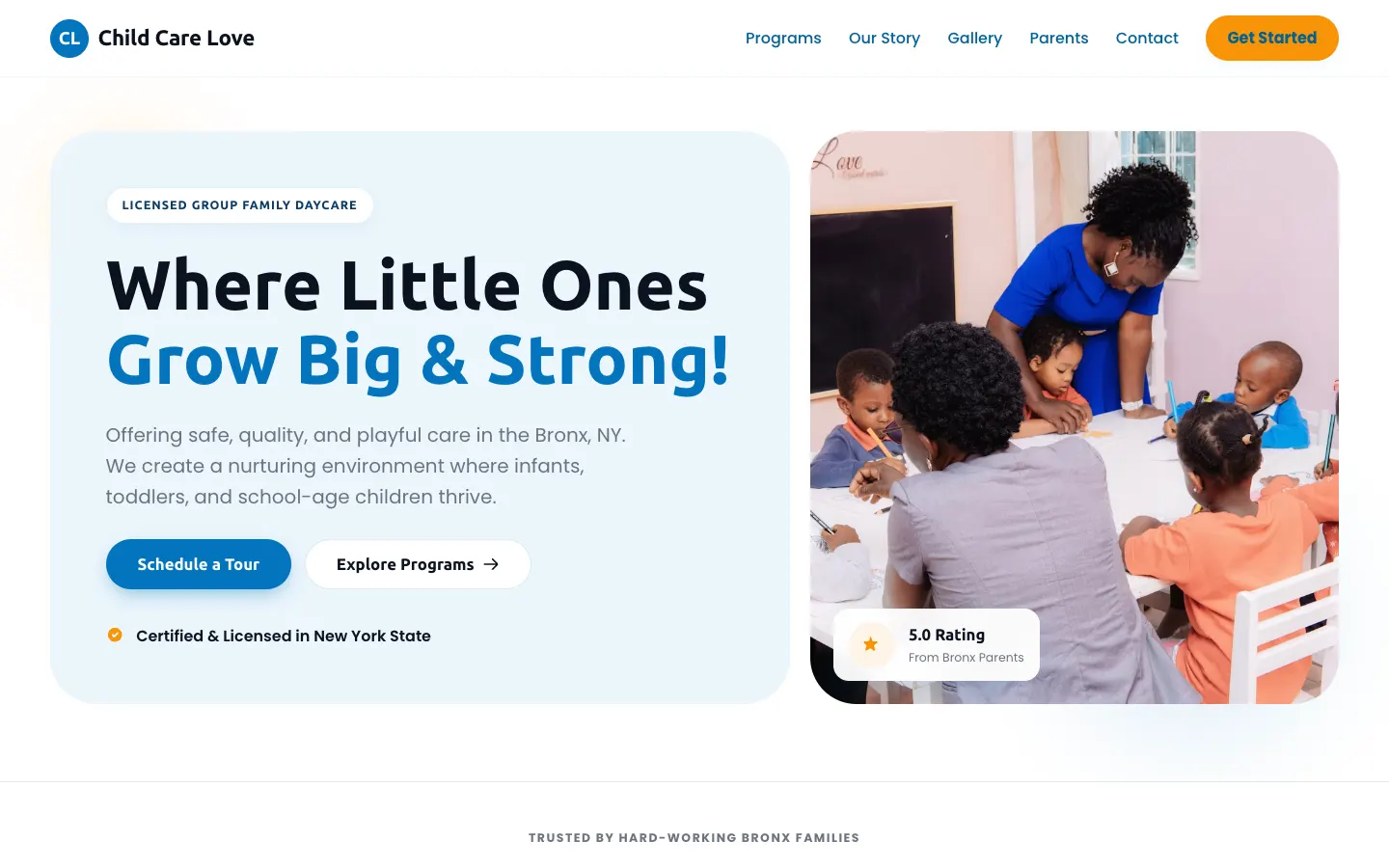
Warm, frosted-glass family daycare site built around a full program ladder from infant care through summer camp.

Infant-to-Summer-Camp Program Ladder. Tiny Hearts Childcare is the ladder made visible, infant care through summer camp with every rung on its own page, which is the structure that keeps a family with you as their child ages out of one program and into the next.

Open the live demo → Browse all demos

Tiny Hearts Childcare - — live childcare services website built on WorkspaceCMS
Where the demand is

How childcare services buyers actually search

Retention is the whole business model here, and it changes what marketing should optimize for. A family that enters at infant care and stays through summer camp is worth years of enrollment, so the highest-return campaign work is not a bigger top of funnel but making the later rungs of the ladder discoverable to families already inside. Most childcare service sites bury everything past the toddler room, and the parent then goes searching for a summer program somewhere else.

The service radius is genuinely tiny. Parents will not drive far past their route with a child in the car, which means the searchable market is measured in neighborhoods rather than cities and the competition is a handful of named nearby providers rather than a broad field. That works in a small operator's favor: it is realistic to be the most thoroughly documented option within a few square miles, in a way it would never be for a metro-wide search.

Seasonality splits into two shapes that need separate handling. Ongoing care demand is triggered by individual family events all year and does not follow a season at all. Camp and school-break coverage is the opposite, with a sharp registration window months before the break itself and near-zero interest outside it. Publishing camp pages after spring has started is the single most common timing mistake in this vertical, and it forfeits the easiest fills on the calendar.

The keyword clusters we build around

  • Program ladder rungsInfant, toddler, preschool, before and after school, summer camp. Each rung gets a real page, and each links up and down the ladder so a current family sees the next step before they search elsewhere.
  • Immediate opening searchesFamilies whose arrangement just fell through and who need care soon. These queries convert fast when the site states current availability honestly instead of making them ask.
  • Camp and school-break coverageSummer camp, winter break, teacher in-service days. Sharp registration windows that must be published and indexed well before the window opens.
  • Neighborhood radiusSearches naming the actual neighborhood, subdivision, or elementary school zone. At this service radius, that granularity is where the real competition happens.
  • Home-based reassuranceParents comparing a family childcare setting to a large center have specific questions about licensing, group size, backup care, and daily structure. Answering them directly is what converts the comparison.
The campaign

Three ways we go get the traffic

Local SEO, AI-assistant visibility and paid media, run by the agency team that has been doing it since long before WorkspaceCMS existed.

Local SEO

The driving radius here is a few square miles, so the geography we build for is subdivisions, elementary school zones, and the streets on the way to work rather than the metro. Every rung of the ladder gets a real page with its own ages, hours, and structure, linked up and down so a current family finds your before-and-after-school program before they go looking elsewhere. Camp and break-coverage pages publish a season ahead of registration, and current openings, licence status, and the daily rhythm stay as structured content you can update.

AI search visibility

A parent weighing a home setting against a large center asks an assistant to compare them, and the answer is built from whoever published concrete facts. That is winnable here: group size, how many children one caregiver has at a time, licence status, ages served per program, hours, backup care when you are ill, and rate structure. State those plainly, answer the questions parents genuinely ask about a home environment, and ChatGPT, Claude, Perplexity, and Google AI Overviews have something to quote with your name attached to it.

Paid media

Budget concentrates instead of spreading: a handful of neighborhoods, tight geofences, and two seasonal pushes timed to summer camp and school-break registration rather than a flat spend all year. Search leans on immediate-opening intent, the family whose nanny just gave notice, because that searcher enrolls within the week and reads availability before anything else. Paid social handles camp promotion and reaches parents inside neighborhood groups where recommendations already circulate, before anyone has typed a query. We run strategy, build, and week-to-week optimization.

Campaigns are an add-on to a WorkspaceCMS plan and start from $499/mo. The plan itself is a monthly subscription. The build is included, the platform is not free. Local SEO campaigns are scoped to single and multi-location businesses rather than national or global SEO. Paid search management covers service businesses rather than online stores; ad spend is billed by Google or Meta directly to your own account. Full campaign scope → · Plan pricing →

What gets in the way

Six things that hold childcare services sites back

01

The program ladder stops at the homepage

Older rungs like before-and-after school or summer camp typically get a line in a list and nothing else, so neither search engines nor current families can find them. Each rung needs its own page with its own hours, ages, and price structure, or the business keeps losing children at the age where a competitor's program becomes visible.

02

Large centers dominate the obvious search terms

Multi-site centers with marketing budgets hold the broad city-level terms and will keep holding them. A smaller service wins by being unambiguously specific about the neighborhood and the setting, which is exactly what the families in that radius are searching for anyway.

03

Availability changes weekly and the site never says so

A parent searching for care needs to know whether there is a spot now. Sites that leave that unstated push every visitor into a phone call, and many never make it. Keeping a current openings statement on the site is small work with outsized effect on inquiry quality.

04

Camp registration opens after the campaign starts

Break-coverage demand concentrates into a few weeks and then vanishes. Pages published once the window is open have no time to be indexed or cited, so the fills go to whichever provider planned a season ahead. This is a calendar discipline problem more than a content problem.

05

The setting is the differentiator and it is invisible online

Small group size, a consistent caregiver, a home environment: these are the reasons families choose this option, and they cannot be conveyed by a stock photo of a classroom. Real imagery of the actual space and a plainly written day structure do more here than any amount of adjectives.

06

Referrals arrive with nowhere to land

This industry runs on neighbor recommendations, and a referred parent typically searches the name, finds a thin page, and hesitates. A site that answers licensing, hours, ages, rates, and openings turns that referral into an enrollment instead of another round of comparison shopping.

Campaign add-ons

Pick the campaign that fits the market

Every package below is bought from your dashboard once your site is live. Names, prices and deliverables are read from the catalog at page load, so what you see here is what you would be buying.

Questions

Childcare Services marketing, answered

Is a radius of a few neighborhoods too small to run campaigns in?

It is the easiest case, not the hardest. Parents will not drive far past their route with a child in the car, so a tight geofence concentrates everything on families who could realistically enroll and keeps you out of auctions against centers on the other side of town.

When does the summer camp page need to go live?

A season before registration opens. Camp interest arrives in a short burst and vanishes the week school ends, so a page published once parents are already searching has no time to be indexed, linked, or cited, and the fills go to whoever planned earlier.

How do we compete with large centers on the obvious search terms?

You do not chase them. A multi-site center will hold the city-level term, but it cannot credibly claim your street, your group size, or one consistent caregiver from infancy onward, and those are precisely what families inside your radius are typing and reading for.

Should the site say whether we currently have openings?

Yes, and it should be something you can change in a minute. Leaving availability unstated pushes every visitor into a phone call, and a parent who needs care this month will simply ring the provider whose page had already answered the question.

Most of our families come through neighbor referrals. Does search still matter?

A referred parent almost always searches your name before calling, and what they find decides whether the recommendation survives. A page answering licence status, hours, ages served, group size, and rates converts that referral rather than sending them back out to compare.

Your free site is one click away

Ready to grow a childcare services business?

Get the site built, then put a campaign behind it. Start online, or talk it through with a strategist first.

Want the full picture? See what a campaign includes