

Growth campaigns · Heavy Equipment Attachments

Website Marketing for Heavy Equipment Attachment Sellers

An owner-operator knows the machine sitting on the trailer and has no idea what pin diameter it takes. The sale goes to the seller who turns that machine name into a confident answer, and that is the result this campaign is built around.

Live Heavy Equipment Attachments demo

Quarrymark Attachments

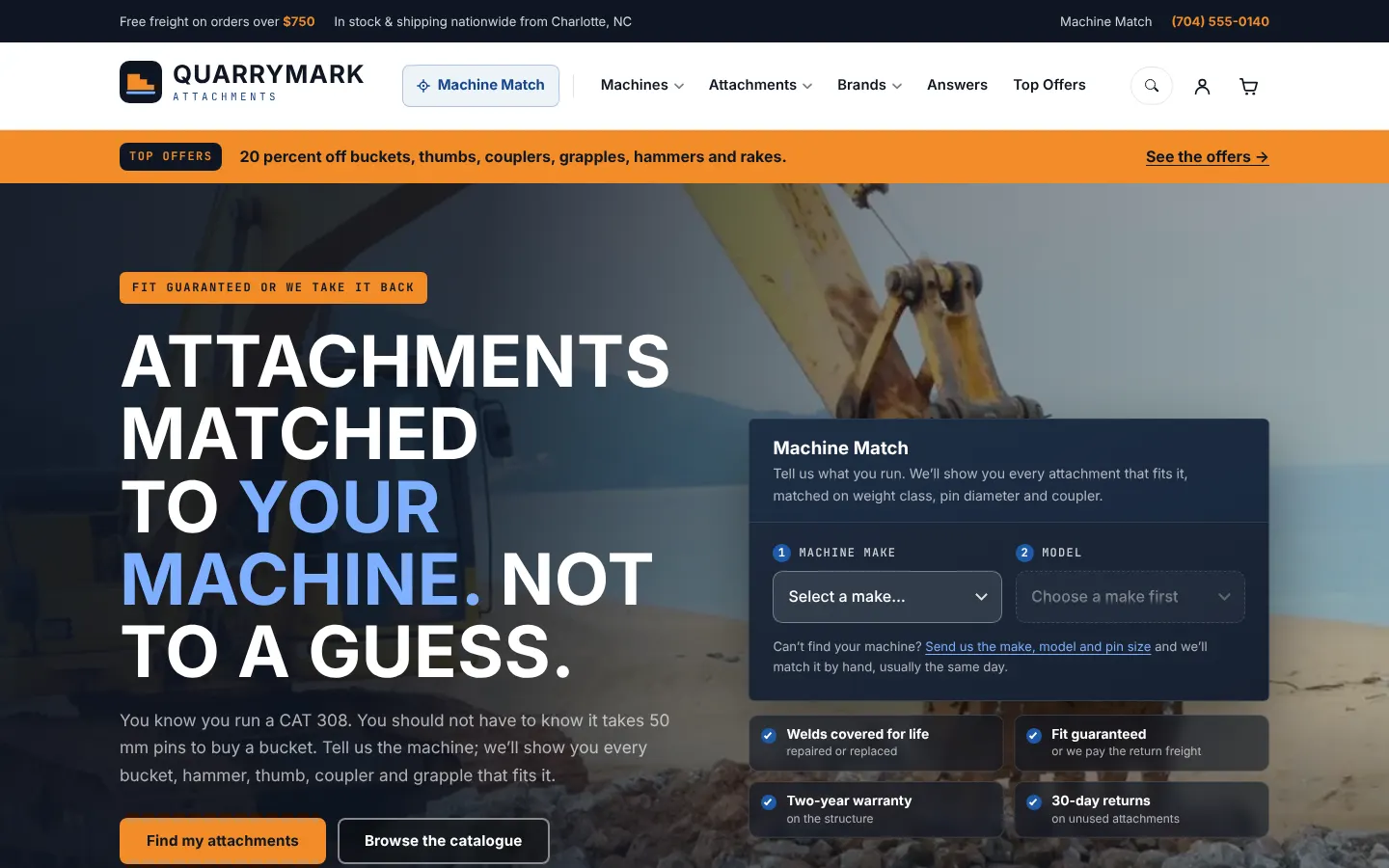
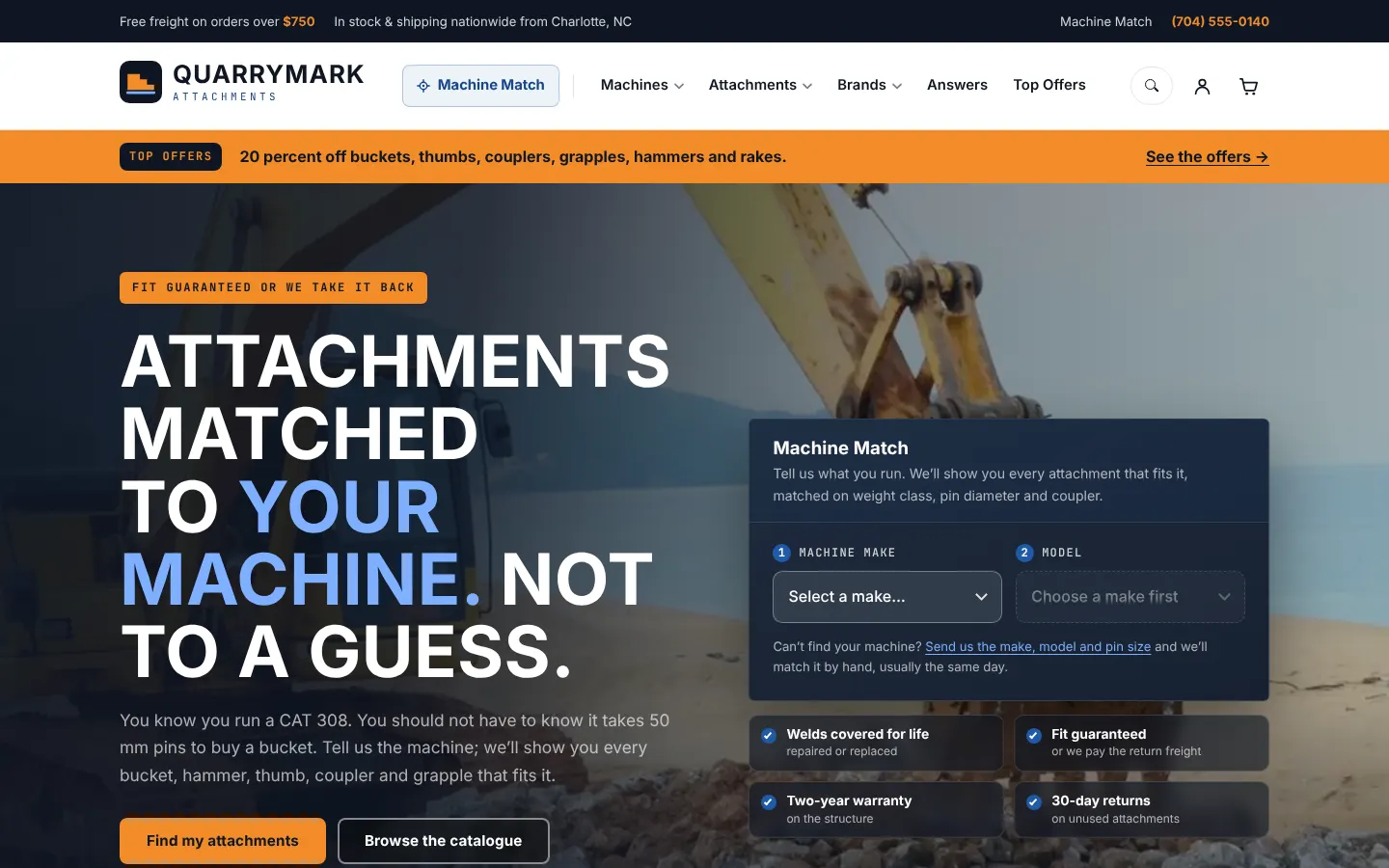
Heavy equipment attachment store where buyers pick their machine and see only the buckets, hammers and couplers that fit it.

Machine Match Fitment. Quarrymark Attachments shows the shape this describes: pick a machine and the catalog narrows to what pins on, with the fitment facts written on the page instead of hidden in a selector.

Quarrymark Attachments — live Heavy Equipment Attachments website built on WorkspaceCMS
New eCommerce plans

Selling online? We design, build and manage storefronts like this one.

For stores on Shopify or BigCommerce. Your store keeps the products, inventory, checkout and payments. We build the storefront free on your plan as a WorkspaceCMS site connected to your store, not a theme, then keep it fast, found and updated every month.

  • eCommerce Launch$499/mo
  • eCommerce Growth$799/mo
  • eCommerce Scale$1,299/mo

Billed monthly on a 12-month plan. Another platform, or a migration, is quoted after a call.

Quarrymark Attachments, a demo store built on WorkspaceCMS

Quarrymark Attachments is a demo store built on WorkspaceCMS.

Where the demand is

How Heavy Equipment Attachments buyers actually search

Attachment buyers search by machine before they search by product. The query names a make and a model, sometimes a weight class, and then the job: a ditching bucket, a thumb, a breaker for a demolition contract that starts on Monday. The person typing is usually an owner-operator or a small contractor who runs the machine and buys for it, so there is no procurement layer to satisfy. There is only a buyer who cannot afford to guess, because a bucket that does not pin on is freight both ways and a lost week.

That makes fitment the whole marketing problem. The variables a buyer rarely knows by heart are pin diameter, the spacing between ears, the coupler style already on the stick, and the auxiliary hydraulic flow a hammer or grapple needs. A seller who publishes those facts against named machines owns the search that a catalog organised by product type never reaches, and the machine pages become the most valuable pages on the site long before the product pages do.

Demand follows the digging season and the rental calendar. Spring brings a rush of new machine owners equipping for the year, storm cleanup pulls grapples and brush buckets forward without warning, and rental houses refreshing their fleets buy in batches that look nothing like a single order. Freight is the quiet decider throughout: a heavy item ships by truck, so a buyer weighs delivery terms and return policy as carefully as the steel itself.

The keyword clusters we build around

  • Machine make and modelA named excavator, skid steer or backhoe loader plus an attachment type. These need a page per machine that lists only what fits it.
  • Pin, coupler and weight classBuyers who do know their numbers search the dimension directly. Fitment specifications belong in page text, not inside a PDF drawing.
  • Job-led searchesTrenching, land clearing, demolition and rock work. The job decides the attachment, so these land best on guides that end at a filtered set of products.
  • Hydraulic requirementsFlow, pressure and case drain questions for hammers, augers and grapples. A buyer checking compatibility wants a plain answer before checkout.
  • Freight, warranty and returnsHow a heavy item arrives, what happens if it does not fit, and what the warranty covers. These questions are asked before the cart, not after.
  • Fleet and rental purchasingRental yards and contractors standardising across several machines, where the sale is a repeat relationship rather than a single item.
The campaign

Three ways we go get the traffic

Local SEO, AI-assistant visibility and paid media, run by the agency team that has been doing it since long before WorkspaceCMS existed.

Local SEO

The organic work starts with machine pages: one per make and model, each listing only the attachments that pin on, with the pin diameter, coupler and weight class stated as text. Product pages then carry the reverse view, the machines each item fits, so a search from either direction lands somewhere useful. Job guides for trenching, clearing and rock work end in filtered product sets, and freight, warranty and return terms each get a page of their own that a buyer can find before committing to a heavy order.

AI search visibility

Operators now ask an assistant what attachments suit a particular machine, and the assistant can only repeat what a site states plainly. So fitment gets written as sentences rather than hidden in a selector, hydraulic requirements get stated with their units, and the fit guarantee and return terms read as prose a model can quote. A seller whose machine data is readable gets named in the answer; one whose fitment lives inside a dropdown simply is not part of the conversation.

Paid media

Paid social for an attachment store is about reaching people at the moment they take delivery of a machine. The audiences worth buying are new owner-operators, small excavation contractors and rental yards, and the creative that works shows the fitment check doing its job: pick the machine, see what pins on. Spring equipping and storm cleanup are the windows worth timing, and anything aimed at the catalog itself is planned with the team before it runs, because a buyer who has not named their machine is the one most likely to order the wrong part.

Campaigns are an add-on to a WorkspaceCMS plan and start from $499/mo. The plan itself is a monthly subscription. The build is included, the platform is not free. Local SEO campaigns are scoped to single and multi-location businesses rather than national or global SEO. Paid search management covers service businesses rather than online stores; ad spend is billed by Google or Meta directly to your own account. Full campaign scope → · Plan pricing →

What gets in the way

Six things that hold Heavy Equipment Attachments sites back

01

A catalog sorted by product, searched by machine

Most attachment stores list buckets, then thumbs, then hammers. Buyers arrive holding a machine name. Without a page per machine, every one of those searches lands on a competitor who built one.

02

Fitment facts locked inside spec sheets

Pin diameter, ear spacing and coupler style are often published as drawings or downloads. A search engine and an assistant both read text, so data in an image never earns the query it answers.

03

Returns that cost more than the margin

A bucket that will not pin on ships back by truck. Every wrong-fit order is a marketing failure that shows up in the freight bill, so the site has to stop the guess before the cart rather than apologise after it.

04

Hydraulic attachments sold without the hydraulic question

A hammer or a grapple needs a flow the carrier can supply. When the product page skips that check, the buyer either stalls or orders something their machine cannot run.

05

Freight terms hidden until checkout

Heavy goods ship on a truck and buyers know it. If delivery cost and lead time appear only at the final step, the abandoned cart is the predictable result.

06

Seasonal demand meeting an empty content calendar

Spring equipping and storm cleanup arrive in sharp bursts. The seller whose land clearing and brush guides were indexed before the season takes the orders that everyone else answers late.

Done for you

The plan underneath the campaign

Every campaign here runs on a WorkspaceCMS plan. We design and build the site for you at no cost as part of a monthly plan, then make your updates for you with no cap on update tickets. Hosting, SSL and break-fix are handled for you, and there is a real team to talk to when you need one. What updates include → · Plan pricing →

Campaign add-ons

Pick the campaign that fits the market

Every package below is bought from your dashboard once your site is live. Names, prices and deliverables are read from the catalog at page load, so what you see here is what you would be buying.

Questions

Heavy Equipment Attachments marketing, answered

Why build a page for every machine instead of every product?

Because that is how buyers search. An owner-operator types the machine they own and the job they need done, and a page answering that pair is the one that ranks and converts. Product pages still matter, and each one links back to the machines it fits so both directions are covered.

Our fitment data lives in a spreadsheet. Is that enough to start?

Usually, yes. The spreadsheet is the raw material; the work is publishing it as readable pages, with pin diameter, coupler and weight class written out against each machine. Gaps get flagged rather than guessed, because a wrong fitment claim costs more than a missing one.

How do we cut wrong-fit returns through the website?

By asking for the machine before showing the product and by stating the fitment facts in plain text on every page. A buyer who confirms the fit before checkout does not ship a bucket back by truck, and a clear fit guarantee gives the hesitant ones a reason to order.

Does WorkspaceCMS run the store itself?

No. The site is the storefront and the content; the cart and checkout run on your commerce platform, connected through the plan. Store integration and its build are quoted separately from the monthly plan, so the catalog, payments and fulfilment stay on the platform you choose.

When should seasonal content be published?

Before the season it serves. Spring equipping guides and storm cleanup pages need time to be indexed, so they go up while the yard is still quiet. Published during the rush, they arrive after the orders have already gone to whoever planned ahead.

Your free site is one click away

Ready to grow your Heavy Equipment Attachments business?

Get the site built, then put a campaign behind it. Start online, or talk it through with a strategist first.

Want the full picture? See what a campaign includes