Growth campaigns · Funeral Home

Growth campaigns for funeral homes

Two families search for you on the same evening. One is standing in a hospital corridor after midnight and needs a phone answered by a person. The other is planning calmly, years out, and wants to read what an arrangement actually covers.

Live Funeral Home demo

Hearthstone Family Funeral Home

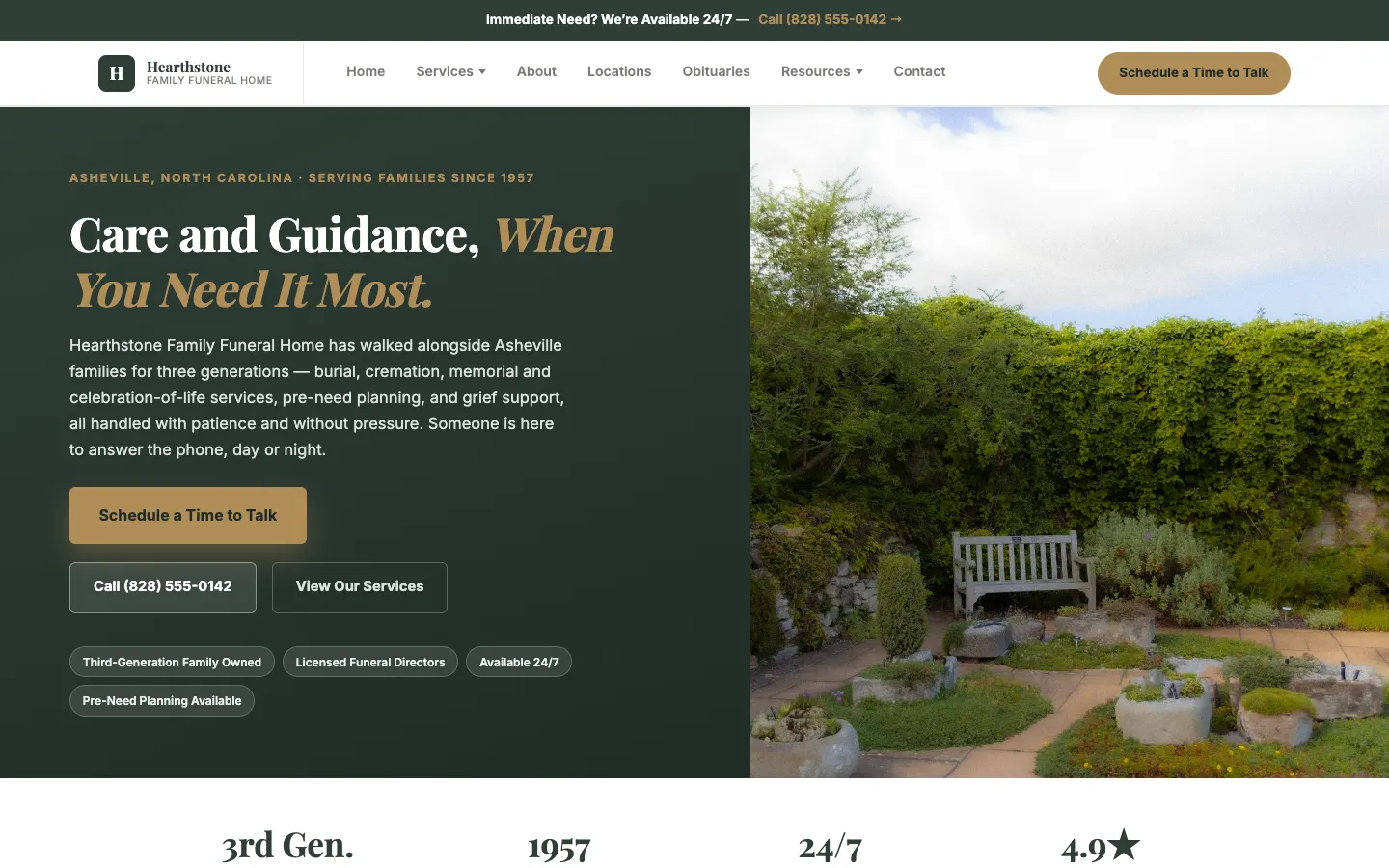
A calm, dignified forest-green and champagne-gold funeral home site for Asheville: an always-visible 24/7 immediate-need phone line, an obituary listing, pre-need planning information, and veteran honors, with a low-pressure tone throughout.

24/7 Immediate-Need CTA + Obituary Listing. Hearthstone Family Funeral Home serves both families at once, with an always-visible immediate-need line, obituaries kept on the home's own site, and pre-need information held calmly apart from them.

Open the live demo → Funeral Home websites

Hearthstone Family Funeral Home — live funeral home website built on WorkspaceCMS
Where the demand is

How funeral home buyers actually search

Immediate-need search is unlike anything else in local services. It happens within hours of a death, frequently at night, frequently from a phone in a hospital corridor, by someone who has never arranged a funeral and does not know what the first step is. They are not comparing five providers. They are looking for a phone number, an indication that someone will answer now, and enough calm on the page to feel that this is a safe place to call. Load time and an obvious phone line matter more here than in any other vertical.

The second stream is pre-need, and it behaves like a considered purchase: repeat visits, reading about cremation versus burial, veterans benefits, what a plan actually covers, whether prepaid funds are protected. These searchers ask price questions openly and expect an answer, particularly since providers are required to make general pricing available to consumers. A home that publishes clear, itemised information wins trust from a group that is explicitly comparing, while vagueness reads as something to be wary of.

Then there is obituary traffic, which is the quiet giant. Obituary and service pages are read by extended family and colleagues, often from other states, and they carry more visits than the rest of the site combined. Handled well they build local name recognition across an entire community and quietly feed pre-need interest. Handled badly they sit on a third-party platform that collects the audience, sells the flowers and leaves the funeral home with none of it. Meanwhile the shift toward cremation keeps compressing average revenue, and consolidators with central marketing budgets are competing for the same families.

The keyword clusters we build around

  • Immediate needFuneral home and cremation searches with a location, run in the hours after a death. The page has to be reachable, fast and answerable by phone.
  • Cremation and service optionsDirect cremation, memorial services, burial comparisons. Families researching what the options mean before choosing among them.
  • Cost and planning questionsCost and inclusion questions asked openly. Publishing clear pricing information meets both a consumer expectation and a regulatory one.
  • Pre-need and veterans benefitsAdvance planning, prepaid arrangements and veteran honours. A slow, high-trust cluster that pays out years later.
  • Obituaries and servicesName searches from extended family and community members. The single largest source of visits and the most commonly given away.
  • Faith and cultural traditionsFamilies searching for a home that understands a specific tradition's requirements and timing.
The campaign

Three ways we go get the traffic

Local SEO, AI-assistant visibility and paid media, run by the agency team that has been doing it since long before WorkspaceCMS existed.

Local SEO

Proximity decides this one, so the local surface carries the campaign: an accurate profile, reviews handled with care, and pages for every town and chapel genuinely served. The content splits along the two audiences, with cremation and burial explained for a family rather than for the profession, veterans honours, and what a prepaid arrangement protects. The largest single change available is usually the obituaries. Hosted on the home's own site they draw extended family and colleagues from other states and build recognition across a community; hosted elsewhere they hand that audience, and the flower orders, to a platform.

AI search visibility

Families ask assistants what direct cremation includes, whether a veteran's honours are covered, and which homes serve a particular town. Those are question-shaped, emotionally loaded searches that assistants answer readily. Homes publishing general pricing information, service descriptions with real inclusions, faith and cultural accommodations, and marked-up service-area data get quoted; homes that answer everything with a telephone number do not. Because the questions arrive in plain language, funeral homes are among the most citable local businesses for anyone willing to write the answers down.

Paid media

Overnight is when this vertical converts, so hours weighting and call extensions matter more than creative ever will. Immediate-need and cremation terms carry the campaign, with the home's own name defended because consolidator groups bid across every town they operate in. The copy rule is absolute: no urgency devices, no offers, no discount language of any kind. A family in shock needs a legible name, a town, and a number a person answers, and anything reading as promotion in that moment costs the call outright.

Campaigns are an add-on to a WorkspaceCMS plan and start from $499/mo. The plan itself is a monthly subscription. The build is included, the platform is not free. Local SEO campaigns are scoped to single and multi-location businesses rather than national or global SEO. Paid search management covers service businesses rather than online stores; ad spend is billed by Google or Meta directly to your own account. Full campaign scope → · Plan pricing →

What gets in the way

Six things that hold funeral home sites back

01

The immediate-need caller cannot find the phone number

Navigation designed for browsing fails a person in shock. If the call path is not the most obvious element on every page, and answered by a human at any hour, the family calls whoever's page was simpler.

02

Obituaries hosted on someone else's platform

The traffic, the audience and the flower revenue accrue to a third party, and the funeral home's own site gets no benefit from the most-read pages associated with its name.

03

Pricing is treated as a phone conversation

Families expect to see general pricing, and the industry is required to make it available. A home that withholds it reads as evasive to exactly the comparison-minded family it is trying to win.

04

Consolidators outspend the independent home

Corporate groups run centralised campaigns across many locations. Independence is the advantage, but only if the site actually says who the family is and how long they have served the community.

05

Cremation compresses the economics

As direct cremation grows, average revenue per family falls, and marketing that treats every inquiry identically stops working. Service options and memorial offerings have to be explained, not assumed.

06

Marketing tone is a genuine risk

Ordinary promotional devices (urgency, discounts, aggressive retargeting) are actively offensive here. Growth has to come from being findable and reassuring, never from pressure.

Campaign add-ons

Pick the campaign that fits the market

Every package below is bought from your dashboard once your site is live. Names, prices and deliverables are read from the catalog at page load, so what you see here is what you would be buying.

Questions

Funeral Home marketing, answered

Should we publish our general price list on the site?

Yes. Families expect it, the profession is required to make general pricing available to consumers, and the ones asking are actively comparing. Itemised information reads as trustworthy where an invitation to call for a quote reads as evasive.

Can we move obituaries off a third-party platform onto our own site?

Yes, and it is usually the highest-return change available. Those pages are read by extended family and colleagues in other states, and hosting them yourself keeps the visits, the community recognition and the flower orders with the home.

Is advertising appropriate in this profession at all?

Being findable is not the same as being pushy. Nothing in the campaign uses urgency or promotion. The aim is that a family searching after midnight finds a name they already recognise from the community and feels calm about calling it.

Direct cremation keeps compressing what a family arranges. What can marketing do?

Explain memorial and service options instead of assuming a family knows they exist. A cremation inquiry is not a decision about a ceremony, and homes that describe what can accompany one have a different conversation than homes treating every call identically.

A corporate group opened two towns over. How does an independent compete?

With the thing a consolidator structurally cannot claim. Say which family owns the home, how many generations have run it, and which congregations and communities it has served, on the town pages where those families are actually searching.

Your free site is one click away

Ready to grow a funeral home business?

Get the site built, then put a campaign behind it. Start online, or talk it through with a strategist first.

Want the full picture? See what a campaign includes