
Growth campaigns · Interior Design

Growth campaigns for interior design studios

Someone saves images for a year, then searches once, with a room and a style inside the query. The studio that gets that call is the one whose site made the scope, the process and the money legible before anybody picked up a phone.

Live Interior Design demo

Fold & Field Interiors

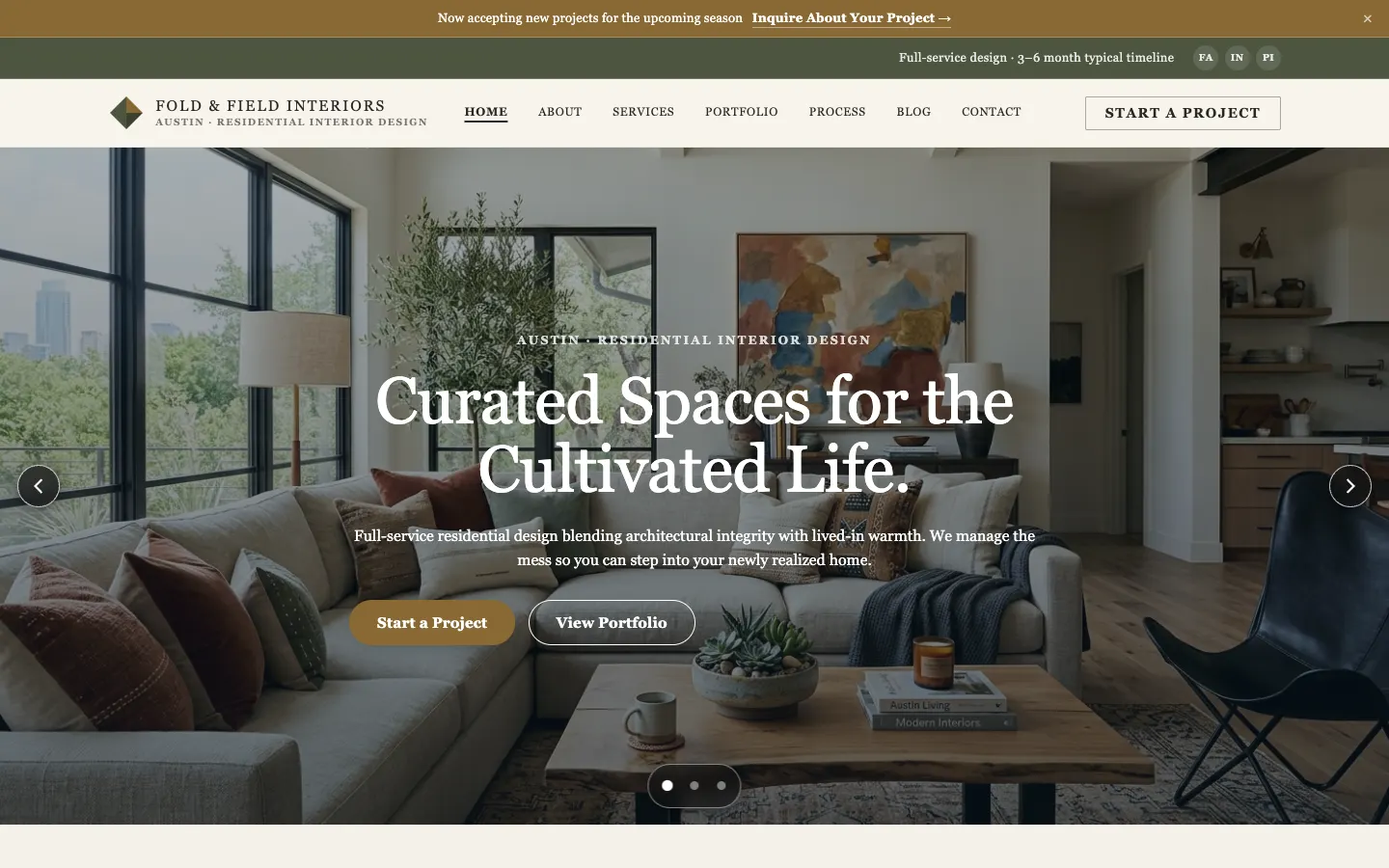
An olive, brass, and warm-linen serif site for an Austin residential interior design studio, organised around "The Design Ladder": four tiered engagements (consultation, concept & sourcing, procurement, full-service) a client picks a rung of, with a dedicated full-service renovation page, a five-step process page from discovery through handover, a room-by-room project portfolio, client testimonials, an FAQ, a blog, and a start-a-project form with three qualifying dropdowns.

The Design Ladder Tiers + Room-by-Room Portfolio. Fold & Field Interiors puts the qualifying work on the page, with tiered engagements a client picks a rung of, a room-by-room portfolio, and a start-a-project form that asks the awkward questions before the call.

Open the live demo → Interior Design websites

Fold & Field Interiors — live interior design website built on WorkspaceCMS
Where the demand is

How interior design buyers actually search

"Interior designer near me" means at least five different purchases. One person wants help choosing paint. Another wants a full-service renovation with a contractor and a permit set. A third wants furniture sourced for one room, and a fourth wants remote design because there is no local studio they like. Studios that publish a single services page collect all five kinds of inquiry and spend their week disqualifying four of them. Tiered offerings, described explicitly, convert better and cost far less time.

Discovery starts on image platforms and ends in search. A homeowner collects looks for months, then converts a saved image into a query built around a room and a style, or around a specific problem like an awkward layout, a dark north-facing space, or a kitchen that has to work with an existing footprint. Room-level and problem-level pages catch this traffic; a homepage carousel does not. The searcher is also comparing designers against a much larger free field of influencers and retailer design services, so the value of a professional has to be argued rather than assumed.

Money is the recurring blocker. Homeowners rarely know whether a designer charges by the hour, by the project or through procurement, and they consistently underestimate what furnishings cost, which makes the first conversation awkward for both sides. Seasonality compounds it: enquiries cluster ahead of holidays and after home purchases, then go quiet, and referrals from builders and realtors arrive in irregular bursts. Studios that explain fee structures and typical project scale publicly get fewer calls and better ones, and it stabilises the pipeline more than any single tactic.

The keyword clusters we build around

  • Room and spaceKitchen, primary bath, nursery, whole-home. Maps directly to how the searcher describes their project and to how the portfolio should be organised.
  • Service tierConsultation, concept and sourcing, procurement, full-service. Publishing the tiers is what stops the inbox filling with the wrong projects.
  • Style and aestheticStyle-led searches carried over from image platforms. Best served by portfolio entries written with the style vocabulary the client used.
  • Fees and processHow designers charge, what procurement means, how long a project runs. High-intent, and it qualifies before the discovery call.
  • Renovation and trade collaborationProjects involving contractors, architects and permits, plus the builder and realtor referrals that come with them.
The campaign

Three ways we go get the traffic

Local SEO, AI-assistant visibility and paid media, run by the agency team that has been doing it since long before WorkspaceCMS existed.

Local SEO

The organic map is rooms and problems rather than services: a primary bath page, a nursery, a north-facing living room that never gets light, a kitchen that has to work inside an existing footprint. That is how a saved image becomes a query. Service-tier pages sit beside them doing the qualifying, consultation through concept and sourcing to full-service, with inclusions and exclusions stated, so paint advice and a whole-home renovation stop arriving through one form. Portfolio entries get the brief and the constraint written out, and neighbourhood coverage matters because homeowners read reviews before letting anyone inside the house.

AI search visibility

Homeowners ask assistants what full-service actually includes, whether a designer charges hourly or through procurement, and how long a kitchen runs before anything is installed. A studio with published tiers, real inclusions and boundaries, an honest process description and project write-ups carrying specifics can be quoted on all three. A gallery cannot. That matters more here than in most categories, because the assistant is also being asked to justify hiring a professional against influencers and retailer design services giving the same advice away.

Paid media

Search here is thick with the wrong people: design students, aspiring decorators, and homeowners shopping for one cushion. Negatives do the heavy lifting long before bid strategy does. What converts is room-level and tier-level phrasing inside a tight radius, run continuously rather than in the seasonal bursts studios default to, since enquiries already cluster before holidays and after home sales and a campaign switched on in those weeks is bidding against everyone who had the same idea. Paid social earns its place because the category is discovered visually.

Campaigns are an add-on to a WorkspaceCMS plan and start from $499/mo. The plan itself is a monthly subscription. The build is included, the platform is not free. Local SEO campaigns are scoped to single and multi-location businesses rather than national or global SEO. Paid search management covers service businesses rather than online stores; ad spend is billed by Google or Meta directly to your own account. Full campaign scope → · Plan pricing →

What gets in the way

Six things that hold interior design sites back

01

Every inquiry is a different service

Paint advice, one-room sourcing and a full renovation all arrive through the same form. Without published tiers, the designer's week goes on triage rather than on billable work.

02

Budget mismatch surfaces on the first call

Homeowners underestimate furnishing and construction costs, so a promising inquiry ends the moment real numbers appear. Explaining scale and fee structures in public prevents most of those calls.

03

Portfolio images carry no searchable text

Gorgeous galleries with a project title and nothing else. The searcher's actual query (a room, a style, a constraint) appears nowhere on the page, so the strongest work never gets found.

04

Competing with free advice

Influencers, retailer design services and endless free content have reset expectations about what design guidance is worth. The professional case has to be made explicitly rather than implied by taste.

05

Lumpy, seasonal demand

Inquiries cluster before holidays and after home sales, then stall. Search work smooths that only if it runs continuously, which is exactly when studios are tempted to pause it.

06

Referral relationships are unmanaged

Builders, realtors and architects send occasional work with no structure behind it. There is usually no page addressed to those partners and no reason for them to send the next one your way.

Campaign add-ons

Pick the campaign that fits the market

Every package below is bought from your dashboard once your site is live. Names, prices and deliverables are read from the catalog at page load, so what you see here is what you would be buying.

Questions

Interior Design marketing, answered

How do we stop fielding inquiries for projects we do not take?

Publish the tiers, say what each includes and excludes, and qualify inside the form itself. Most studios find the inquiry count drops while the number of projects that actually start rises, because triage moves off the calendar and onto the page.

Should we say anything about fees when every project is different?

Explain how you charge, hourly, by project or through procurement, and the scale of work you take, even without publishing a figure. That removes the awkward first call where a homeowner discovers what furnishings cost and disappears.

Is a saved image on a pin board worth anything to us?

Only if the search it eventually triggers lands somewhere. Image platforms are where you are discovered; the room-and-style query weeks later is where you are hired, and a studio publishing only pictures owns the first half and none of the second.

Builders and realtors send us occasional work. Can that be made steadier?

Give those partners a page written for them, describing how you coordinate with a contractor around permit-set timing and what you need from a realtor's client before a walkthrough. Referrals repeat when the next one is easy to make.

Clients compare us to influencers giving design advice away. How do we answer that?

By arguing the professional case explicitly instead of implying it through taste. Trade sourcing, coordinating a contractor, holding a specification through a delayed lead time: none of that appears in a styling video, and most studio sites never mention it.

Your free site is one click away

Ready to grow a interior design business?

Get the site built, then put a campaign behind it. Start online, or talk it through with a strategist first.

Want the full picture? See what a campaign includes