
Growth campaigns · Luxury Real Estate / Team

Marketing for Luxury Real Estate Teams

Towers are keywords here. Buyers search a building by name, then the stack, the assessment, the short-term-rental rule. Your team knows the lines; the portal page knows the address. This campaign turns that knowledge into pages and routes the overnight inquiry before breakfast.

Live Luxury Real Estate / Team demo

The Santiago Group

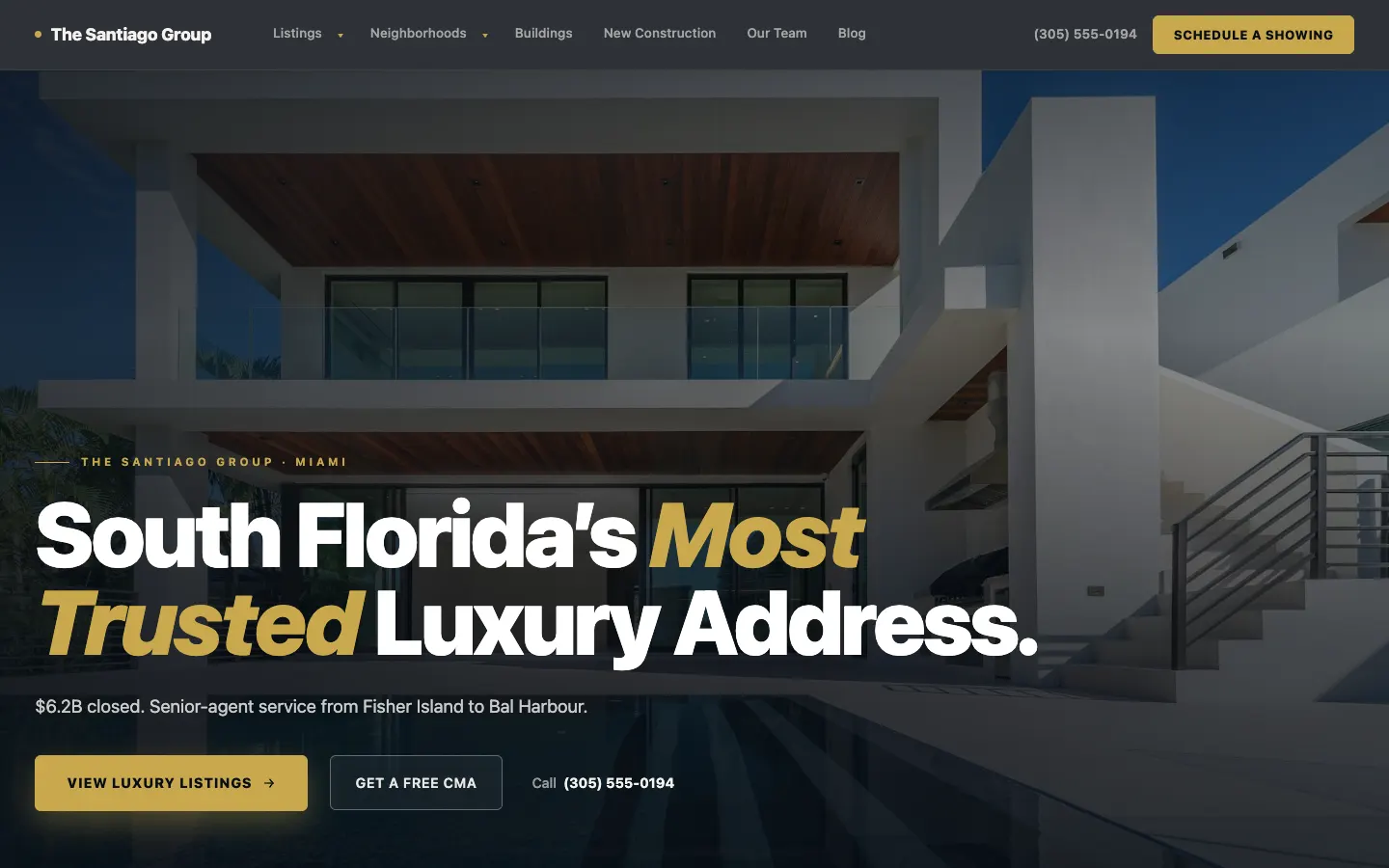
Dark-cinema Miami luxury brokerage with animated listings, condo building inventory pages, IDX map search, and a $6B+ team portfolio that converts high-net-worth buyers on contact.

Condo Building IDX Pages. The Santiago Group shows the page type this campaign is built on, a condo building profile with real inventory and stack detail behind it, which is what can out-answer a portal on a tower name.

Open the live demo → Luxury Real Estate / Team websites

The Santiago Group — live luxury real estate / team website built on WorkspaceCMS
Where the demand is

How luxury real estate / team buyers actually search

Buildings behave like keywords in a luxury condo market. Prospects search a tower by name, then ask what is available in it, what the association charges, whether it allows short-term rental, and how its lines compare. Those queries are handled today by portal pages that know nothing about the building beyond its address. A team with real inventory and real knowledge of the stack can out-answer them, which is the single biggest organic opportunity in this vertical.

The buyer is often not in the market yet, geographically speaking. Relocation and international purchasers research for months from another time zone, comparing neighbourhoods, tax treatment, and dockage or parking before they engage anyone. Their first contact is frequently a form filled at an odd hour, which puts response speed and routing at the centre of whether the campaign appears to work. A brilliant lead that sits in an inbox overnight is indistinguishable from no lead at all.

Scale changes the failure modes rather than removing them. Multiple agents mean multiple personal sites, competing profiles, and duplicated content that dilutes the team's own authority. IDX feeds mean thousands of thin pages that can drag the whole domain down if they are published unmanaged. And listings expire, which quietly turns a page that earned rankings into a dead end unless there is a plan for what it becomes afterwards.

The keyword clusters we build around

  • Building and tower namesBuyers researching a specific address by name. Building pages with inventory, association detail, and line comparisons beat generic portal listings on relevance.
  • Neighbourhood inventory searchesCondos and homes for sale in a named area or price band. Curated, editorially written area pages give this traffic somewhere better than a raw filtered feed.
  • Relocation and international buyingOut-of-state and overseas purchasers researching taxes, ownership structures, associations, and logistics before they contact anyone. Reference content earns the first conversation.
  • Team and agent reputationProspects checking the team name and individual agents after an introduction. Owned bios, structured team data, and a maintained review presence control that screen.
  • Seller and valuation intentOwners inside your buildings wondering what their line is worth now. Building-specific market commentary is the most efficient listing-side hook a team has.
The campaign

Three ways we go get the traffic

Local SEO, AI-assistant visibility and paid media, run by the agency team that has been doing it since long before WorkspaceCMS existed.

Local SEO

What usually sinks a team's domain is the IDX feed left to publish itself: thousands of near-identical filtered pages competing with one another and burning crawl budget. So the first decisions are indexation rules, canonicals, and what a listing page becomes the day it closes, retained with sold context or folded into the building profile, so earned authority does not evaporate each quarter. On top of that sit the pages a feed cannot generate: building profiles carrying floor lines, view corridors, renovation history and association posture, plus corridor-level market commentary written by someone who works the stack.

AI search visibility

Relocation questions land in assistants constantly: can this tower be rented by the week, what does the association actually assess, how does ownership work for a foreign buyer. The answer gets assembled from sources with structured building and listing data, named service areas, agent credentials, published notes on closing logistics and tax treatment, and reviews that exist. A team site that renders its inventory through an animated map and nothing else is legible to buyers and blank to a model, so it never enters that answer set.

Paid media

Bidding against portal budgets on broad property terms is a transfer of money rather than a strategy. The workable allocation is tower and building names, valuation intent from owners already inside them, brand defence on the team name and each agent's, and retargeting of building-page readers. Because so many clicks come from another time zone, ad scheduling and lead routing are treated as one decision: a campaign that produces inquiries at three in the morning and answers them the following afternoon reads as a failed campaign no matter what the click data shows.

Campaigns are an add-on to a WorkspaceCMS plan and start from $499/mo. The plan itself is a monthly subscription. The build is included, the platform is not free. Local SEO campaigns are scoped to single and multi-location businesses rather than national or global SEO. Paid search management covers service businesses rather than online stores; ad spend is billed by Google or Meta directly to your own account. Full campaign scope → · Plan pricing →

What gets in the way

Six things that hold luxury real estate / team sites back

01

Portals answer building-name queries first

Type a tower name and you get a syndicated listing page with a stock photo and a filter. It ranks because of domain strength, not because it is useful. Teams that publish genuine building intelligence, floor lines, association posture, view corridors, renovation history, can displace it, but only if that content exists as a durable page rather than as a filtered search result.

02

IDX feeds generate thin pages at scale

An unmanaged feed can spawn thousands of near-identical pages with no unique text. Left alone, they compete with each other, waste crawl budget, and pull down the pages you actually want ranked. Deciding what gets indexed, what gets canonicalised, and what gets editorial treatment is a prerequisite before any of this traffic is worth chasing.

03

Expired listings leave dead pages behind

A listing page that earned links and rankings disappears the day the property closes. Multiply that across a busy team and the site keeps hollowing out. Without a rule for what happens next, redirect, archive with sold context, or fold into the building page, the team loses accumulated authority every quarter and never notices.

04

Response time decides the campaign's fate

Overnight inquiries from other time zones are normal here. If routing is manual and the first reply lands the next afternoon, conversion collapses and the channel gets blamed. Speed to first response is not a sales detail sitting outside marketing; it is the variable that most changes what any given budget produces.

05

Agents compete with the team for the same terms

Individual members build personal sites and profiles, then rank against the team for the neighbourhoods the team is trying to own. Traffic splits, messaging diverges, and inquiries land wherever they happen to fall. A workable structure gives agents a distinct role, personal brand and sphere, rather than letting everyone chase the same query.

06

Discreet and off-market inventory cannot be published

A meaningful share of high-end activity never appears in a feed, so the site cannot show the work that best demonstrates capability. The answer is not to hint at what cannot be shown but to build authority on the public layer, buildings, neighbourhoods, process, so private buyers arrive already convinced you are worth a private conversation.

Campaign add-ons

Pick the campaign that fits the market

Every package below is bought from your dashboard once your site is live. Names, prices and deliverables are read from the catalog at page load, so what you see here is what you would be buying.

Questions

Luxury Real Estate / Team marketing, answered

Should our raw IDX filter pages be indexed?

No. We index the pages carrying unique editorial value, usually building profiles and curated area pages, and keep filtered results out so they cannot cannibalise those pages or spend crawl budget on near-duplicates.

What happens to a listing page the day the unit closes?

It follows a rule set in advance rather than quietly dying. Usually it is kept with sold context or folded into the building profile, so the authority that page earned stays on your domain instead of becoming a dead URL.

Our agents rank against the team for the same towers. How is that resolved?

By splitting the territory rather than banning personal sites. The team owns buildings, corridors and process content; agents own their names and their spheres, so introductions and inquiries compound instead of dividing the same query between you.

A lot of our best inventory never reaches a feed. How does the site show capability?

Through the public layer: building intelligence, association detail, corridor commentary and process. A private buyer arrives already convinced you know the stack, which is what earns the discreet conversation that never appears online at all.

Inquiries arrive at three in the morning from Europe. Does the campaign account for that?

It has to. Routing and response coverage are set alongside ad scheduling, because a brilliant relocation lead answered the next afternoon converts like no lead at all and the channel gets blamed for a handoff problem.

Your free site is one click away

Ready to grow a luxury real estate / team business?

Get the site built, then put a campaign behind it. Start online, or talk it through with a strategist first.

Want the full picture? See what a campaign includes