
Growth campaigns · Custom Home Builder

Marketing for Custom Home Builders

Buyers start with dirt: a wooded lot in one school district, a septic question, a subdivision they drove past on a Sunday. Your campaign has to meet them at the land stage and stay visible through months of drawings, allowances and framing bids.

Live Custom Home Builder demo

Alder & Stone Custom Homes

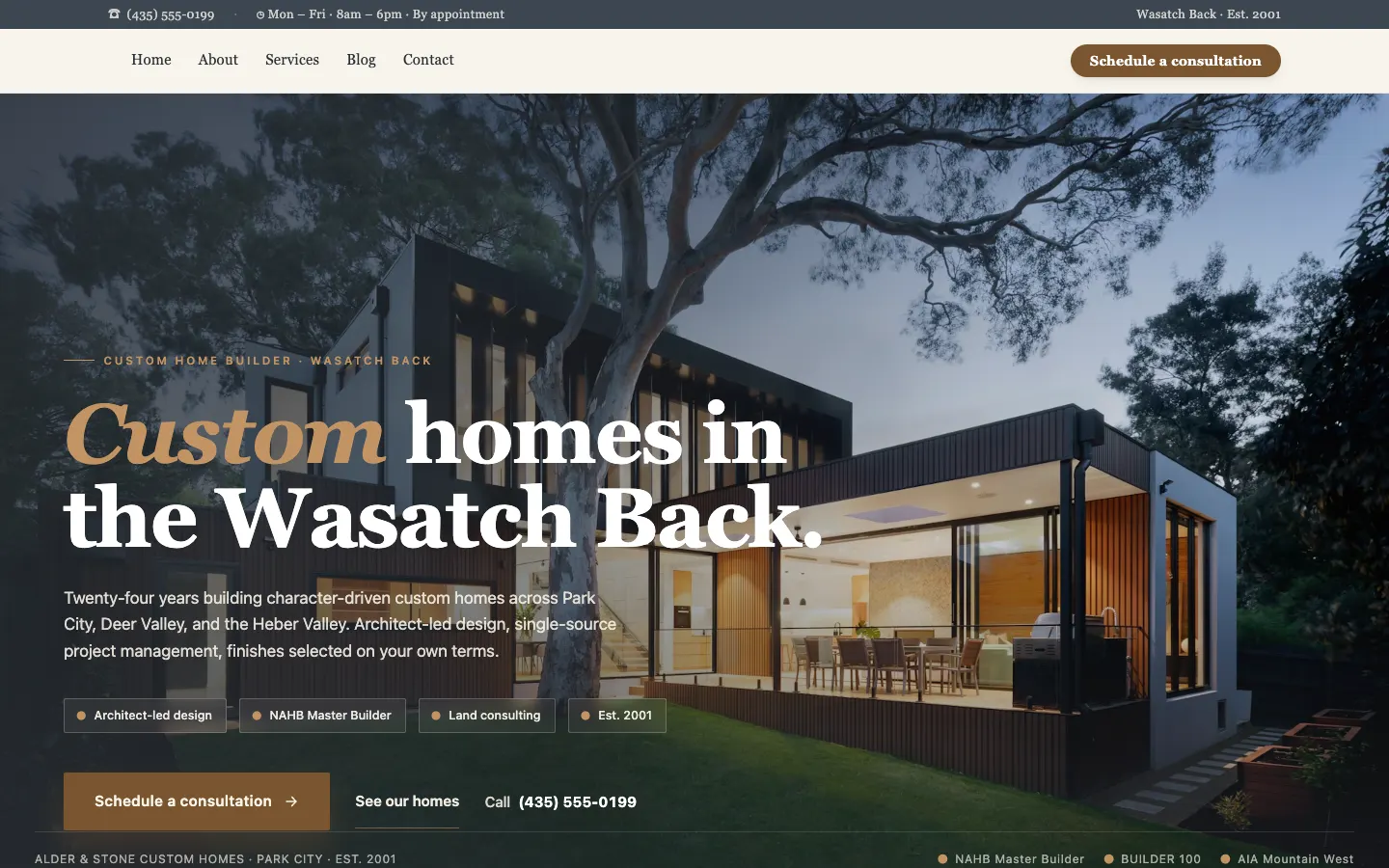
Park-City custom builder with a land-acquisition workflow, floorplan library, and process explainer for high-trust sales.

Land + Build Process Map. Alder & Stone Custom Homes is the shape we campaign against: its Land and Build Process Map answers the feasibility and allowance questions on the page, so a land-stage searcher lands somewhere that can start a design conversation.

Open the live demo → Custom Home Builder websites

Alder & Stone Custom Homes — live custom home builder website built on WorkspaceCMS
Where the demand is

How custom home builder buyers actually search

Almost nobody wakes up and searches for a custom home builder. The search starts with dirt. Buyers hunt for lots inside one school district, ask whether a sloped or wooded site can be built on at all, or type the name of a subdivision they drove through on a Sunday afternoon. By the time a prospect searches your category outright, they have usually already spoken to a lender and walked a competitor's model home.

The sales cycle is unlike anything else in residential property. Months separate the first inquiry from a signed build agreement, and more months pass before ground breaks. A lead that goes quiet is therefore not a lost lead, and the pages that carry the most weight are the unglamorous ones: how allowances are set, what a change order does to the schedule, who owns the drawings, what happens when the framing bid comes back above the budget everyone agreed to.

Demand follows the ground rather than the retail calendar. Inquiries cluster in late winter and early spring from families who want to be under roof before the next school year starts, then again in the days after parade-of-homes weekends and open-house tours, when prospects have just walked through finished work and can picture their own. Publishing and ad budget belong ahead of those windows, not during them.

The keyword clusters we build around

  • Build on your lotOwners who already hold land and need to know you will build on it, price the site work, and answer the septic, well, and access questions before they will hand over a survey.
  • Lot and land shoppingThe earliest stage of all: buyers looking for buildable parcels in named districts. Land pages and a process explainer put you in the conversation before a competitor's sales agent does.
  • Floorplan and style browsingProspects working through a plan library and comparing architectural styles. They land on one plan and convert on the request to modify it, so every plan needs its own inquiry path.
  • Cost, allowance, and process questionsPeople still deciding whether to build at all. Plain answers about draws, allowances, and change orders earn the inquiry that a gallery of finished kitchens never will.
  • Builder comparison and reputationSearches pairing your name with reviews, complaints, or a rival builder. Owned pages and a published process decide how that comparison reads to someone who has already met you.
The campaign

Three ways we go get the traffic

Local SEO, AI-assistant visibility and paid media, run by the agency team that has been doing it since long before WorkspaceCMS existed.

Local SEO

Every buildable parcel, every floorplan and every finished project becomes its own indexable page, because a plan library buried in a slider ranks for nothing. Community pages name the school districts and subdivisions you actually pour foundations in. A written build-process page catches the procedural searches, how draws are released, who owns the drawings, what a change order does to the schedule, that arrive long before anyone books a design meeting, and a maintained Google Business Profile keeps the build-radius question from being answered by a production builder's sales centre.

AI search visibility

Ask an assistant how a true custom build differs from semi-custom, or what an allowance actually covers when the tile bid comes back high, and it answers from sources that commit to specifics. A published step map running from lot walk to punch list, a warranty policy in plain words, the counties you pour in named outright, structured project data carrying style, roof type and district, and cost-mechanics answers that do not dodge are what get quoted. A gallery of finished kitchens with no captions is unreadable to a model, however well the photographer shot it.

Paid media

The constraint here is trade capacity, not click volume. A builder with a full spring schedule and a fixed set of framers wants fewer conversations, filtered by district, lot status and price band, so campaigns run tight geography and lean on build-on-your-lot intent rather than the broad category term that national volume builders defend with in-house media teams. Retargeting follows readers of the process and allowance pages, who are further along than anyone who bounced off the photo gallery, and budget is pulled forward ahead of parade-of-homes weekends rather than spent during them.

Campaigns are an add-on to a WorkspaceCMS plan and start from $499/mo. The plan itself is a monthly subscription. The build is included, the platform is not free. Local SEO campaigns are scoped to single and multi-location businesses rather than national or global SEO. Paid search management covers service businesses rather than online stores; ad spend is billed by Google or Meta directly to your own account. Full campaign scope → · Plan pricing →

What gets in the way

Six things that hold custom home builder sites back

01

Land questions gate every inquiry

A prospect with no lot cannot buy from you yet, and a prospect with a difficult lot needs a feasibility answer before anything else. Sites that jump straight to finished-home photography skip the one question standing between the visitor and a conversation, so the form gets filled in by people who are not ready and skipped by people who are.

02

Photography carries the brand and indexes badly

Builders invest heavily in gallery imagery and then publish it in sliders with no text, no plan reference, and no location. Search engines and AI assistants read almost none of it. The work that took a year to finish contributes nothing to visibility unless each project carries a written story around it.

03

The lag between lead and contract breaks attribution

A form filled in during March may sign in October. Any measurement window shorter than the build cycle makes good campaigns look dead and rewards whatever channel happened to touch the buyer last. Without long-window tracking and a real follow-up sequence, budget gets cut from the channel that actually started the relationship.

04

Allowance and change-order anxiety goes unanswered

Every prospect has heard a story about a build that ran over. Most builder sites say nothing about how pricing is structured, so the visitor assumes the worst and calls a competitor who does explain it. Publishing the mechanics is uncomfortable and it is also the single highest-converting content a builder can put online.

05

Production builders bid on your category

National volume builders with in-house media teams buy the same terms you do, at spend levels no regional custom builder should try to match. Competing on the broad head term is a losing trade. The winnable ground is narrower: your specific districts, your lot types, your price band, and the semi-custom-versus-true-custom distinction they blur.

06

Trade capacity caps how many leads you want

Unlike most industries, more inquiries can be a problem. A builder with a full schedule and a fixed set of trades needs fewer, better-qualified conversations, filtered by geography, lot status, and budget band. Campaigns tuned purely for volume fill the calendar with people you will have to turn away.

Campaign add-ons

Pick the campaign that fits the market

Every package below is bought from your dashboard once your site is live. Names, prices and deliverables are read from the catalog at page load, so what you see here is what you would be buying.

Questions

Custom Home Builder marketing, answered

We build on the client's lot as often as our own. Should those be separate pages?

Yes. A family holding a survey and a family choosing from your community sites are asking different questions, and mixing them means the build-on-your-lot searcher never sees anything about site work, access or feasibility.

A prospect wants to know whether a sloped, wooded lot can be built on at all. Where does that answer live?

On a feasibility page of its own, covering grading, access, septic and well, with a path to a site review. That question gates the inquiry, so burying it under finished-home photography loses the ready buyer and keeps the unready one.

Should we publish how allowances and change orders are priced?

It is uncomfortable and it converts better than anything else you will put online. Every prospect has heard a story about a build that ran over, and the builder who explains the mechanics gets the call from someone who was already worried.

Parade of Homes brings a wave of traffic that disappears a week later. Can any of it be kept?

Yes, by publishing the plan and process pages ahead of the weekend and retargeting people who walked through, so the visitor who could picture themselves in your model still has somewhere to go once the tour is over.

National production builders bid on our category term. Do we have to compete there?

No, and trying is a losing trade against their media teams. The winnable ground is narrower: your named districts, your lot types, your price band, and the semi-custom versus true-custom distinction their pages deliberately blur.

Your free site is one click away

Ready to grow a custom home builder business?

Get the site built, then put a campaign behind it. Start online, or talk it through with a strategist first.

Want the full picture? See what a campaign includes