
Growth campaigns · Toy Store

Website Marketing for Independent Toy Stores

Most toy searches are a small panic. The party is on Saturday, the buyer knows the child is turning seven and nothing else, and what they want is a shop that will simply tell them what to get. Answering that is the whole opportunity.

Live Toy Store demo

Tinker & Tumble Toys

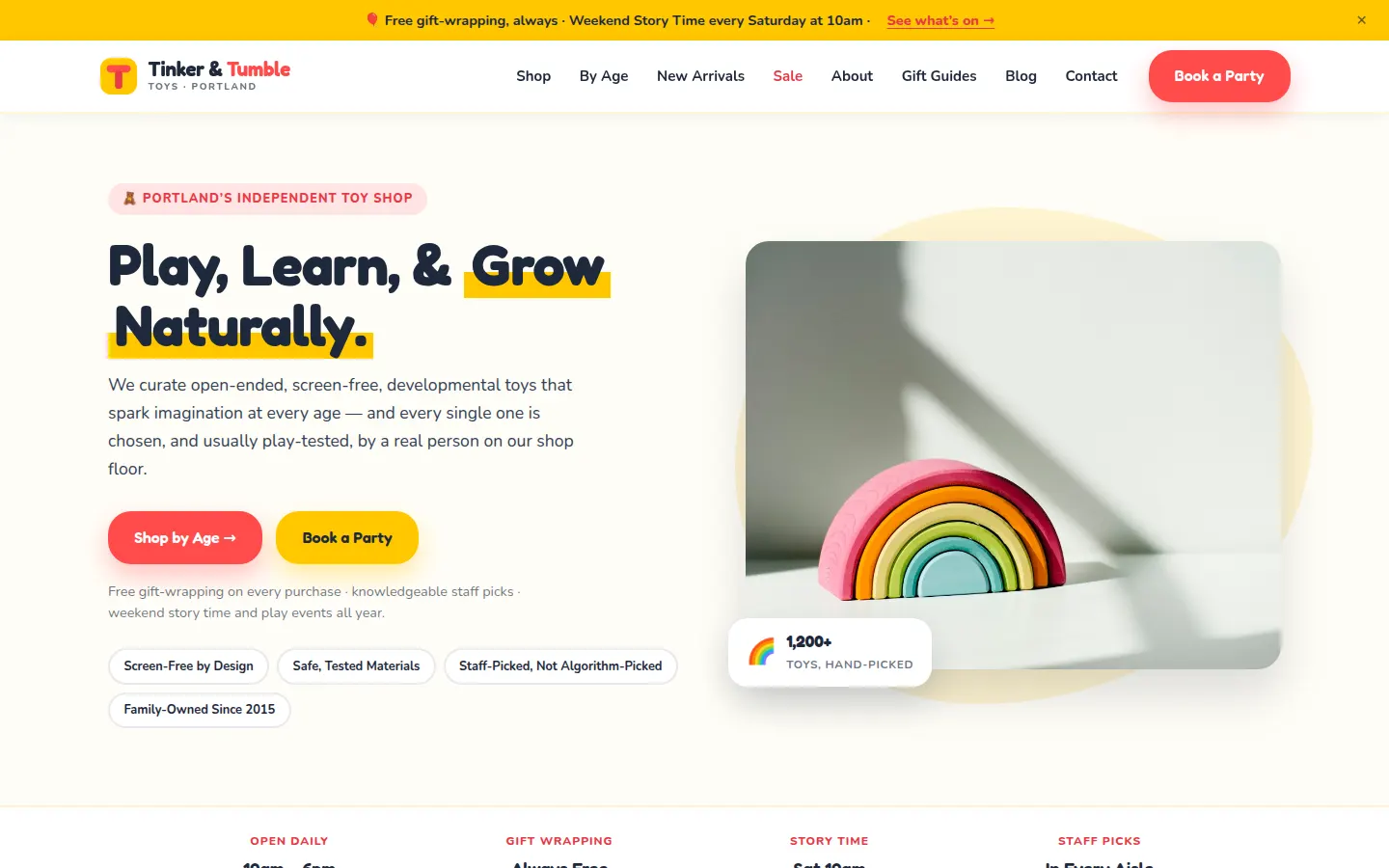
A sunny-yellow-and-coral toy shop site for Portland: shop-by-age merchandising, staff-picked gift guides, a birthday-party & play-event booking flow, spec/review-schema product pages, and a warm, playful Fredoka + Nunito identity.

Shop-by-Age + Birthday-Party Booking Flow. Tinker & Tumble Toys is the build this points at, with shop-by-age merchandising, named staff picks and a birthday party booking flow sitting exactly where the gift searches land.

Open the live demo → Toy Store websites

Tinker & Tumble Toys — live toy store website built on WorkspaceCMS
Where the demand is

How toy store buyers actually search

Toy demand is overwhelmingly gift demand, and gift buyers search by recipient rather than by product. They type an age, sometimes an interest, almost never a brand or a SKU. That is why shop-by-age merchandising and staff-picked gift guides do more work than a conventional catalog structure: they mirror the actual question. It is also why the independent has an angle the giant retailers cannot copy, because a search phrased as what should I get is asking for a recommendation, and a recommendation needs a person behind it.

The competitive picture is unusual. On any specific product name, the marketplaces and big-box chains are unbeatable and it is not worth trying. What they do not serve is the parent who wants open-ended, screen-free or developmentally chosen toys, who wants gift wrapping today, or who wants somewhere to hold a birthday party. Every one of those is a local search with a small pool of competitors, and each one is worth more per visit than a product term you would lose anyway.

Then the calendar takes over. This trade concentrates a huge share of its year into the weeks before the winter holidays, with a secondary rhythm of birthdays running steadily underneath and a small back-to-school lift. Gift guides and event pages published in autumn compete for searches decided in late autumn, so content that goes live in December is competing after the decision. The party and play-event side has its own booking lead time, which behaves more like a venue than a shop.

The keyword clusters we build around

  • Gift by age and occasionGift searches naming an age or an occasion. These belong on shop-by-age and gift-guide pages written as recommendations, not as filtered product lists.
  • Play-type and educationalOpen-ended, wooden, sensory, STEM and screen-free searches from parents choosing on values. Poorly served by the big retailers and highly winnable.
  • Local toy shoppingToy store near me, gift wrapping and same-day pickup. Fast, high-intent searches where a real storefront wins outright.
  • Birthday parties and eventsParty venue and play-event searches with a booking behind them. Local, seasonal in a different way from retail, and often the highest-value visitor.
  • Brand and specialty linesSearches for the specialty lines you actually carry, where stock and local availability are the deciding factor rather than price.
The campaign

Three ways we go get the traffic

Local SEO, AI-assistant visibility and paid media, run by the agency team that has been doing it since long before WorkspaceCMS existed.

Local SEO

Structure follows the way gift buyers think, which is age and interest first and brand almost never. Shop-by-age and play-type pages come ahead of any catalog logic, and staff picks get published as recommendations with a name attached, since that is the thing a chain has no way of faking. Holiday guides go live in early autumn so they have time to earn authority before the searches peak, and the near-me layer, wrapping, same-day pickup, in-store events and a birthday party page with real availability, takes the local searches outright.

AI search visibility

Parents ask assistants for a gift for a cautious six-year-old who hates loud toys, and the recommendation comes from published specifics. So age suitability, materials, finishes, small-part warnings and what a toy is actually for get written into product content rather than left to a manufacturer's title. Store hours, wrapping, pickup and party services get described clearly, and the FAQ carries the questions staff answer at the counter every day. A shop with genuine recommendations in text gets named by ChatGPT or an AI Overview; a wall of product titles does not.

Paid media

Toy creative is demonstration. Paid social works when a member of staff is filmed showing what a toy does, why a four-year-old stays with it and which part breaks first, and it can be aimed at parents, grandparents and gift buyers inside the delivery radius rather than at a national audience. Two peaks carry the year: the run into the winter holidays, where gift guides get promoted from early autumn, and the steady birthday rhythm underneath, where party packages and open dates are the offer. In-store events give the creative a reason to exist between them.

Campaigns are an add-on to a WorkspaceCMS plan and start from $499/mo. The plan itself is a monthly subscription. The build is included, the platform is not free. Local SEO campaigns are scoped to single and multi-location businesses rather than national or global SEO. Paid search management covers service businesses rather than online stores; ad spend is billed by Google or Meta directly to your own account. Full campaign scope → · Plan pricing →

What gets in the way

Six things that hold toy store sites back

01

A catalog organized by brand instead of by age

Gift buyers do not know the brand, they know the child. A structure that mirrors how people search, starting with age and interest, converts a stranger who has nine minutes and a party invitation.

02

Staff expertise that never reaches the site

The reason people come to an independent toy shop is that somebody there knows what a cautious six-year-old will actually play with. Published as staff picks and guides, that knowledge becomes the thing search engines and assistants can point to.

03

Gift guides published after the season starts

Holiday searching begins well before the holiday. A guide that goes live in the final weeks arrives after buyers have already found somebody else's, and it will not have accumulated any authority.

04

Party bookings buried under retail

A birthday party is a scheduled, high-value commitment and it needs its own page with availability, package detail and a real booking path. Treated as a footnote on the events page, it stays a well-kept secret.

05

Competing with big-box retail on product names

Chasing individual toy names is a losing bid against national retail. The winnable ground is age, occasion, play type, local availability and the guidance nobody else offers.

06

Safety and age-suitability questions left unanswered

Parents ask about small parts, materials, finishes and age ranges before buying. When the site does not address it, the sale moves to a listing that does, even if the shop staff would have answered better in person.

Campaign add-ons

Pick the campaign that fits the market

Every package below is bought from your dashboard once your site is live. Names, prices and deliverables are read from the catalog at page load, so what you see here is what you would be buying.

Questions

Toy Store marketing, answered

The chains own every product name. What can an independent actually win?

Age and occasion gifting, play-type searches like open-ended, wooden or screen-free, and the entire local layer: near-me, gift wrapping, same-day pickup, in-store events and birthday bookings. Those searches convert far better for a shop with staff who can recommend something, and the chains serve them poorly.

When should holiday gift guides go live?

Early autumn, so they are indexed and have accumulated some authority before the searches peak. A guide published once the season is underway is arriving after buyers have already found somebody else's, and it will spend the whole peak playing catch-up.

Does the birthday party side need its own page?

Yes, because parents search for a party venue in a completely different way from how they shop for toys, and with a booking lead time attached. Packages, open dates and a real booking path turn those searches into scheduled commitments instead of a run of voicemails.

How do we get staff knowledge onto the site without hiring a writer?

By capturing it in the form it already takes at the counter. A staff pick is two sentences about which child a toy suits and why, and a handful of those per month becomes the shop-by-age and gift-guide content that no national retailer can produce.

Parents keep asking about small parts and materials. Is that marketing?

It is, because it is the question standing between a browse and a purchase. Age suitability, finishes, small-part warnings and what a toy is made of belong in the product content, or the sale moves to a listing that answered even though your staff would have answered better.

Your free site is one click away

Ready to grow a toy store business?

Get the site built, then put a campaign behind it. Start online, or talk it through with a strategist first.

Want the full picture? See what a campaign includes