
Growth campaigns
Legal Marketing Campaigns That Win New Court Reporting Clients
A great website is the foundation; campaigns are how you actively go win new firm accounts. When you're ready to grow faster than referrals allow, a growth campaign puts a real team to work on your search rankings, ads, and content, with the strategy and the execution handled for you.
Referrals fill a calendar until they don't
Most established reporting firms are built on relationships: the litigation paralegals who've called you for years, the two or three firms that send you the bulk of their depositions. That works right up until a key account merges, moves its litigation in-house, or a competitor undercuts you on a national coverage contract. Suddenly a chunk of your schedule evaporates and there's no pipeline behind it.
Campaigns exist to replace that fragility with a steady stream of new firm relationships. A referral has to wait for someone to remember your name. A campaign puts you in front of the scheduling desk that just lost its usual reporter to a conflict, or the boutique firm that's never had a go-to agency for realtime, and does it on purpose, week after week, instead of by luck.
The channels that actually land new firm accounts
Growth campaigns are optional paid add-ons layered on top of your site. Which ones you run depends on whether you're chasing one-off coverage or standing accounts, and how far your reporters can travel:
- Local SEO campaigns: ongoing work to climb for the competitive, high-value searches ("deposition services [city]," "legal videographer [county]," "realtime court reporter near me") that a day-one foundation alone won't win.
- Paid search (PPC) captures the urgent "need a reporter this week" queries at the top of the page immediately, so you're booking rush and conflict coverage while your organic rankings build.
- Content and AI-visibility campaigns: human-edited pieces on daily-copy turnaround, remote and hybrid depositions, exhibit sharing, read-and-sign, and e-transcript formats that both rank and get your firm named when an attorney asks an AI assistant who to call.
- Account outreach to scheduling desks, with targeted email and follow-up aimed at the paralegals, litigation managers, and firm administrators who actually book coverage, keeping you on the shortlist for the next matter.
- Legal directory and association presence reinforces your listings in the bar-adjacent directories and stenographer/videographer networks firms check when their regular agency can't cover a date.
Who does the keyword research, writing, and ad management
Running these channels well is a job in itself, and it's not the job you trained for. Choosing which courthouse and coverage-area terms to target, writing content a litigation paralegal trusts, setting bids on "expedited deposition transcript" without torching a budget, and reading the numbers each month all take time your reporters and scheduling staff don't have between assignments.
That work is done by the 1Digital team behind WorkspaceCMS, an SEO and marketing agency working since 2012 and Google Partner. They handle the keyword research, the writing and editing, the ad spend, and the reporting, and check in with you on what's producing accounts. The platform's AI infusion makes that work faster; it doesn't replace the person deciding whether "realtime" or "legal videography" is the smarter bet for your market this quarter.
Why the campaign and the site have to move together
A campaign that drives a scheduling paralegal to a page where they can't quickly see your coverage counties, turnaround options, or a way to request a reporter is money spent to bounce a buyer. Traffic without a site built to catch it just funds your competitors' second impression.
Because your WorkspaceCMS site already loads fast, answers the coverage-and-turnaround questions up front, and puts a request path on every screen, each campaign click lands somewhere designed to turn it into a booked deposition and, eventually, a standing account. The foundation and the growth engine are built to reinforce each other rather than leak between the two.
Grow your practice
Guides for growing your court reporting & legal support services
Practical guides to get found on search, book more appointments, and win new patients.
- Get found on searchShow up first when attorneys search for a court reporter
- Book more jobsTurn website visitors into scheduled deposition and transcript jobs
- Win new clientsWin new law-firm accounts with campaigns run by a real team
- See examplesSee a real, live legal site built to get found and book work
- Agency vs DIYWhy DIY sites rarely rank or book, and what to do instead
See it in action
A real site, live on the web
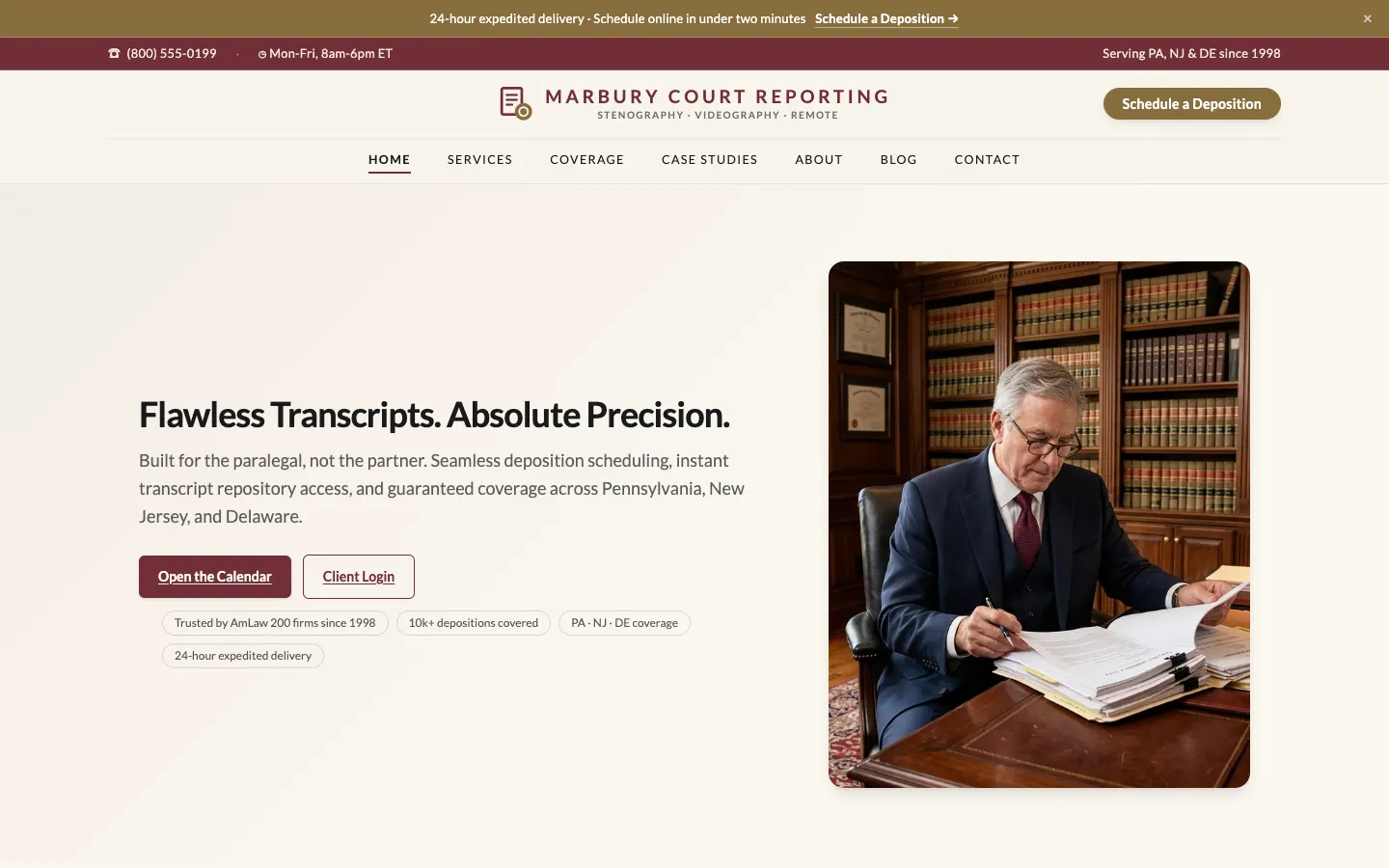
A real site we designed and built, live on the web. This one is our Court Reporting Agency build. Explore it, then picture it with your services, your photos, and your words.
Court Reporting Agency Demo
Marbury Court Reporting
- A dedicated scheduling page listing exactly what to have ready to book
- Service pages for realtime stenography, videography, and remote depositions
- A 24/7 transcript repository pitched as the end of chasing voicemails
- A PA/NJ/DE coverage page naming venues, suites, and remote capability
- Five complex-litigation case studies: patent, expert, multi-district, trial
- Paralegal testimonials and an FAQ on rush and after-hours turnaround
Questions,
answered.
Are marketing campaigns included in the plan?
Your plan includes the free site build, hosting, and the SEO foundation. Growth campaigns (paid ads, local SEO, content, scheduling-desk outreach) are optional paid add-ons you turn on when you're ready to actively grow, priced separately so you only pay for the growth work you want.
We already get plenty of referrals. Why would we run campaigns?
Referrals are great until a major account changes hands or moves litigation in-house and takes a big share of your calendar with it. Campaigns build a pipeline of new firm relationships in the background so a single lost account doesn't leave you scrambling. The 1Digital team runs both the strategy and the execution. It isn't a dashboard you're left to operate.
Which channel should a reporting firm turn on first?
It tracks with what's hurting. Firms that need coverage on the books now usually start with paid search to catch urgent and conflict requests, while local SEO and content build the durable rankings that win the firms who'll book you repeatedly. We recommend the mix around your market and goals rather than selling a fixed package.
Ready to get your Court Reporting & Legal Support Services website built, free?
Annual plan includes a free semi-custom website build: 3 to 12 pages, depending on your plan.
No setup fees · 12-month term, then month-to-month · 30-day money-back guarantee