
Search visibility
How Sneaker Shops Get Found on Google and in AI Search
Sneaker buyers do not search "shoe store." They search a silhouette, a colorway, and a size, often with "near me" attached, and they buy from whoever shows that exact pair in stock. That specificity is the opportunity: these are some of the most precise, highest-intent searches in retail, and most independent shops are invisible for every one of them. Here is what actually gets a sneaker shop into those results.
Why sneaker searches are unusually winnable
Most local retail SEO is a brawl over a handful of generic terms. Sneaker resale is not. A buyer hunting a specific pair types the model, often the colorway, and increasingly the size. That is a long, specific query with obvious purchase intent and far less competition than the head terms everyone fights over.
The catch is that you can only rank for a pair if that pair exists as a page. A shop whose inventory lives on an Instagram grid and a shelf has nothing for Google to index, so every one of those searches goes to a marketplace, which then charges you a commission to sell your own inventory back to a buyer who was looking for you.
What actually moves a sneaker shop up the results
Visibility here compounds from a few concrete things. Miss them and you stay stuck behind the aggregators; get them right and you start catching searches at the exact moment someone is ready to spend:
- A real page per pair: model, colorway, size, and condition as indexable text rather than a photo caption. This is the single biggest lever, and the one most shops skip entirely.
- Local relevance signals: shop name, address, phone, hours, and the neighborhoods you serve, structured so Google can confidently place you for "sneaker store near me" and "consignment sneakers [city]."
- Technical health means clean, crawlable code and schema markup that tells Google you are a sneaker retailer and consignment shop, and where you are. The layer buyers never see and search engines read first.
- Speed on mobile matters, because these searches happen on a phone, frequently while the buyer is standing somewhere else deciding whether to come to you. A fast site outranks a prettier one that stutters.
- Depth that survives a sellout: sold pairs kept live and clearly marked keep your catalog substantial between drops, so you do not vanish from model searches every time inventory turns.
- Reputation signals: steady genuine Google reviews and consistent listings, which matter more in resale than almost anywhere else because the buyer is trusting you on authenticity.
Release-date traffic arrives weeks early
Sneaker search has a rhythm that most retail does not: interest in a release spikes well before the release date and is enormous relative to the number of pairs that exist. People search a drop for weeks, looking for release info, retailer lists, and raffle rules.
A release calendar and per-drop pages capture that traffic ahead of the date and then convert it with something only you can offer: your in-store raffle rules, your reservation process, your waitlist. Without those pages the search still happens; it just lands on a national blog running ads against inventory you are the one actually holding.
Getting found in AI search, not just Google
Buyers increasingly ask ChatGPT, Gemini, or Perplexity "where can I buy [pair] in size 10" or "best sneaker store in [city]" and act on the answer. These assistants do not rank links. They read structured, well-organized sites and summarize them. A clear authentication page, clean product data, and fast pages make you the shop that gets named.
WorkspaceCMS builds every sneaker shop site with the schema, structure, and clarity both Google and AI assistants rely on. On the Premium plan, an AI Visibility Tracker shows how often assistants surface your shop across ChatGPT, Claude, Perplexity, and Gemini, measured rather than assumed.
Grow your practice
Guides for growing your sneaker shops
Practical guides to get found on search, book more appointments, and win new patients.
- Get found on searchShow up when someone searches a pair by name and size
- Sell more onlineTurn browsers into inquiries, holds, and store visits
- Win new customersWin new buyers and the consignors who keep you stocked
- See examplesSee a sneaker resale site built to move inventory
- vs. DIYUnderstand why a link-in-bio and a marketplace booth stall out
See it in action
A real site, live on the web
A real site we designed and built, live on the web. This one is our Sneaker Shop build. Explore it, then picture it with your services, your photos, and your words.
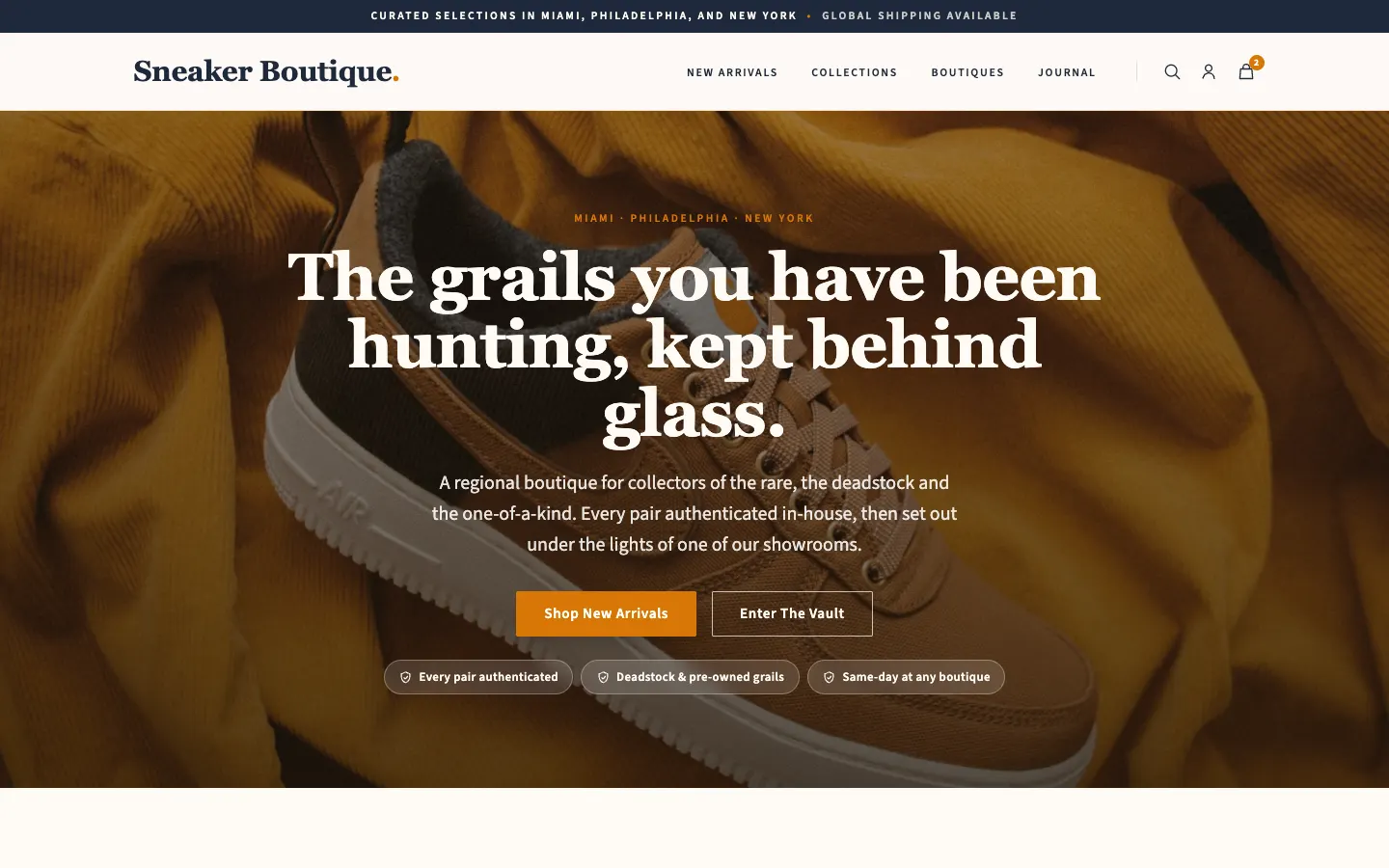
Sneaker Shop Demo
Sneaker Boutique
- Collection pages for new arrivals, archive models, and by-appointment grails
- Product pages carrying condition, colorway, year, and box details with an inquire-for-sizing flow
- An authentication explainer and three boutique location pages built for "sneaker store near me"
Questions,
answered.
Should every pair really get its own page?
Every pair worth more than the few minutes it takes to list, yes. That is what makes model-and-size searches findable at all. The listing flow is built to be quick, and once a pair sells the page stays up marked sold, so the work keeps paying off as catalog depth instead of disappearing.
Does this help me appear in ChatGPT, Perplexity, and Gemini answers?
Yes. Those tools summarize sites that are structured, accurate, and quick to load, and we build to that standard by default. Premium adds an AI Visibility Tracker so the results are measurable, not a guess.
Will you handle Google Business Profile and reviews too?
Your website is the foundation, and a growth campaign extends into the off-site signals that reinforce local ranking, from listings consistency to review generation. It is handled by the team rather than left as homework for whoever is working the counter.
Ready to get your Sneaker Shops website built, free?
Annual plan includes a free semi-custom website build: 3 to 12 pages, depending on your plan.
No setup fees · 12-month term, then month-to-month · 30-day money-back guarantee