Growth campaigns · Tactical Gear

Marketing for tactical and outdoor gear retailers

This buyer verifies a cut rating before they read a headline, and half the usual advertising playbook is closed off by platform policy anyway. What remains is organic depth, gear guides written by people who have worn the kit, and creative scoped to what will actually be approved.

Live Tactical Gear demo

Granite Ridge Outfitters

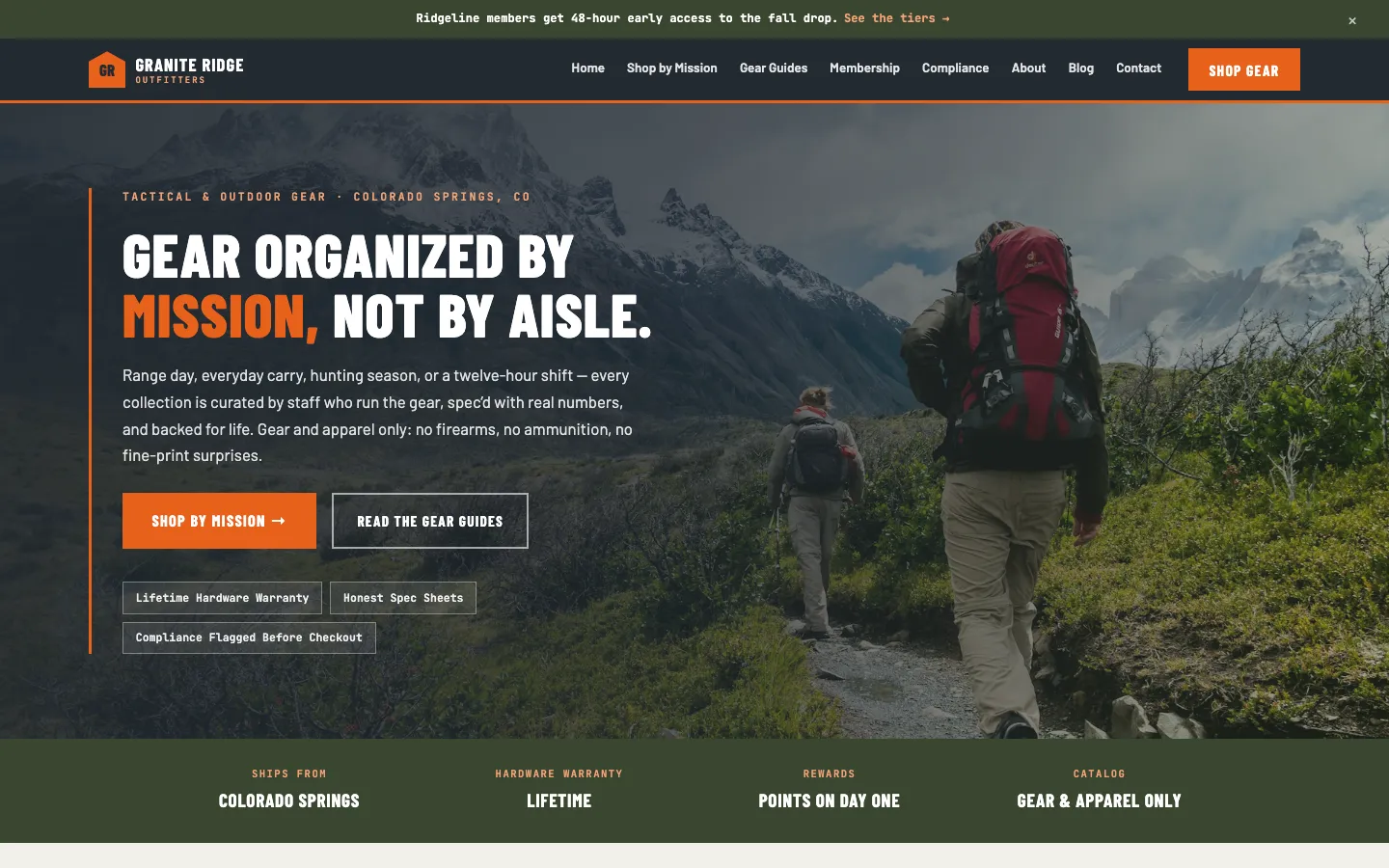
A slate-olive-and-signal-orange tactical/outdoor gear site from Colorado Springs: a shop-by-mission category grid (range day / EDC / hunting / duty), spec-heavy product pages with Product JSON-LD, a plain-English age-gate and export/ITAR compliance page, Ridge Rewards loyalty tiers, and a counter-written gear-guide hub.

Shop-by-Mission Grid + Compliance-Aware Merchandising. Granite Ridge Outfitters shows what this campaign is built to feed: a shop-by-mission grid, spec-heavy product pages with proper structured data, a plain-English compliance page, and a gear-guide hub written from behind the counter.

Open the live demo → Tactical Gear websites

Granite Ridge Outfitters — live tactical gear website built on WorkspaceCMS
Where the demand is

How tactical gear buyers actually search

Tactical buyers are among the most research-driven in retail and among the least persuadable by conventional advertising. They search by brand and model, then by specification, denier, cut rating, plate size, NIJ level, MOLLE compatibility, and they cross-check against video reviews and long forum threads written by people with the same use case. A product page that repeats manufacturer marketing copy contributes nothing to that process. A page that states measured weights, materials, sizing and compatibility becomes the reference someone links to.

The channel constraint is the defining fact of the category and it shapes the whole plan. Major ad platforms restrict or refuse a great deal of weapons-adjacent advertising, so accounts get disapproved, remarketing options narrow and entire product lines cannot be promoted in the usual way regardless of budget. Retailers who ignore that build a growth plan on a channel that will not carry it. The ones who succeed lean on organic depth, email, community and carefully scoped creative that stays inside what the platforms permit.

Demand also arrives in defined waves rather than evenly. Hunting seasons open state by state, range and training demand climbs with the weather, duty and agency purchasing follows budget cycles, and refund season reliably moves higher-ticket items. Underneath all of it sits a compliance layer other retailers never think about, age gating, shipping restrictions by state, export considerations, and buyers who explicitly check that a retailer understands the rules before they trust it with an order. Handled openly, compliance is a trust asset. Handled quietly, it becomes a support burden and a returns problem.

The keyword clusters we build around

  • Brand and model specificationBuyers who already know the product and are verifying fit, size, compatibility and availability. These pages win on measured detail and honest stock information, not on marketing adjectives.
  • Mission and use-caseRange day, everyday carry, hunting, duty. Buyers assemble a load-out around a purpose, so category pages built by mission match how they think and pull in far broader searches than a product-type tree.
  • Gear guides and comparisonsHow to size a plate carrier, which cut rating suits what work, comparisons between competing systems. This is the engine of the whole organic plan and the material that earns links and citations.
  • Compliance and shipping questionsWhat ships where, what needs age verification, what is restricted in a given state. Answering these openly resolves the buyer's main hesitation and cuts the support load at the same time.
  • Loyalty and repeat purchaseRewards tiers, restock alerts and consumables. Repeat buying is where the margin lives in this category, so the programme deserves indexed pages rather than being buried in an account area.
The campaign

Three ways we go get the traffic

Local SEO, AI-assistant visibility and paid media, run by the agency team that has been doing it since long before WorkspaceCMS existed.

Local SEO

Organic carries the weight in this category for the simple reason that no platform policy can switch it off. Dozens of retailers publish the same supplier description for the same plate carrier, which is why none of them rank, so product pages get rewritten around measured weights, denier, cut ratings, plate sizes and MOLLE compatibility with structured data underneath. Category pages are built by mission, range day, everyday carry, hunting, duty, because that is how a load-out is assembled. The gear-guide hub is the engine, deep enough that the reviewers this audience already trusts link to it. A storefront adds local search for try-on demand.

AI search visibility

How do I size a plate carrier, what does a cut rating mean in practice, which retailers ship this to my state: assistants get asked all of it, and they avoid quoting stores that only repeat manufacturer copy. Being the source means measured product data marked up properly, guides that name a trade-off and admit when the cheaper option is enough, and a compliance page written in plain English rather than legal boilerplate. ChatGPT, Claude and Perplexity will cite a page that states a limitation; they have nothing to work with on a page calling everything mission-ready.

Paid media

Plan around the policy rather than against it. Weapons-adjacent creative is restricted or refused outright on the major platforms, accounts get disapproved over lines that seemed harmless, and remarketing options narrow without warning, none of which changes with a larger budget. What is realistic here is social and creative built deliberately inside what the platforms permit, apparel and soft goods leading rather than restricted items, supported by email and by the community that already talks about this gear. Timing matters too, since hunting seasons open state by state and refund season reliably moves the higher-ticket rigs.

Campaigns are an add-on to a WorkspaceCMS plan and start from $499/mo. The plan itself is a monthly subscription. The build is included, the platform is not free. Local SEO campaigns are scoped to single and multi-location businesses rather than national or global SEO. Paid search management covers service businesses rather than online stores; ad spend is billed by Google or Meta directly to your own account. Full campaign scope → · Plan pricing →

What gets in the way

Six things that hold tactical gear sites back

01

Ad platforms restrict the category by policy

Weapons-adjacent advertising is limited or blocked outright on major platforms, and no budget changes that. Growth here has to be planned around organic search, email, community and creative scoped to what will actually be approved, rather than on a paid-search plan that gets disapproved in week one.

02

Manufacturer copy makes every retailer identical

Most of the category publishes the same supplier descriptions, so dozens of stores compete with byte-identical product text and none of it ranks. Rewritten, measured specifications with real photography and compatibility notes are what separate a store that ranks from a store that lists.

03

Buyers trust reviewers, not retailers

Purchase decisions are made in videos and forums long before a store is chosen. Counter-written gear guides that acknowledge trade-offs and say when a cheaper option is sufficient are the only retail content that gets taken seriously in that environment, and they are what earns the link.

04

Compliance friction shows up as abandoned carts

Age gates, state restrictions and export rules surprise buyers at checkout and they leave. Explaining the rules in plain language on their own page, and surfacing restrictions on the product page rather than at payment, converts better and reduces the refund and support work behind it.

05

Stock volatility undermines every ranking page

Products in this category go out of stock for long stretches, and the pages that ranked become dead ends. A deliberate approach to out-of-stock items, restock notification, honest availability language, alternatives on the page, keeps the earned rankings working instead of leaking traffic.

06

The brand has to read as competent to a skeptical audience

This buyer detects marketing gloss instantly and discounts everything after it. Tone, photography and the willingness to state limitations plainly do more for conversion than any offer, and they are the difference between being a store people order from twice and one they try once.

Campaign add-ons

Pick the campaign that fits the market

Every package below is bought from your dashboard once your site is live. Names, prices and deliverables are read from the catalog at page load, so what you see here is what you would be buying.

Questions

Tactical Gear marketing, answered

Does an age gate hurt our search visibility?

Only if it blocks crawlers or hides the product copy behind an interstitial. A gate that lets the page be read while gating the purchase path keeps the listing indexable and still does the job the regulation asks of it.

Why do you keep pushing gear guides?

Because this audience decides in videos and forum threads long before it picks a store. A guide that admits when a cheaper carrier is sufficient earns the link and the citation that a page of product descriptions never will.

What do we do with a product that is out of stock for months?

Keep the page working rather than letting it die. Honest availability language, a restock notification and compatible alternatives listed on the page hold the ranking that item earned instead of leaking the traffic to a competitor.

Should state shipping restrictions appear on the product page?

Yes, well before checkout. Buyers who discover a restriction at payment abandon and often complain, whereas a restriction surfaced on the listing filters the order and cuts the returns and support work sitting behind it.

Our copy comes from the manufacturer. Is that a problem?

It is the central one. Identical supplier text across dozens of retailers means nothing distinguishes your listing, so measured weights, real photography, sizing notes and compatibility detail are what separate a store that ranks from a store that merely lists.

Your free site is one click away

Ready to grow a tactical gear business?

Get the site built, then put a campaign behind it. Start online, or talk it through with a strategist first.

Want the full picture? See what a campaign includes