
Growth campaigns · Urgent Care

Urgent care marketing for a decision made in minutes

A parent in a parking lot with a feverish child taps whichever clinic shows open now, close by, and taking her plan. This campaign is about being on that map with the hours correct, the wait visible and the insurance answer readable before she pulls out.

Live Urgent Care demo

CareNow Urgent Care

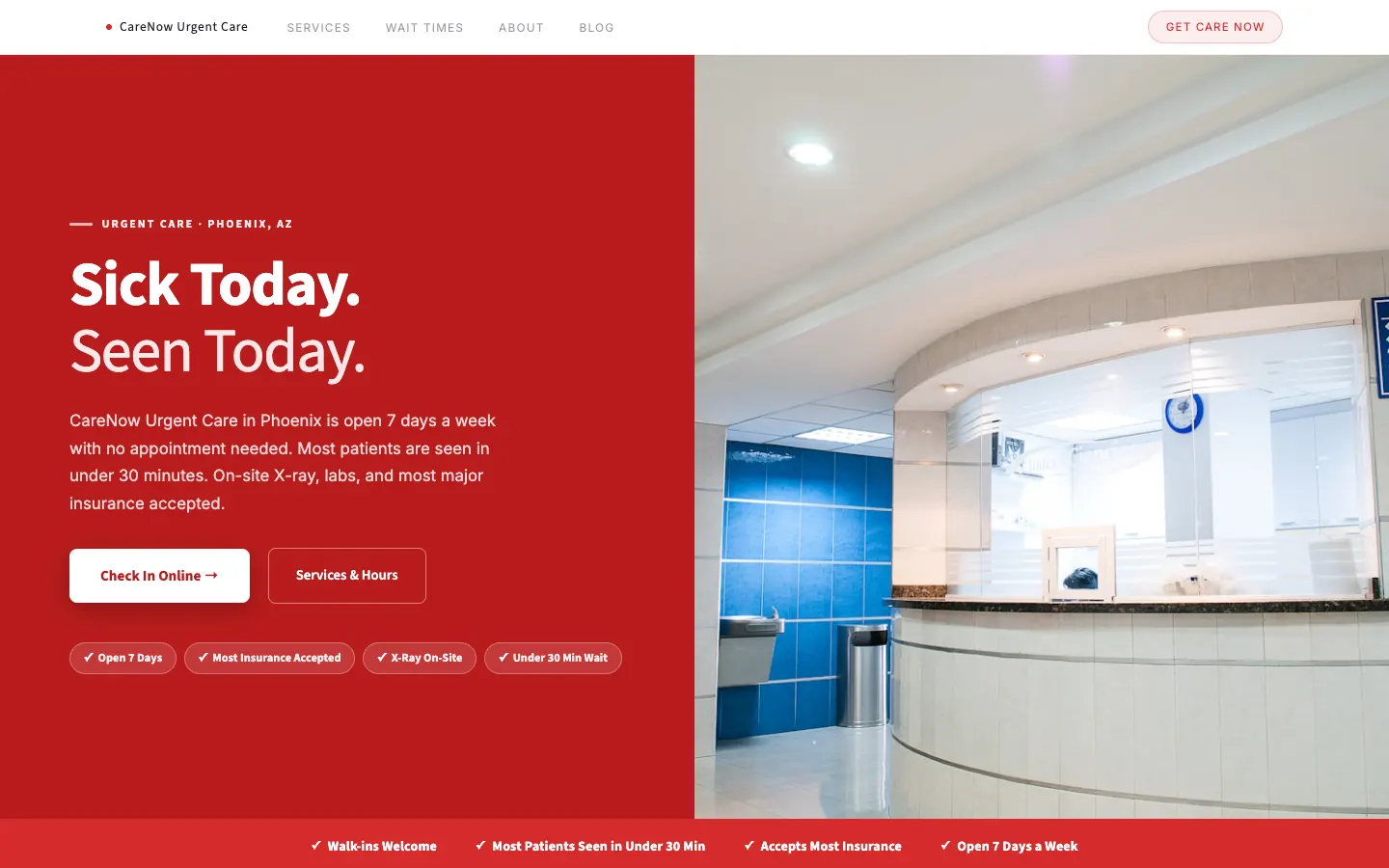
A high-urgency urgent care site with a live wait-time widget, walk-in CTA, and insurance-accepted trust signals.

Live Wait Time Widget. CareNow Urgent Care puts the whole argument on one screen: a live wait-time widget, a walk-in call to action and insurance trust signals, which is exactly what a parking-lot search filters on.

Open the live demo → Urgent Care websites

CareNow Urgent Care — live urgent care website built on WorkspaceCMS
Where the demand is

How urgent care buyers actually search

Urgent care is the shortest funnel in local healthcare. Research, comparison and decision compress into a few minutes on a phone, and the criteria are brutally practical: how far away, is it open now, how long is the wait, and will my insurance be accepted. Content that would serve a specialty practice well is close to irrelevant here. What matters is that the operational answers are visible before the tap.

Because the search is a map search, the local pack does most of the work and hours accuracy becomes a marketing asset. A clinic listed as open when the doors are locked converts a patient into a one-star review and a permanent avoidance. Conversely, publishing a live wait time is one of the few genuine differentiators available in the category, because it answers the question the patient is actually weighing against a hospital emergency room.

Volume is seasonal in a way few local businesses experience. Respiratory season, school physicals before the academic year, sports clearance, summer injuries, and the periodic testing surges all move demand in large steps. Meanwhile the real competitive threat is not the clinic across town but hospital-owned networks with far larger budgets and telehealth apps promising a consult without leaving the couch. Occupational health and employer contracts run on a completely different, relationship-led cycle and need their own path on the site.

The keyword clusters we build around

  • Open now and near meMap-driven searches where hours, distance and wait time decide everything. The campaign work here is listing accuracy and location page quality more than article writing.
  • Symptom and injury triagePeople searching a symptom and trying to work out whether it is an urgent care or an emergency room. A clear triage page earns the visit and prevents the wrong one.
  • Insurance and self-payWhether a plan is accepted, and what a visit costs without coverage. This is the most common reason a patient abandons a clinic page, and it is entirely fixable.
  • Physicals and clearancesSchool, sports, DOT and pre-employment physicals. Predictable seasonal demand that most clinics never build a dedicated page for.
  • Occupational healthEmployer-side searches for workers' comp, drug screening and injury care. A different buyer, a longer cycle, and worth its own section rather than a line on the services list.
  • Services offered on siteX-ray, stitches, IV fluids, labs. Patients search the capability because it determines whether one trip solves the problem or turns into two.
The campaign

Three ways we go get the traffic

Local SEO, AI-assistant visibility and paid media, run by the agency team that has been doing it since long before WorkspaceCMS existed.

Local SEO

Nearly everything happens inside the map result, so location page quality and listing hygiene outrank article writing. Each clinic gets its own indexable page with its own hours, directions, on-site capability, accepted plan list and reviews, rather than one page hiding behind a location dropdown. Around that sit triage pages helping someone decide between a walk-in visit and an emergency room, plus physicals and sports-clearance pages built before the school year rather than during the rush for them.

AI search visibility

Is this an urgent care problem or an emergency room problem? Assistants field that at every hour, and they answer from clinics that published the operational facts: hours and holiday closures as structured data, whether there is an X-ray machine and a suture room on site, which plans are taken, what a self-pay visit involves, and triage guidance written as direct answers. A clinic that lists its services as bare nouns reads as interchangeable to Perplexity and to the parent.

Paid media

Scheduling is the lever here, not creative volume. Delivery weights toward evenings, weekends and respiratory season and pulls back through the flat weeks, because someone searching on a Tuesday afternoon in July is a different patient from someone searching at eight on a Sunday night. Radius targeting is drawn tightly around each site so clinics in the same group stop bidding against one another. Occupational health runs as a separate campaign entirely: the employer buying drug screening panels is not the patient with a sprained wrist.

Campaigns are an add-on to a WorkspaceCMS plan and start from $499/mo. The plan itself is a monthly subscription. The build is included, the platform is not free. Local SEO campaigns are scoped to single and multi-location businesses rather than national or global SEO. Paid search management covers service businesses rather than online stores; ad spend is billed by Google or Meta directly to your own account. Full campaign scope → · Plan pricing →

What gets in the way

Six things that hold urgent care sites back

01

Listing hours drift out of sync with reality

Holiday hours, an early close for staffing, a location that changed its schedule. Wrong hours in the map listing produce a patient at a locked door and a review that outlives the mistake. Listing hygiene across every location is ongoing campaign work.

02

Hospital-owned networks outspend and outrank you

Health system marketing budgets dwarf an independent clinic's. The counter is not matching spend but owning the operational answers systems are slow to publish: real wait times, self-pay clarity and neighborhood-level location pages.

03

Patients cannot tell if you take their insurance

A generic 'most major insurers accepted' line sends people to a competitor whose page names the plans. Publishing the accepted plan list, and a plain self-pay explanation, removes the most common bounce reason on a clinic site.

04

Multi-location sites collapse into one page

Clinics with several sites often run a single location page with a dropdown. Each site needs its own indexable page with its own hours, directions, services and reviews, or the map results have nothing distinct to rank.

05

Wait time is your differentiator and it is invisible

If a patient cannot see the wait before choosing, she weighs you against an emergency room on gut feel. Surfacing wait time on the site and in the search snippet turns an operational fact into a conversion lever.

06

Occupational health is buried under consumer content

Employer contracts are steady revenue with a completely different sales cycle, and they get one bullet on a services page. A dedicated path with the screening panels, turnaround and contact route reaches a buyer the consumer site never speaks to.

Campaign add-ons

Pick the campaign that fits the market

Every package below is bought from your dashboard once your site is live. Names, prices and deliverables are read from the catalog at page load, so what you see here is what you would be buying.

Questions

Urgent Care marketing, answered

Does every clinic need its own page, or can one page cover the group?

Each clinic needs its own indexable page with its own hours, directions, on-site services and reviews. A single page behind a location dropdown gives the map nothing distinct to rank, and it is the most common structural fault we find on urgent care sites.

How much damage do wrong holiday hours in the map listing really do?

More than any content problem on the site. A patient at a locked door writes a review that outlives the mistake and never tries the clinic again, so keeping hours, early closes and holiday schedules accurate across every location is standing campaign work.

Should we publish the insurance plans we accept?

Naming them removes the most common exit point on a clinic page. A line promising that most major insurers are accepted sends the patient to the competitor whose page lists her plan, and a plain self-pay explanation captures the uninsured visit as well.

Can an independent clinic compete with the hospital network's urgent care brand?

Not on budget, but on the operational answers health systems are slow to publish. Real wait times, neighborhood-level location pages, self-pay clarity and on-site capability are decided locally and can go live long before a system's marketing department approves anything.

Does occupational health belong on the same site as walk-in care?

On the same site, on its own path. The employer buying pre-employment screening and injury care works on a relationship-led cycle, so those enquiries need a dedicated section with the panels and turnaround stated, routed away from the consumer intake flow.

Your free site is one click away

Ready to grow a urgent care business?

Get the site built, then put a campaign behind it. Start online, or talk it through with a strategist first.

Want the full picture? See what a campaign includes