Growth campaigns · Wedding Planning

Inquiry campaigns for wedding planning studios

Most of next year's inquiries are decided between the winter holidays and early spring, and the couple has usually booked a venue and a photographer before they think about a planner. The campaign has to be waiting when that third search happens.

Live Wedding Planning demo

Summit & Veil Weddings

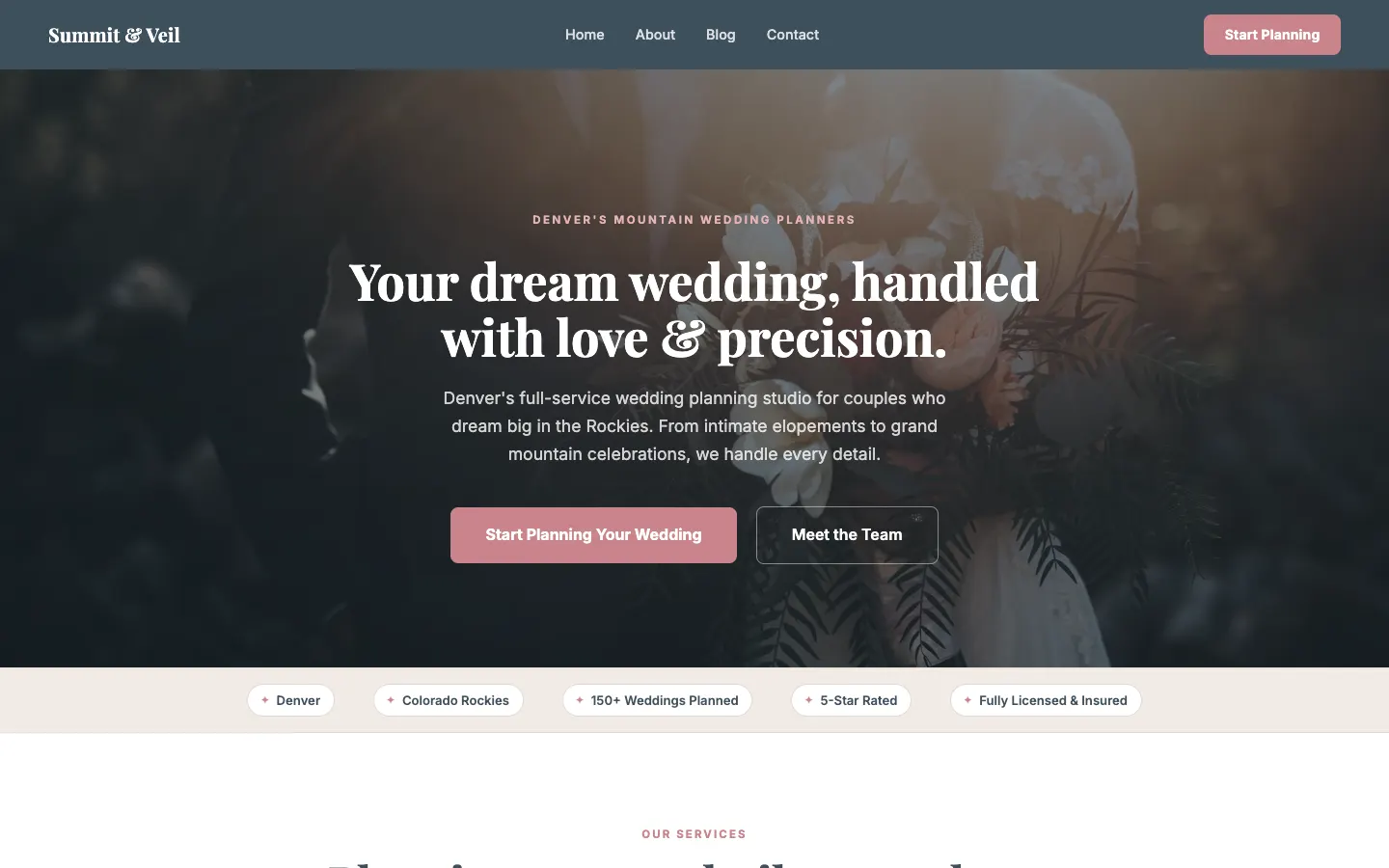
Modern mountain romance aesthetic for a Denver wedding planning studio. Dusty rose and cool slate, Playfair Display headings, and an elegant inquiry funnel.

Colorado Mountain Wedding Planner. Summit & Veil Weddings runs the inquiry funnel this campaign feeds, with mountain-wedding positioning specific enough to intercept venue-led searches and a paced inquiry path suited to a decision that takes weeks.

Open the live demo → Wedding Planning websites

Summit & Veil Weddings — live wedding planning website built on WorkspaceCMS
Where the demand is

How wedding planning buyers actually search

Almost the entire year's inquiry volume is set by engagement season, the stretch running from the winter holidays through Valentine's Day, when a disproportionate share of proposals happen. The searches that follow arrive in a predictable order: venue first, then photographer, then planner, which means a planner is often being found by a couple who already has a date and a location and is now assessing what they cannot manage themselves. Meeting that couple requires content built around venues and logistics, not around planning as an abstract service.

The comparison is unusually intimate. A couple is choosing someone who will be present at one of the most significant days of their lives, so they read voice and personality as closely as portfolio, and they weigh whether the planner has handled their kind of wedding: their guest count, their venue type, their family complexity, their cultural traditions. Generic studio copy fails this test badly, because the exact thing being evaluated is specificity of experience.

Service tiers complicate the funnel more than most planners account for. Full planning, partial planning, and day-of coordination attract different budgets and different anxieties, and the searcher rarely knows which one they need. A site that presents a single undifferentiated service loses the couple who thinks they cannot afford a planner and the one who thinks coordination is all they want. Meanwhile, referral flow from venues and photographers arrives untracked, landing on a site that has to sell without any of the context that referral carried.

The keyword clusters we build around

  • Venue-specific planningSearches naming a venue, region, or setting you have worked. Extremely convertible because the couple has already committed to the location and is now solving for expertise there.
  • Service tier clarityFull planning versus partial versus day-of coordination. Couples search these terms while trying to work out what they need, and the studio that explains the difference honestly wins the inquiry.
  • Destination and travel weddingsCouples planning from another city who need someone with vendor relationships on the ground. Long lead times, larger scope, and a distinct set of logistics questions to answer.
  • Cultural and multi-tradition weddingsCeremonies with specific religious or cultural requirements. Couples look hard for evidence of real experience, and generic pages are transparently unconvincing here.
  • Planning process questionsHow far ahead to hire, what a planner actually does, how vendor coordination works. Early-cycle content that builds trust before the inquiry and gets quoted heavily by AI assistants.
The campaign

Three ways we go get the traffic

Local SEO, AI-assistant visibility and paid media, run by the agency team that has been doing it since long before WorkspaceCMS existed.

Local SEO

Couples arrive with a date and a venue already chosen, so the pages that intercept them are venue and region guides written from weddings you actually planned rather than an abstract description of planning. Each service tier gets its own page saying plainly what it covers and what it does not, because the searcher rarely knows which one they need. Referred couples arriving from venue and photographer recommendation lists get their own landing paths, so those relationships stop showing up in analytics as anonymous direct traffic.

AI search visibility

Newly engaged couples ask assistants how early to hire a planner, what full planning includes that coordination does not, and who already knows a particular venue. A studio becomes citable by defining its tiers precisely, naming the venues and regions it has worked, describing the timeline from first meeting through the rehearsal, and answering the questions couples with complex family or cultural requirements actually ask. We publish and structure that so ChatGPT, Claude, Perplexity, and Google AI Overviews can name your studio with correct detail.

Paid media

Timing dominates everything else here: campaigns are in position before proposals happen, not after, and the heaviest weeks run from the winter holidays through early spring. Search is segmented by tier so a day-of coordination searcher and a full-planning searcher never see the same message, and geofencing follows the venues and regions you genuinely serve rather than a radius drawn around your office. Paid social carries real wedding imagery, which is where a couple forms an impression of your voice long before they inquire.

Campaigns are an add-on to a WorkspaceCMS plan and start from $499/mo. The plan itself is a monthly subscription. The build is included, the platform is not free. Local SEO campaigns are scoped to single and multi-location businesses rather than national or global SEO. Paid search management covers service businesses rather than online stores; ad spend is billed by Google or Meta directly to your own account. Full campaign scope → · Plan pricing →

What gets in the way

Six things that hold wedding planning sites back

01

The whole year is decided in engagement season

Inquiry volume concentrates into the weeks between the winter holidays and early spring, and a studio that starts campaigning in March has already missed most of the couples who will marry the following year. Content and paid campaigns have to be in position before proposals happen, not after.

02

Couples find the venue before they find you

The search sequence puts planners third, behind venue and photographer, so the couple usually arrives with a location already chosen. Sites organized around abstract planning services do not intercept that search. Venue and region pages, written from real experience at those places, do.

03

Nobody knows what tier they need

A couple who believes a planner is out of reach never inquires, and one who thinks day-of coordination covers everything hires the wrong service and is disappointed. Explaining the tiers plainly, including what each does not include, converts more inquiries and produces better-matched clients.

04

Venue and vendor referrals arrive untracked

Much of this industry's best business comes through venue recommendation lists and photographer referrals, which appear in analytics as direct traffic and receive no credit. Without pages built for those referred visitors, the studio cannot tell which relationships produce revenue or reinforce them deliberately.

05

Every planner's site says the same things

Seamless, stress-free, and your vision brought to life appear on nearly every studio site in every market, which makes them invisible. The distinguishing detail is concrete: the venues worked, the guest counts handled, the traditions understood, the specific logistics solved. That is also what search and AI systems can actually use.

06

The inquiry-to-booking gap is weeks long

A couple inquires, meets several planners, discusses it with family and often with whoever is contributing to the budget, and decides much later. A site and a campaign that measure success at the form submission miss most of what determines whether that inquiry becomes a signed contract.

Campaign add-ons

Pick the campaign that fits the market

Every package below is bought from your dashboard once your site is live. Names, prices and deliverables are read from the catalog at page load, so what you see here is what you would be buying.

Questions

Wedding Planning marketing, answered

When should our campaign actually be running?

Ahead of engagement season rather than inside it. Most of the following year's inquiries begin between the winter holidays and early spring, and venue pages, tier pages, and campaigns launched during that window have no time to earn position before couples decide.

Couples find their venue before they find us. How do we get in earlier?

Mostly you do not, and the better play is to be excellent at the third search. Pages written from weddings you have run at a named venue, covering its load-in rules, its in-house coordinator, and its quirks, reach a couple exactly when they realize the venue will not plan the day for them.

Should we spell out what each service tier does not include?

It is one of the highest-value things a planning site can publish. It converts couples who assumed a planner was beyond them, stops someone hiring day-of coordination for a wedding that needed full planning, and gives assistants a clear definition to quote.

Our best leads come from venue and photographer referrals and we cannot see them. Can that be fixed?

Partly, with dedicated landing paths for referred couples so that traffic stops collapsing into anonymous direct visits. Once you can see which venues and photographers genuinely send bookings, you can reinforce those relationships deliberately instead of guessing which ones matter.

Every planner in our market says seamless and stress-free. How do we sound different?

By replacing adjectives with facts a competitor cannot copy: the venues you have worked, the guest counts you handle comfortably, the traditions and multi-day ceremonies you understand, the logistics you have solved. That detail is also the only part search engines and assistants can use.

Your free site is one click away

Ready to grow a wedding planning business?

Get the site built, then put a campaign behind it. Start online, or talk it through with a strategist first.

Want the full picture? See what a campaign includes