Growth campaigns · Wedding Venue

Growth campaigns for wedding venues

Couples shortlist on two numbers most venues will not publish: how many guests fit, and roughly what a Saturday costs. This campaign gets your spaces onto that spreadsheet and onto the tour calendar, during the engagement-season rush when the venue itself is empty.

Live Wedding Venue demo

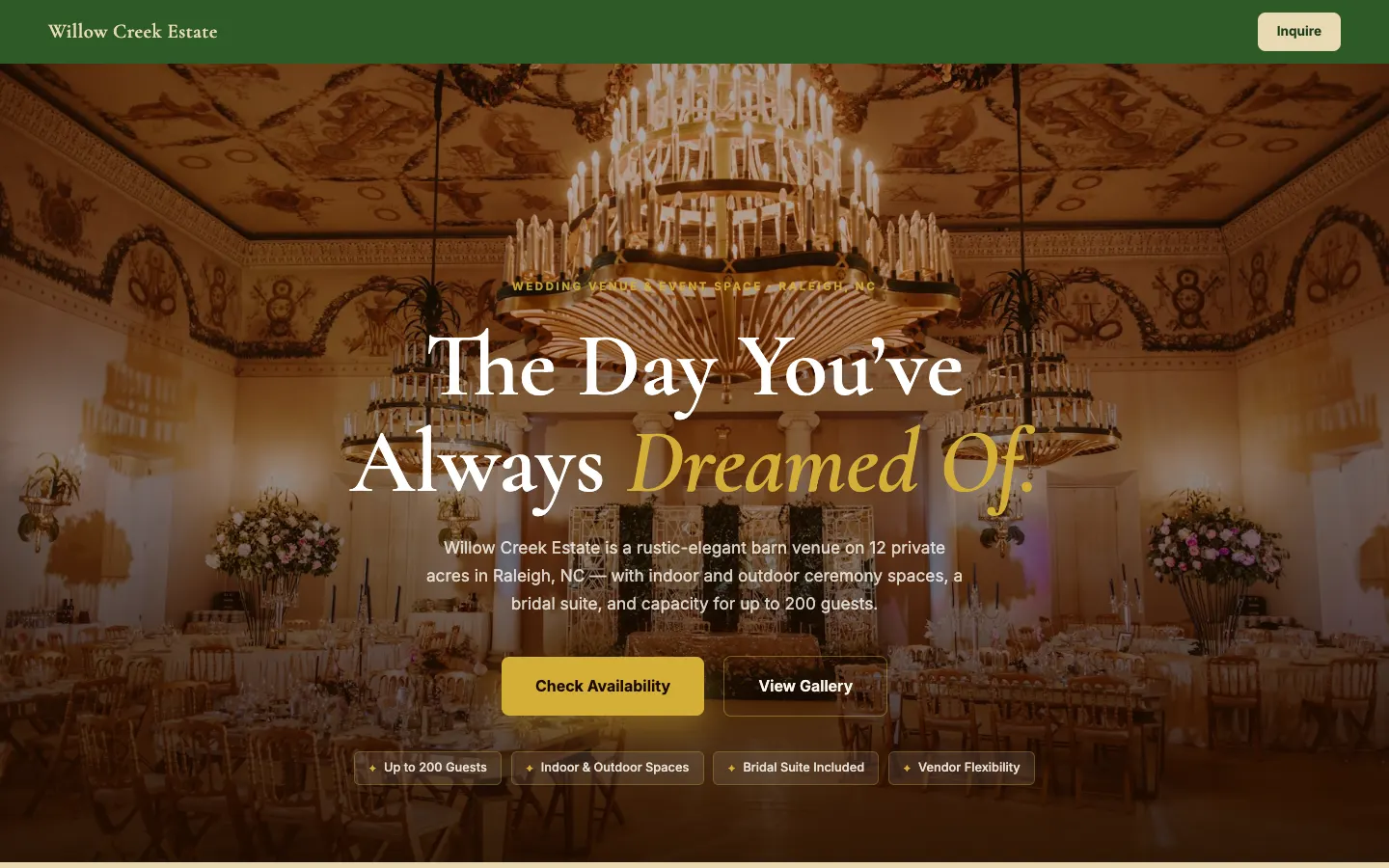
Willow Creek Estate

A rustic-elegant forest-green wedding venue site with Cormorant Garamond serif headings, space cards with capacity info, and tiered pricing.

Space Cards + Tiered Rental Pricing. Willow Creek Estate lists every space with its seated and standing capacity beside seasonal rental tiers, so a couple can shortlist it late at night without booking a tour first.

Open the live demo → Wedding Venue websites

Willow Creek Estate — live wedding venue website built on WorkspaceCMS
Where the demand is

How wedding venue buyers actually search

The venue decision is the first big one a couple makes and it locks everything else: date, guest count, budget, half the vendor list. That makes it a slow, high-anxiety purchase with an unusual dynamic: the searcher is planning an event they have never planned before, using vocabulary they are learning as they go. They search by aesthetic before they search by logistics. Barn, industrial, waterfront, garden, estate, rooftop. Getting the aesthetic language on the page in the couple's own words, rather than in venue-industry terms, is most of the organic battle.

Elimination happens on two hard numbers the couple will not compromise on: how many people fit, and roughly what a Saturday costs. A venue that hides both is not being mysterious, it is being skipped, because the couple has a spreadsheet and a venue with no figures cannot go on it. Directories understand this perfectly, which is why they occupy the top of most venue searches and charge accordingly for a listing that repeats what your own site declined to say.

Seasonality here is inverted from the event itself. Enquiries spike between the December holidays and February, when engagements cluster, for weddings eighteen months out. That means the campaign's busiest inbound stretch is the venue's quietest operating stretch, and a venue that lets its content go dormant over winter misses the exact window that fills the following year. Weekday and off-season inventory is the other perennial problem: it needs its own positioning (corporate, micro-wedding, elopement, anniversary), because it will never sell against a Saturday.

The keyword clusters we build around

  • Aesthetic and settingBarn, garden, waterfront, industrial, estate and rustic paired with a region. This is how couples actually begin, before capacity or price enters the picture.
  • Capacity-qualified searchVenues for a specific guest count, or small and intimate weddings. Publishing capacity per space, seated and standing, captures a search most venues answer only on a tour.
  • Pricing researchCost searches paired with your region and season. A tiered pricing page keeps the couple on your site instead of sending them to a directory that estimates it for them.
  • All-inclusive versus bring-your-ownCouples working out what a package covers and what they still have to hire. A clear inclusions page removes the biggest source of enquiry-stage confusion.
  • Off-peak and non-wedding eventsWeekday, winter and micro-wedding searches, plus corporate and celebration bookings, aimed at the inventory a Saturday campaign never touches.
The campaign

Three ways we go get the traffic

Local SEO, AI-assistant visibility and paid media, run by the agency team that has been doing it since long before WorkspaceCMS existed.

Local SEO

Couples begin with an aesthetic and a drive time, long before catering rules or capacity enter it, so barn, waterfront, industrial, garden and estate pages come first, written in the words a couple uses rather than in venue-trade vocabulary. Then the qualifying layer: a page per space with seated and standing figures, an inclusions page stating what is hired in, and separate positioning for weekday, winter and micro-wedding dates that will never sell against a June Saturday. Guests travel to the venue, so proximity work is built around where they are coming from.

AI search visibility

Assistants get asked for venues within an hour of a city, under a guest count, on a particular weekend. They filter on what is machine-readable: capacity per space, ranges by season and day of week, stated inclusions, noise curfews, catering rules, whether outside vendors are permitted. A venue described as elegant and timeless with its figures locked inside a downloadable brochure cannot be filtered on at all, so it never enters the list, while the one that published its curfew gets named.

Paid media

The inbound spike runs from the December holidays through February, for weddings eighteen months out, which is precisely when the venue is quiet and most owners let the campaign idle. That window is where the pressure belongs. Search traffic should land on a space page with capacity visible rather than a homepage, because a couple holding a guest count disqualifies venues in seconds. Paid social carries wide, well-lit room shots in both ceremony and reception layouts, and retargeting earns its keep across a decision that runs months from first tour to signed date.

Campaigns are an add-on to a WorkspaceCMS plan and start from $499/mo. The plan itself is a monthly subscription. The build is included, the platform is not free. Local SEO campaigns are scoped to single and multi-location businesses rather than national or global SEO. Paid search management covers service businesses rather than online stores; ad spend is billed by Google or Meta directly to your own account. Full campaign scope → · Plan pricing →

What gets in the way

Six things that hold wedding venue sites back

01

Directories rent you your own visibility

Wedding marketplaces dominate the searches couples run and charge for placement in them. Your own site can take a meaningful share of that traffic, but only if it answers the capacity and price questions the directory listing answers on your behalf.

02

Capacity buried in a PDF

A couple with a guest count wants a number in the first ten seconds. When it lives in a downloadable brochure behind a form, they leave for a venue whose site simply said it. Space-by-space capacity, seated and standing, belongs on the page.

03

No pricing at all, on principle

The reasoning is that price should come after the tour, once they have fallen for the place. In practice the couple never books the tour, because a venue with no published range cannot be compared and gets cut from a shortlist built in a spreadsheet.

04

Galleries that hide the actual space

Detail shots of table settings and rings are beautiful and tell a couple nothing about whether their guests fit. Wide, well-lit images of each space, in both ceremony and reception configurations, are what get a tour booked.

05

Weekday and winter dates sit empty

Off-peak inventory sold with the same message as a June Saturday will not move. It needs separate positioning and separate search targeting, aimed at couples optimising for cost and at events that are not weddings at all.

06

Enquiries that stall after the first reply

The gap between enquiry and booking can run months. Without a structured follow-up sequence and a straightforward way to book a tour, the couple simply tours whoever answered fastest and stayed in touch.

Campaign add-ons

Pick the campaign that fits the market

Every package below is bought from your dashboard once your site is live. Names, prices and deliverables are read from the catalog at page load, so what you see here is what you would be buying.

Questions

Wedding Venue marketing, answered

We only discuss pricing after a tour. What does that cost us?

Shortlist places. The couple is building a comparison spreadsheet and a venue with no figures cannot go on it, so a starting range by season and day of week is what keeps you in the running at all.

How specific do capacity figures need to be?

Per space, seated and standing, on the page rather than inside a brochure behind a form. A couple with a guest count wants that number within seconds, and it is the question your tour currently answers for free.

How do we fill Tuesdays and January?

With separate positioning rather than a discount banner on the wedding page. Micro-weddings, elopements, anniversaries and corporate bookings are different searches by different buyers, and off-peak inventory only moves when it has pages of its own.

The wedding directories sit above us. Is that permanent?

Their advantage is that they answer capacity and price on your behalf. Once your pages answer both, plus curfews, catering rules and vendor policy, a real share of that traffic can arrive directly instead of being rented back to you.

Our gallery is mostly table settings and rings. Why is that a problem?

Detail shots tell a couple nothing about whether their guest list fits the room. Wide, well-lit images of each space in both ceremony and reception configurations are what actually convert a browser into a booked tour.

Your free site is one click away

Ready to grow a wedding venue business?

Get the site built, then put a campaign behind it. Start online, or talk it through with a strategist first.

Want the full picture? See what a campaign includes