Growth campaigns · Party & Event Supplies

Occasion-led campaigns for party and event supply shops

Nobody shops this catalog by category. Someone is putting on a jungle-themed first birthday in three weeks or ordering centerpieces for a gala, and the shop whose site is organized by occasion is the one that turns up in that search.

Live Party & Event Supplies demo

Confetti & Clover Party Co.

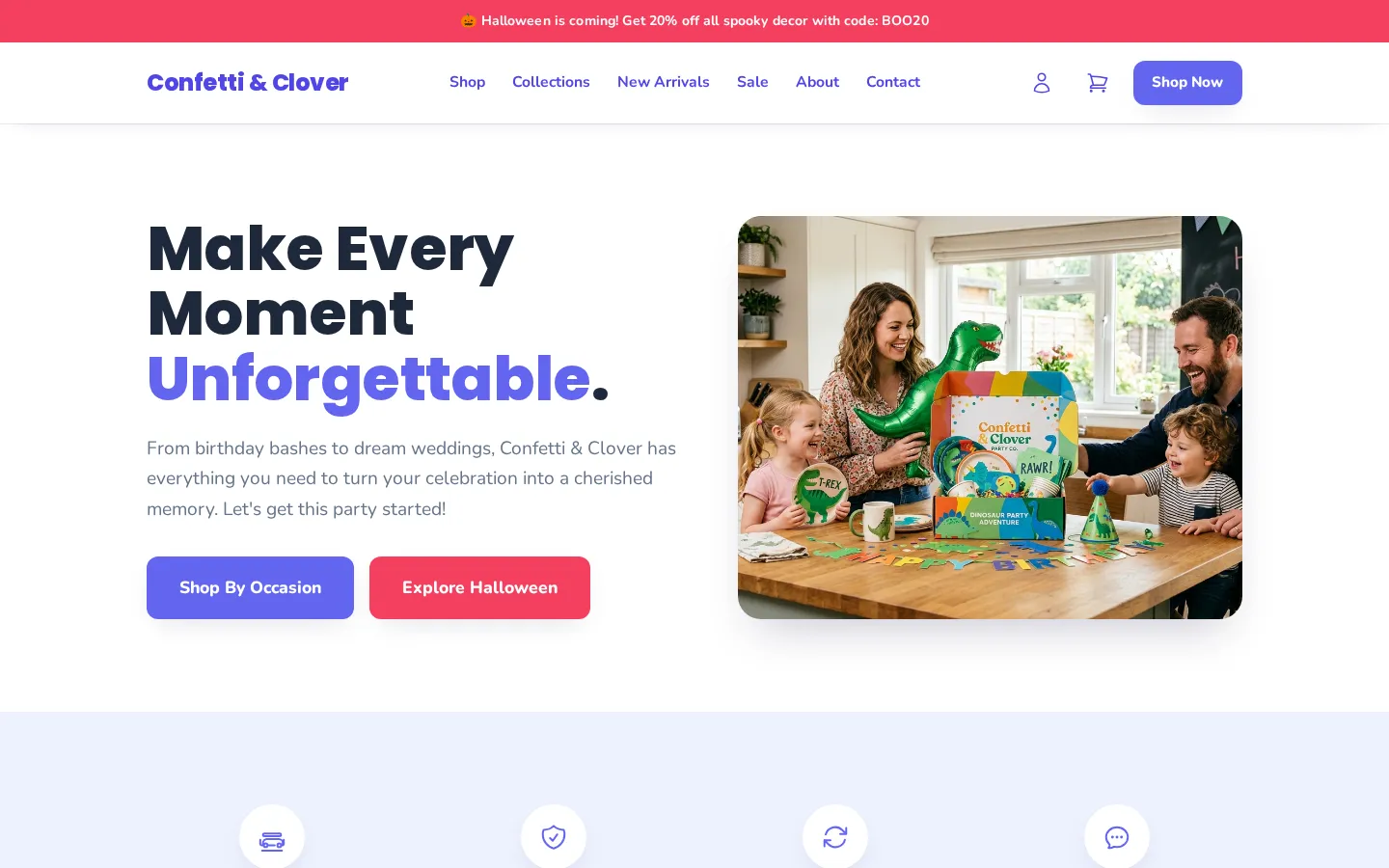
Occasion-first party supply shop wrapped in neon glow and frosted glass, built around a theme-browsing path from birthday to bulk wholesale.

Bulk Wholesale Planner Hub. Confetti & Clover Party Co. shows the occasion-first structure this campaign depends on, with a path running from a single birthday theme through to the wholesale hub where the repeat planners live.

Open the live demo → Browse all demos

Confetti & Clover Party Co. — live party & event supplies website built on WorkspaceCMS
Where the demand is

How party & event supplies buyers actually search

This vertical lives and dies by a calendar that repeats every year with almost no variation. Graduation, Halloween, the winter holiday run, and the spring wedding and shower season each produce a demand spike that begins weeks before the event and vanishes the day after, and the content for each has to exist and be indexed before the spike starts. A Halloween page published in October is a page competing with pages that were published the previous January.

Two very different customers share the same catalog. The individual host is buying one occasion, browses by theme and color, values inspiration and coordination, and decides quickly. The bulk buyer, a planner, a school, a venue, a corporate administrator, is buying repeatedly, cares about quantity pricing, lead time, and reorder convenience, and is worth many times more over a year. They search differently and need entirely separate paths, but most shops route them through the same product grid.

Price comparison is brutal because the products are largely undifferentiated and marketplaces stock them too. Competing on price alone is unwinnable, so the defensible ground is coordination and expertise: complete themed sets, quantity guidance for a given headcount, color matching, and the practical knowledge of what actually gets used at an event. That content also happens to be what earns organic visibility, because the marketplaces do not write it and the search results have room for someone who does.

The keyword clusters we build around

  • Occasion and milestoneFirst birthday, retirement, baby shower, graduation, quinceanera. The dominant way this catalog is actually searched, and each occasion deserves a curated hub rather than a filtered category view.
  • Theme and paletteJungle safari, neon, boho, specific color pairings. Visual browsing intent that converts best through curated sets and inspiration content rather than a raw product list.
  • Bulk and wholesalePlanners, schools, venues, and corporate buyers searching by quantity and lead time. A separate path with quantity pricing and a real inquiry route, kept distinct from consumer browsing.
  • Seasonal peaksHalloween, graduation season, holiday parties, spring showers. Published and refreshed well ahead of each window so the pages have time to earn position before demand arrives.
  • Planning questionsHow many favors for a given headcount, what a dessert table needs, how far ahead to order. Practical questions that attract early-stage buyers and are readily quoted by AI assistants.
  • Local pickup and same-weekShoppers who need it before the weekend and want to collect. If you have a real storefront, this is the intent where a marketplace cannot follow you.
The campaign

Three ways we go get the traffic

Local SEO, AI-assistant visibility and paid media, run by the agency team that has been doing it since long before WorkspaceCMS existed.

Local SEO

We rebuild navigation around occasions and themes instead of raw product categories, so a first birthday, a quinceanera, or a retirement party each gets a curated hub where inspiration content links straight to the buyable set with quantities suggested for a guest count. Seasonal hubs are planned a full year out, because a Halloween page published in October is competing against pages that went live the previous winter. A separate bulk path carries quantity guidance and lead times, and storefront pages chase collect-before-the-weekend intent.

AI search visibility

Party planning generates a steady stream of assistant questions: how many favors for a guest count, what a dessert table needs, how far ahead balloons should be ordered before they start sagging. A shop becomes citable by publishing that guidance rather than a product grid, along with theme component lists, lead times, pickup and delivery windows, and a substantive FAQ, structured so it can be parsed. That is what gets your shop named in a ChatGPT, Claude, Perplexity, or Google AI Overviews answer instead of a marketplace listing.

Paid media

Paid work here leads with imagery, because the product is a look rather than a specification. Occasion and theme-led creative on Meta and Instagram carries the coordinated table, the balloon installation, and the color story, scheduled against the same calendar the content follows: live weeks ahead of graduation, Halloween, and the holiday party run rather than during them. The creative built for those pushes is reused across your organic feed and inside the occasion hubs, so a seasonal campaign leaves the site stronger than it found it.

Campaigns are an add-on to a WorkspaceCMS plan and start from $499/mo. The plan itself is a monthly subscription. The build is included, the platform is not free. Local SEO campaigns are scoped to single and multi-location businesses rather than national or global SEO. Paid search management covers service businesses rather than online stores; ad spend is billed by Google or Meta directly to your own account. Full campaign scope → · Plan pricing →

What gets in the way

Six things that hold party & event supplies sites back

01

Marketplaces outprice you on every identical item

Balloons and tableware are commodity goods, and a giant marketplace will always be cheaper on a single SKU. The winnable ground is the complete coordinated set, the quantity guidance, and the local pickup a marketplace cannot offer, all of which have to be built as content rather than assumed.

02

Seasonal pages ship after the season starts

Occasion demand builds weeks ahead and collapses immediately afterward. A page created when the season begins has no time to be indexed, linked, or cited, so it misses the peak it was built for. This vertical requires planning content a full season in advance, every year.

03

Bulk buyers get funneled through the consumer path

A planner ordering for a hundred-guest event is a repeat customer worth many individual hosts, but most shops give them the same product grid and no quantity pricing or lead-time information. Without a dedicated wholesale path with a real inquiry route, that buyer goes to a supplier who built one.

04

Category pages read like a warehouse inventory

Thin filtered listings with no curation, no styling guidance, and no explanation of what goes together give search engines nothing distinctive to rank and give shoppers no reason to choose you. Occasion hubs with genuine coordination advice do both jobs at once.

05

Themes turn over and old pages rot

Party trends move each year, and last season's theme pages linger with discontinued products and broken links. Left alone they drag the site's quality signals down; handled deliberately, with redirects and refreshes, their accumulated authority transfers to the current season's themes.

06

Inspiration traffic never becomes a purchase

Idea searches bring plenty of visitors who bounce, because the styling content and the products sit in different parts of the site. Connecting an inspiration piece directly to the buyable set, with quantities suggested for a given guest count, is what converts browsing into a basket.

Campaign add-ons

Pick the campaign that fits the market

Every package below is bought from your dashboard once your site is live. Names, prices and deliverables are read from the catalog at page load, so what you see here is what you would be buying.

Questions

Party & Event Supplies marketing, answered

How far ahead should a seasonal hub be published?

Months, not weeks. Occasion demand builds ahead of the date and collapses the morning after, so a graduation hub created once the season has started is competing against pages that have been accumulating links and citations since the previous year.

A marketplace undercuts us on every identical item. Where can we win?

On coordination and collection. Nobody else publishes what a themed dessert table needs for a given headcount, and nobody else can hand a customer their order on Friday afternoon. Complete sets, quantity guidance, and same-week pickup are ground a warehouse cannot take from you.

Is a separate wholesale section worth building?

For most shops it is the highest-return change on the list. Planners, schools, and venues reorder all year but need quantity breaks, lead times, and a real inquiry route, and routing them through a consumer checkout loses them quietly to a supplier who built one.

What should happen to last year's theme pages?

They get redirected or refreshed, never abandoned. Retired themes accumulate inbound links and discontinued products in equal measure, so pointing them at this season's equivalent transfers the authority instead of leaving dead ends that drag the whole catalog down.

Our inspiration posts get traffic that never buys. Why?

Because the styling content and the products sit in different parts of the site. When an idea page names the exact set, the colors, and how many of each item a given guest count needs, the visit turns into a basket rather than a screenshot.

Your free site is one click away

Ready to grow a party & event supplies business?

Get the site built, then put a campaign behind it. Start online, or talk it through with a strategist first.

Want the full picture? See what a campaign includes