
Growth campaigns · Sneaker Resale

Website Marketing for Sneaker Resale Boutiques

The collector already knows the silhouette, the colorway nickname and their size. What they do not know is who has the pair sitting on a shelf and whether it is genuine, and closing that gap is the entire job of this campaign.

Live Sneaker Resale demo

Sneaker Boutique

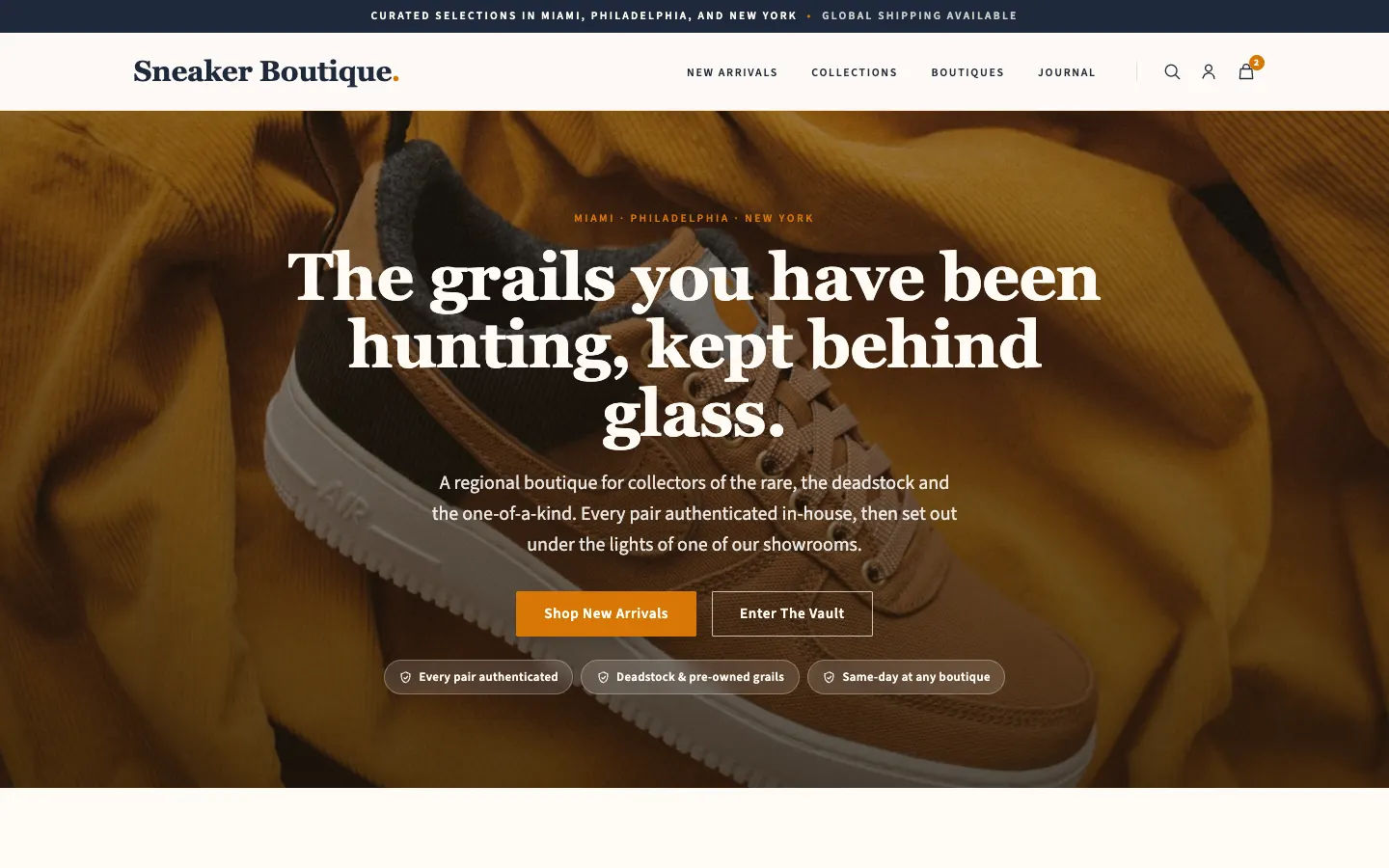
A vault-and-concierge demo for a three-city rare sneaker dealer, written for the collector hunting a specific pair rather than the shopper browsing a size run. Playfair Display over Source Sans 3 in slate, amber and espresso: a "kept behind glass" hero, curated collection pages (new arrivals, the Air Jordan archive, and a Grails vault shown by private appointment), product pages carrying condition, colorway, year, box and lace details with an inquire-for-sizing flow instead of a cart, an authentication explainer, boutique pages for Wynwood, Rittenhouse and SoHo, a sourcing request for pairs not in stock, and a collector's journal.

"Enter The Vault" Grails Collection + Sourcing Request. Sneaker Boutique is the model here, with condition-led listings, an appointment vault that is explained rather than hidden, and consignment given the same weight as the buying side.

Open the live demo → Sneaker Resale websites

Sneaker Boutique — live sneaker resale website built on WorkspaceCMS
Where the demand is

How sneaker resale buyers actually search

Resale demand is almost entirely name-led. A search is a model, a colorway nickname and a size, typed by somebody who has been watching that pair for months and can spot a bad photo instantly. They are not browsing a size run; they are locating a specific object. That changes what a product page has to do: condition, year, box status, lace variants and provenance carry more weight than any lifestyle photography, and a page that omits them reads as a page hiding something.

Authentication anxiety sits underneath every transaction and is the real objection to overcome. The marketplaces built their entire brand on that anxiety, so a boutique competing with them has to publish its own process in detail rather than assert legitimacy. Explaining what gets checked, by whom, and what happens if something fails is more persuasive than any badge, and it is content the marketplaces cannot personalize the way a named shop can.

The calendar is set by the release schedule rather than by retail seasons. A drop generates a spike that begins before the shoe exists at retail and continues for years afterwards as the pair moves into archive territory. Between spikes, the steady demand is local: people search for a sneaker store in their city, walk in, and consign what they are done with. A boutique with real addresses has two businesses to market, the hunt and the storefront, and most sites only ever build for one.

The keyword clusters we build around

  • Model and colorway huntingExact silhouette and colorway searches, often with a size. These need product and archive pages carrying the naming a collector actually uses.
  • Grails and archiveSearches for discontinued and rare pairs. The vault and archive pages are what capture the collector who does not expect anyone to have it.
  • Authentication and legit checksAnxious, high-volume research queries. Answering them properly earns trust long before a purchase and pulls in traffic the marketplaces monetize.
  • Consignment and sellingPeople looking to sell or consign a pair. This is supply-side marketing, and for a resale business supply is the constraint.
  • Local boutique discoveryCity and neighborhood searches for a sneaker store worth visiting. Each shop location needs a page that describes the room, not just an address.
  • Sourcing requestsSearches for a pair nobody stocks. A sourcing request form turns a dead end into a lead and a reason to come back.
The campaign

Three ways we go get the traffic

Local SEO, AI-assistant visibility and paid media, run by the agency team that has been doing it since long before WorkspaceCMS existed.

Local SEO

The platforms own bare model queries, so the plan works around them. Archive and vault pages get built on the naming collectors actually use, nicknames included, with condition grade, production year, box status and lace variants written into the page rather than implied by a photograph. Authentication and care articles earn links on their own merits. Each boutique then gets a page describing the room, the wall and the neighborhood, and consignment gets pages aimed at sellers, because in resale the constraint is inventory rather than demand.

AI search visibility

Is this pair legit gets asked of ChatGPT and Perplexity constantly, and the shops that get cited are the ones that wrote the process down step by step: what is inspected, who inspects it, what happens when a pair fails. Condition grades get defined explicitly instead of assumed, consignment payout timing gets stated, and store locations and appointment access get marked up properly. Being the boutique that explains the category in a collector's own vocabulary is what earns a mention when someone asks an assistant where to buy safely.

Paid media

This category was built on visual social, so that is where paid effort belongs. The creative is pairs on the wall, a vault walkthrough, an authentication check filmed over somebody's shoulder, a consignment payout explained by the person who actually writes it. Two audiences get bought separately: buyers, timed to the release calendar and whatever heat is already circulating, and sellers, who are the harder and more valuable half and respond to the idea of clearing out a rotation. Store-level awareness creative does work no marketplace can imitate, because the room is the differentiator.

Campaigns are an add-on to a WorkspaceCMS plan and start from $499/mo. The plan itself is a monthly subscription. The build is included, the platform is not free. Local SEO campaigns are scoped to single and multi-location businesses rather than national or global SEO. Paid search management covers service businesses rather than online stores; ad spend is billed by Google or Meta directly to your own account. Full campaign scope → · Plan pricing →

What gets in the way

Six things that hold sneaker resale sites back

01

Marketplaces owning every model query

Type any silhouette and the resale platforms fill the page. A boutique cannot win that fight head-on, which is why the strategy has to run through archive depth, condition detail, authentication content and local presence instead.

02

Product pages that skip condition and provenance

For a collector, box status, year, deadstock condition and lace variants are the product. A page listing size and price alone gives a serious buyer nothing to trust and nothing for search to match.

03

An authentication process nobody has written down

The shop checks pairs carefully and says so in one line. Meanwhile the platforms publish entire pages on their process. Detail is the only way to answer the doubt that is stopping the sale.

04

Consignment marketed as an afterthought

Inventory is the constraint in resale, and sellers are searching for terms, payout timing and whether they can walk in. A thin consignment page starves the business it feeds.

05

Appointment-only inventory that reads as unavailable

A vault shown by appointment is a strength presented badly. Without a clear booking path and an explanation of why it works that way, visitors read it as nothing in stock.

06

Store pages that are just a map pin

Three boutiques in three cities are three distinct local opportunities. A page per shop describing the space, the staff and what is usually on the wall converts walk-in searches that an address alone never will.

Campaign add-ons

Pick the campaign that fits the market

Every package below is bought from your dashboard once your site is live. Names, prices and deliverables are read from the catalog at page load, so what you see here is what you would be buying.

Questions

Sneaker Resale marketing, answered

How do we compete with the resale platforms on model searches?

Not head-on, because they fill the results page for any bare silhouette name. What they cannot be is a curated room in your city with a named person behind the counter, and they serve archive and long-tail colorway searches badly. That is the ground the plan takes.

Our vault is appointment-only. Does that read as having nothing in stock?

Only if the page fails to explain it. Described properly, with what lives in the vault and a booking path that takes seconds, appointment access reads as curation. Left as a line saying by appointment, it reads as an empty shop and visitors leave without asking.

Should consignment get its own pages?

Yes, and often it pays back faster than anything aimed at buyers. Sellers search completely different terms and want different answers about what you accept, how payout timing works and whether they can walk pairs in, and inventory is the thing actually limiting the business.

How much condition detail belongs on a product page?

More than most shops publish. For a collector the box status, production year, deadstock grade and lace variants are the product, and a listing showing only size and price gives a serious buyer nothing to trust and gives search nothing to match against.

A pair sells and the listing dies. What should happen to that page?

Keep it and change its job. A sold page that names the pair, records the condition it was in and points toward what else you hold in that silhouette keeps the search value the listing earned, and it quietly proves you handle real inventory.

Your free site is one click away

Ready to grow a sneaker resale business?

Get the site built, then put a campaign behind it. Start online, or talk it through with a strategist first.

Want the full picture? See what a campaign includes